Symbolism
Finis (The End of All Things)
Maximilian Pirner, 1887
Finis (The End of All Things) is an 1887 oil painting by the Czech artist Maximilian Pirner, showing Medusa and a winged Death beside a muse with a lyre above fallen bodies. It belongs to the National Gallery Prague.
- Artist
- Maximilian Pirner
- Date
- 1887
- Medium
- Oil on canvas
- Dimensions
- 100 × 130 cm
- Collection
- National Gallery Prague, Prague, Czech Republic
- Movement
- Symbolism
What you are looking at
The stage is a stepped platform of black stone, set against a pale sky the color of apricots and ash. Nothing in the picture is a landscape in the usual sense. A thin band of sea glints at the far left, low on the horizon, and everything else is figures and cloud.
On the left, crouched at the edge of the platform like a gargoyle, is Medusa. Her hair is a tangle of gray-green snakes, her body muscular and dusky, her hands gripping the stone. She looks up and to the right with an expression closer to alarm than menace. Behind her shoulder hangs Death: a skeleton with pale, bat-like wings and a long staff angled up into the sky, presumably his scythe. His bony arm reaches out across the picture.
The figure he reaches toward is the brightest thing in the painting. A winged young woman, nude except for a veil of blue-green drapery, reclines on top of the black block. She wears a gold laurel wreath and holds a golden lyre against her body. She has turned to look back over her shoulder toward Medusa and Death, guarded rather than afraid.
Below this upper tier lies the human wreckage. A woman sprawls on her back across the step, one arm thrown over her face, a red cloth slipping from her hips; her other hand, stretched toward the left edge, still grips a sword. Behind her two figures cling to each other, one hiding her face in the other's shoulder. Another body in olive-yellow drapery lies face down to the right, and a dark crested helmet rests in the lower right corner. The signature is carved into the stone at lower left, as if part of the architecture: "M. PIRNER 87."
How it was painted
Finis is oil on canvas, about 100 × 130 cm, signed and dated 1887. Pirner trained at the Prague Academy and then at the Vienna Academy, and he spent the years up to 1887 in Vienna. The picture belongs to that Viennese moment, when large allegorical canvases with idealized nudes were the ambition of academically trained painters.
The handling splits the picture in two. The upper zone is painted thinly and lightly, the sky, wings and drapery dissolving into one another in pinks, creams and pale turquoise. The lower zone is dense and dark, with heavy modeling of the bodies and strong local color in the red and olive cloths. Light falls on the reclining woman with the lyre and on the sprawled body below, linking the survivor and the fallen.
The title
Finis is Latin for "the end," the word printers once set at the close of a book. The full title in the National Gallery Prague is given in Czech as Konec všech věcí and in English as The End of All Things. The title names an outcome, not an event: nothing in the picture shows how the end came. There is no burning city and no ruined civilization, only allegorical figures on a platform outside time.
What does Finis mean?
Pirner left no published program for the painting, so any reading is an interpretation. The figures, though, carry well-established attributes.
Medusa, whose gaze turned onlookers to stone, was one of Pirner's recurring subjects; he painted her again in his Medusa of 1891. Here she sits beside Death himself, the two bringers of an ending that cannot be reversed. The skeleton with wings and scythe is the standard figure of Death in European art since the late Middle Ages, the same figure that sweeps through Bruegel's The Triumph of Death.
The laurel wreath and the lyre are the attributes of Apollo and the Muses, and in the emblem books that artists used for centuries they mark Poetry, Music and Fame. Read that way, the winged woman is Art or Poetry, raised above the slaughter, the one presence untouched by the end. A darker reading is equally possible: she is merely the last to be reached, and Death's outstretched arm is moving toward her.
The fallen figures below have no individual identities. The sword and helmet point to war, the embracing pair to love and grief, the sprawled woman to exhaustion or death. Together they stand for human striving, finished.
The painting belongs to the pessimistic, death-haunted imagination that ran through Central European art in the 1880s and 1890s and fed directly into Symbolism. Arnold Böcklin's Isle of the Dead, begun in 1880, is its quieter cousin.
The painter
Maximilian Pirner (1854–1924) was born in Sušice in Bohemia and studied in Prague and in Vienna under Josef Matyáš Trenkwald. In 1887, the year Finis is dated, he left Vienna to teach at the Prague Academy, where he became a professor in 1896. He was associated with the Vienna Secession and the Mánes Union of Fine Arts. His work returns again and again to classical myth, sleepwalkers, demons and death, in works such as Daemon Love (1893) and Hecate (1901), and to the cycle of pastels the National Gallery Prague exhibited as Mythological Misalliances.
Reception and legacy
Pirner is far less known outside the Czech Republic than his Viennese contemporaries, and Finis has found most of its modern audience online. The image circulates widely as an "apocalypse painting," often with descriptions of ruined cities and burning skies that do not match what Pirner painted. The picture is stranger than that: an allegory staged on bare stone, with Medusa, Death and a muse sharing the same platform. For more on how painters have pictured the end, see death in art.
Where is Finis today?
Finis belongs to the National Gallery Prague (Národní galerie Praha), inventory number O 4642. It has been shown with the gallery's nineteenth-century collection in the Trade Fair Palace (Veletržní palác). Displays change, so check the gallery's current program before visiting.
Questions & answers
Who painted Finis (The End of All Things)?
The Czech painter Maximilian Pirner (1854–1924) painted it in 1887; the canvas is signed "M. PIRNER 87" at lower left. Pirner trained in Prague and Vienna and taught at the Prague Academy from 1887. He was known for allegories drawn from classical myth and the macabre, including several images of Medusa.
Where is Finis by Maximilian Pirner today?
It is in the National Gallery Prague (Národní galerie Praha), inventory number O 4642. The painting has been shown with the gallery's nineteenth-century collection in the Trade Fair Palace (Veletržní palác) in Prague. Displays change, so check the gallery's website before visiting.
What does Finis (The End of All Things) mean?
Pirner left no explanation, but the figures carry traditional attributes. Medusa and a winged skeleton with a scythe stand for death and irreversible ending. A winged woman with a laurel wreath and lyre, attributes of Apollo and the Muses, can be read as Poetry or Art. Below them lie fallen figures with a sword and helmet: human life and striving brought to an end.
Who are the figures in the painting?
At left is Medusa, with snakes for hair, and behind her shoulder a winged skeleton, the traditional figure of Death. At top right a nude winged woman with a laurel wreath and golden lyre reclines on a black stone block. In the foreground lie a woman holding a sword, an embracing couple and another fallen body, with a helmet at lower right.
Is Finis a painting of the apocalypse?
Not in the literal sense. Many online descriptions mention ruined cities and fiery skies, but the painting shows neither. Pirner staged an allegory on a bare stone platform under a pale sky. Finis is Latin for "the end," and the picture treats the end of all things symbolically, through Medusa, Death, a muse and the fallen.
Kindred works
You may also study
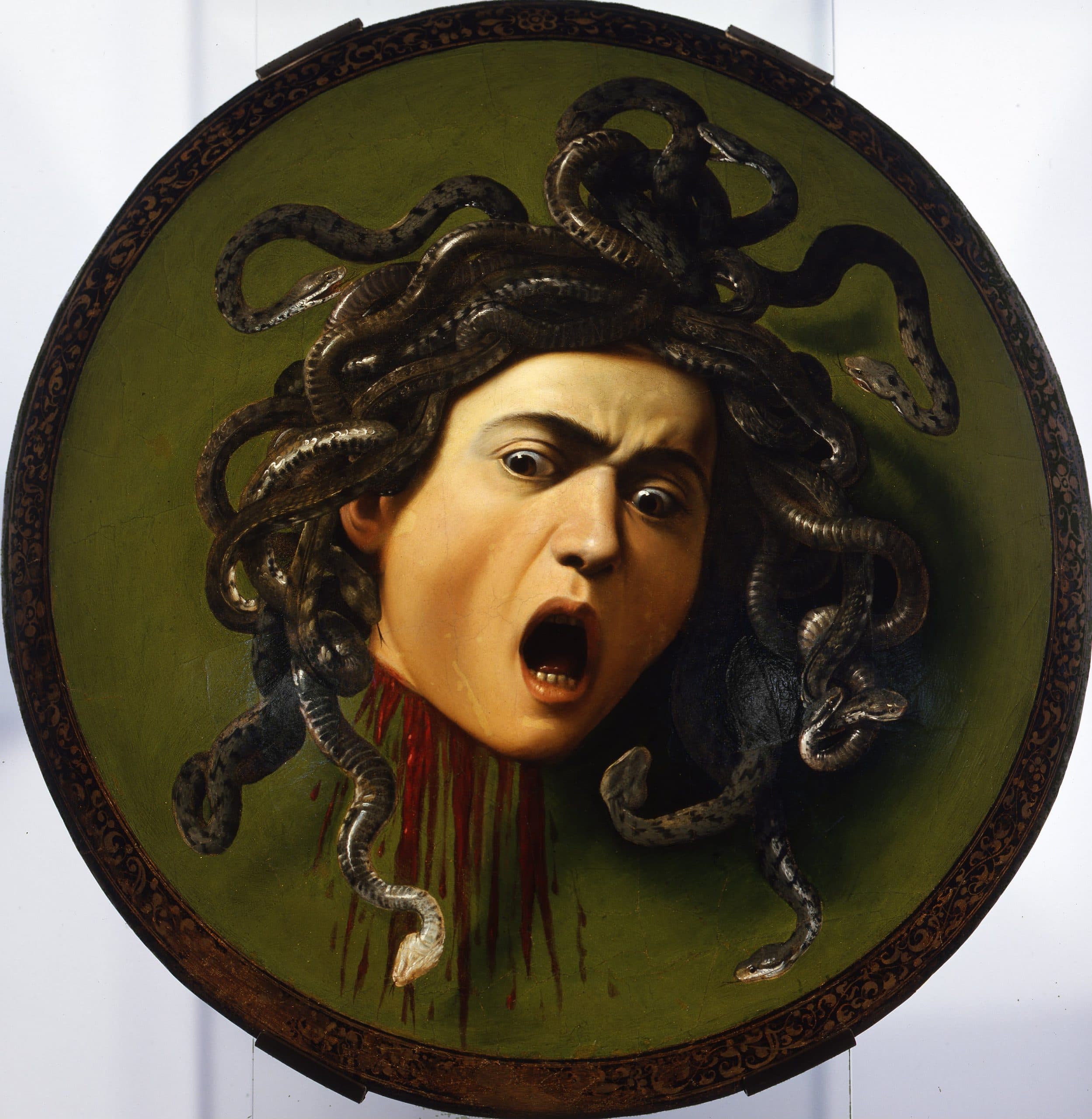
Medusa
Caravaggio · c. 1597–98
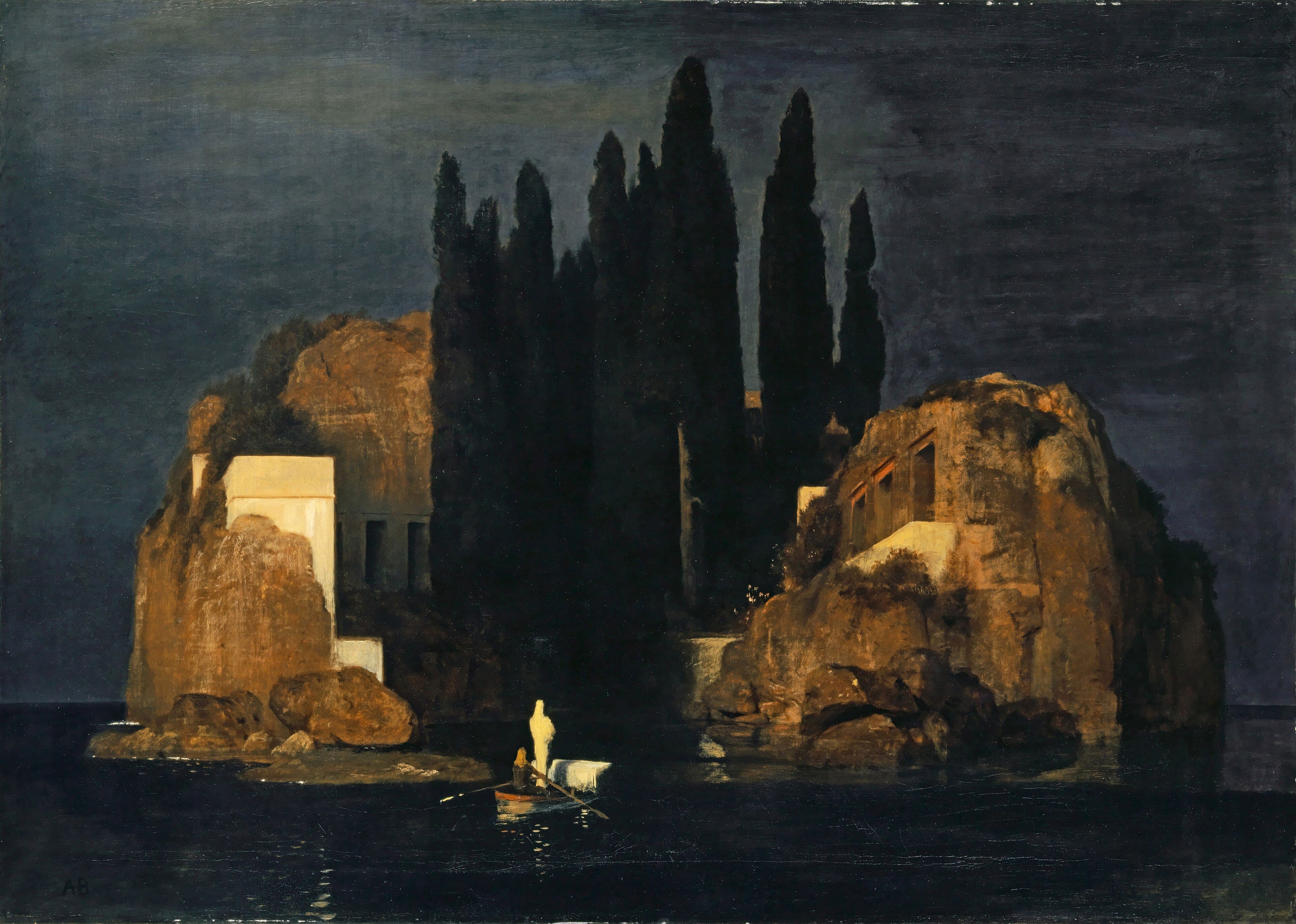
Isle of the Dead
Arnold Böcklin · 1880 (first version); five versions 1880–86
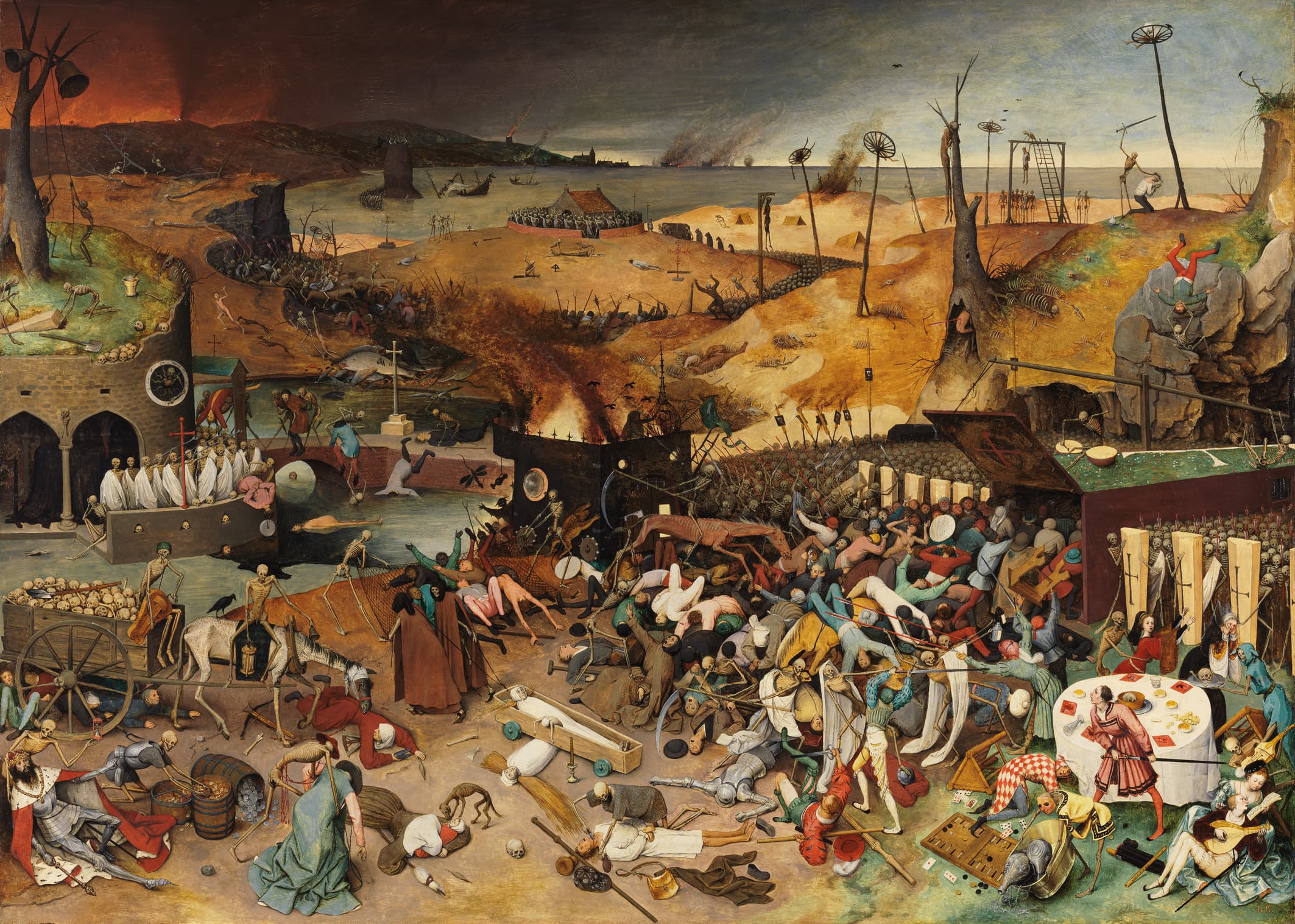
The Triumph of Death
Pieter Bruegel the Elder · c. 1562
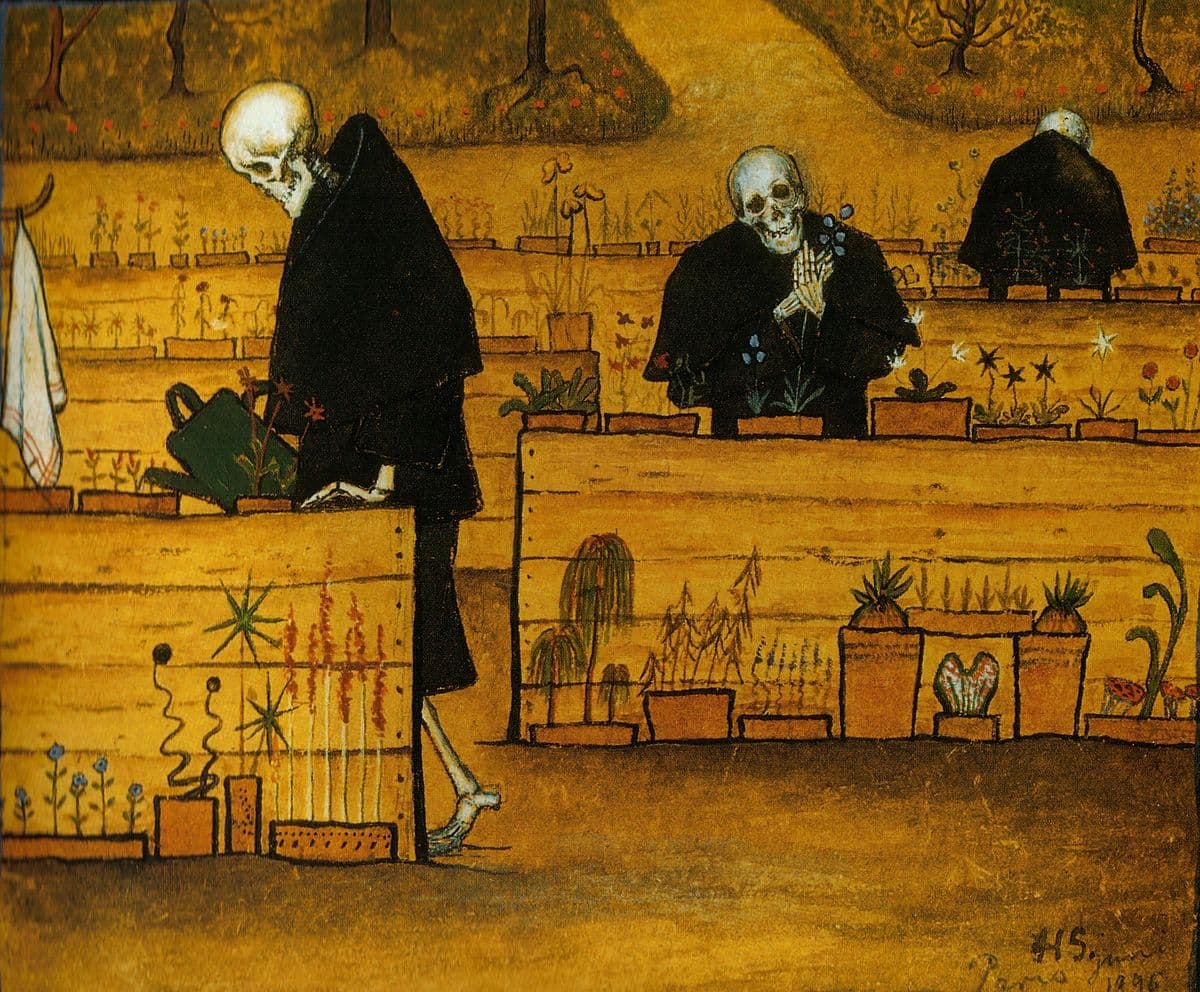
The Garden of Death
Hugo Simberg · 1896
The Angel, the Death, and the Devil
Roberto Ferri · 2018

Venus de Milo
Alexandros of Antioch · c. 150–125 BC
Nymphs Dancing to Pan's Flute
Joseph Tomanek

The Scream
Edvard Munch · 1893