Symbolism
The Knight of the Flowers
Georges Rochegrosse, 1894
The Knight of the Flowers (Le Chevalier aux fleurs) is an 1894 painting by Georges Rochegrosse in the Musée d'Orsay, Paris. Inspired by Wagner's Parsifal, it shows a young knight in silver armor walking unmoved through a meadow of nude flower maidens.
- Artist
- Georges Rochegrosse
- Date
- 1894
- Medium
- Oil on canvas
- Dimensions
- 235.5 × 374 cm
- Collection
- Musée d'Orsay, Paris, France
- Movement
- Symbolism
Le Chevalier aux fleurs (The Knight of the Flowers), sometimes listed as The Knight with the Flower Nymphs, is a monumental canvas by the French painter Georges Rochegrosse (1859–1938), shown at the Paris Salon of 1894 and bought by the French state. At 235.5 × 374 cm it is a true Salon "machine," and it belongs today to the Musée d'Orsay (inventory RF 898). Its subject comes from Richard Wagner's last opera, Parsifal (1882).
What you're looking at
A young knight in polished plate armor strides toward us through a flowering meadow on a hillside. He is bareheaded, with shoulder-length brown hair, and he looks straight ahead and slightly upward, past everything around him. The armor is the coolest, hardest thing in the picture: silver-blue steel reflecting the sky, with small touches of the flowers' reds and greens caught in its curved plates.
Around him, the meadow is alive with women who are half flower. Each wears a headdress that is itself a giant bloom: a pink peony, a purple iris, a red poppy, a crimson rose, a crown of pale petals. They are nude or nearly so, and they rise out of the grass, kneel, recline and reach for him from every side. One at the upper left drapes her arms around his shoulders; another at lower left lies on her back among the stems; others stretch their hands toward his legs and arms. Several have their faces turned up to him in open invitation.
The detail that matters most is what does not happen. No one actually holds him back. Rochegrosse paints the knight in mid-stride, his armored legs and hands already moving through the crowd, and the eye follows him up the slope toward the open sky. The flowers are real ones, closely observed, scattered through the grass in the same species the maidens wear, so that the women seem to grow out of the field itself.
The color is unusually bright for Rochegrosse, who was better known for violent, dark history paintings. Here the palette is spring-like: fresh greens, whites and sky blues set off by points of saturated red and violet.
The composition is wide and shallow, like a frieze. The horizon is a long diagonal of hillside rising from left to right, with a strip of pale blue distance at the far left, so the knight seems to be climbing out of the crowd toward higher, emptier ground. Rochegrosse signed the canvas at the lower right, half hidden among the grasses.
The opera behind it
In Act 2 of Parsifal, the sorcerer Klingsor conjures a magic garden filled with Flower Maidens (Blumenmädchen), seductive spirits whose task is to ensnare the knights of the Grail. Parsifal, the "pure fool," wanders into the garden after defeating Klingsor's men. The maidens surround him, caress him and quarrel over him, but he remains innocent of their meaning and moves on; his greater test, with the enchantress Kundry, comes later in the act.
Rochegrosse condenses that scene into a single image of resistance. Parsifal is not named in the title, which keeps the picture open: it could be read as any chaste knight walking through temptation. Wagner was enormously fashionable among French writers and painters in the 1880s and 1890s, and Parsifal's theme of redemption through renunciation appealed strongly to Symbolist taste.
Meaning
The painting is about chastity and the refusal of desire, a favorite theme of fin-de-siècle art, which often imagined women as beautiful, dangerous forces of nature. The armor is the knight's physical defense, but his real protection is his gaze, fixed beyond the scene. Critics at the 1894 Salon praised the canvas for this moral clarity as well as its color.
Modern viewers often notice the tension Rochegrosse could not avoid: a picture that preaches resistance to sensual temptation is itself an elaborate display of nude bodies. That double message, high-minded subject and sensual surface, is typical of academic and Symbolist painting of the period.
The artist
Georges Rochegrosse was born in Versailles in 1859 and raised by his stepfather, the poet Théodore de Banville. He trained with Jules Lefebvre and Gustave Boulanger and made his name at the Salon with large, gory scenes of ancient history, such as Andromache (1883). Le Chevalier aux fleurs shows a gentler side. In later life he settled in El Biar, in French Algeria, where he died in 1938.
Related works
For other knights and temptations, compare La Belle Dame sans Merci by Frank Dicksee and Hylas and the Nymphs by John William Waterhouse, where the hero is less fortunate. For nymphs in a darker mood, see Nymphs Dancing to Pan's Flute. The wider context is in Symbolism and Academic Art.
Where to see it
Musée d'Orsay, Paris, which received it from the Musée du Luxembourg, the state museum of living artists where it was first displayed after its purchase. The painting is in the public domain.
Questions & answers
Where is Le Chevalier aux fleurs by Rochegrosse?
The painting is in the Musée d'Orsay in Paris (inventory RF 898). The French state bought it after its success at the Salon of 1894 and displayed it at the Musée du Luxembourg, the museum for living artists, before it passed to the national collections now shown at the Orsay.
What story does The Knight of the Flowers show?
It is inspired by Act 2 of Wagner's opera Parsifal, in which the sorcerer Klingsor's Flower Maidens try to seduce the young knight Parsifal in a magic garden. Rochegrosse shows a knight in silver armor walking through a meadow of nude women crowned with flowers, ignoring their advances.
What does Le Chevalier aux fleurs mean?
It is an image of chastity and resistance to temptation. The knight looks straight ahead and keeps walking while the flower maidens reach for him from all sides. Critics of 1894 praised its moral message, though the painting also openly delights in the sensual beauty it asks the hero to refuse.
How big is The Knight of the Flowers?
The canvas measures 235.5 × 374 cm, more than two meters high and nearly four meters wide, with the figures close to life-size. The scale was typical of Salon paintings intended for public museums rather than private homes, and it lets the maidens surround the viewer almost as they surround the knight.
More by the artist
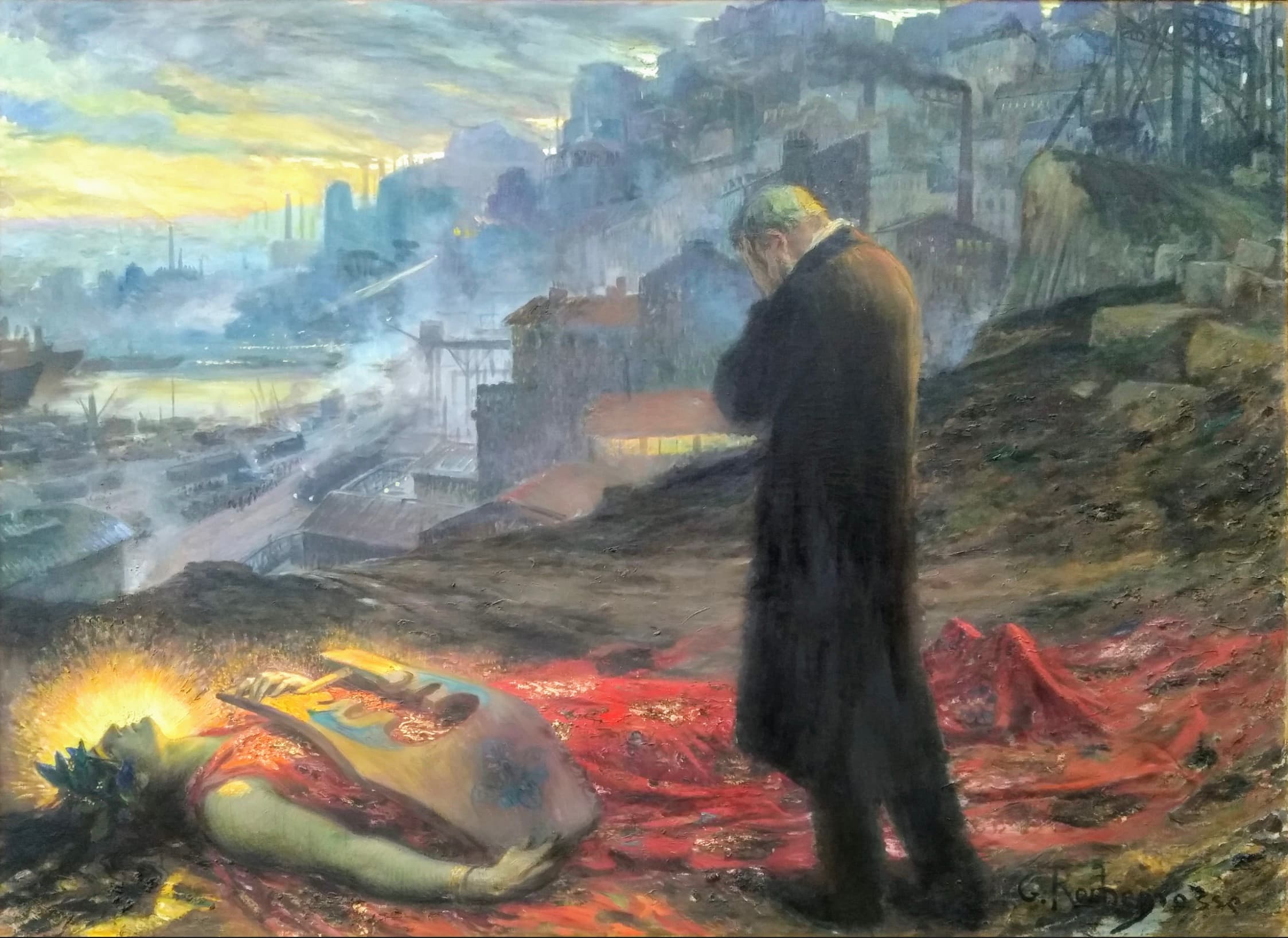
Georges Rochegrosse
Kindred works
You may also study
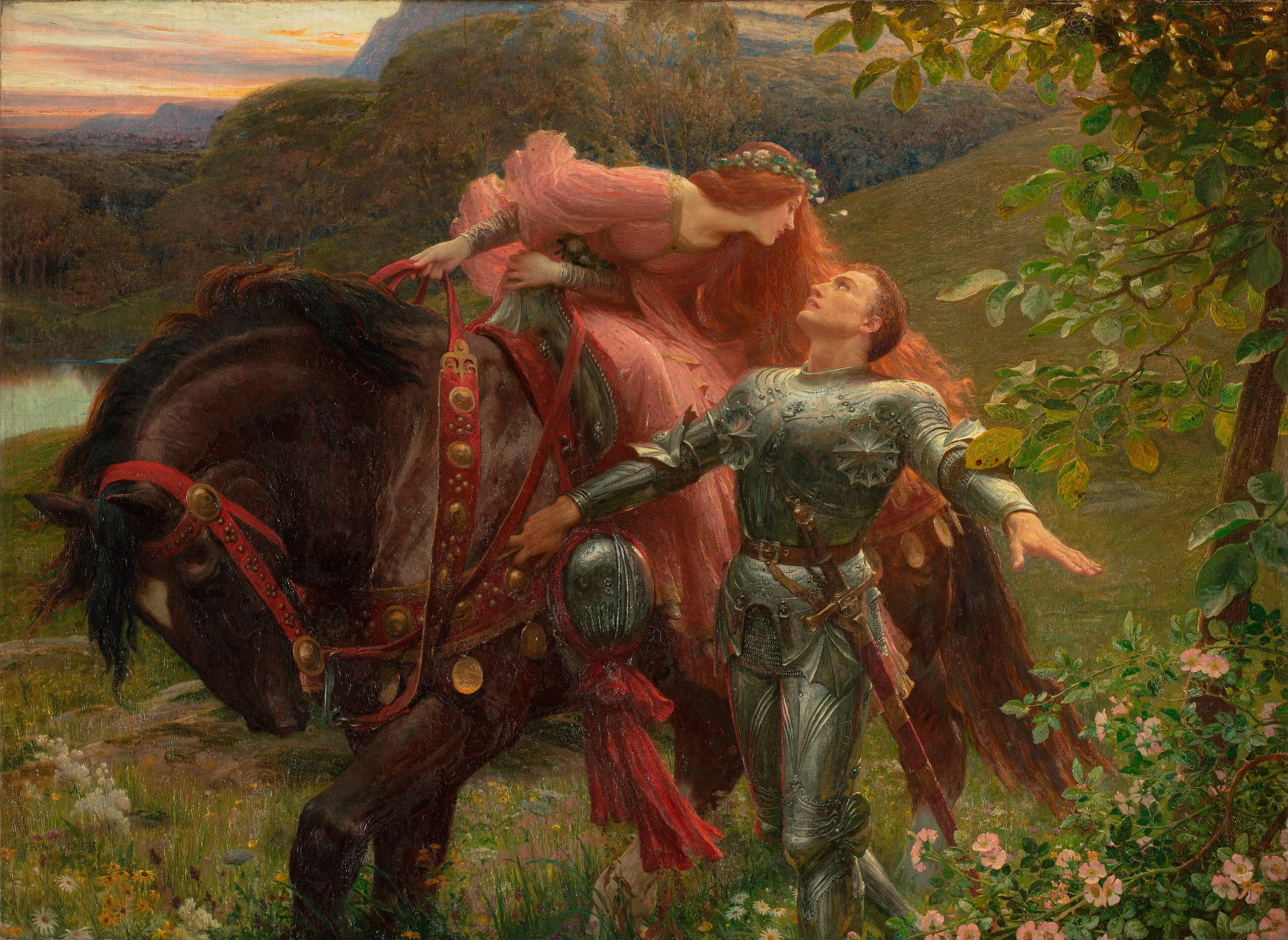
La Belle Dame sans Merci
Sir Frank Dicksee · 1901
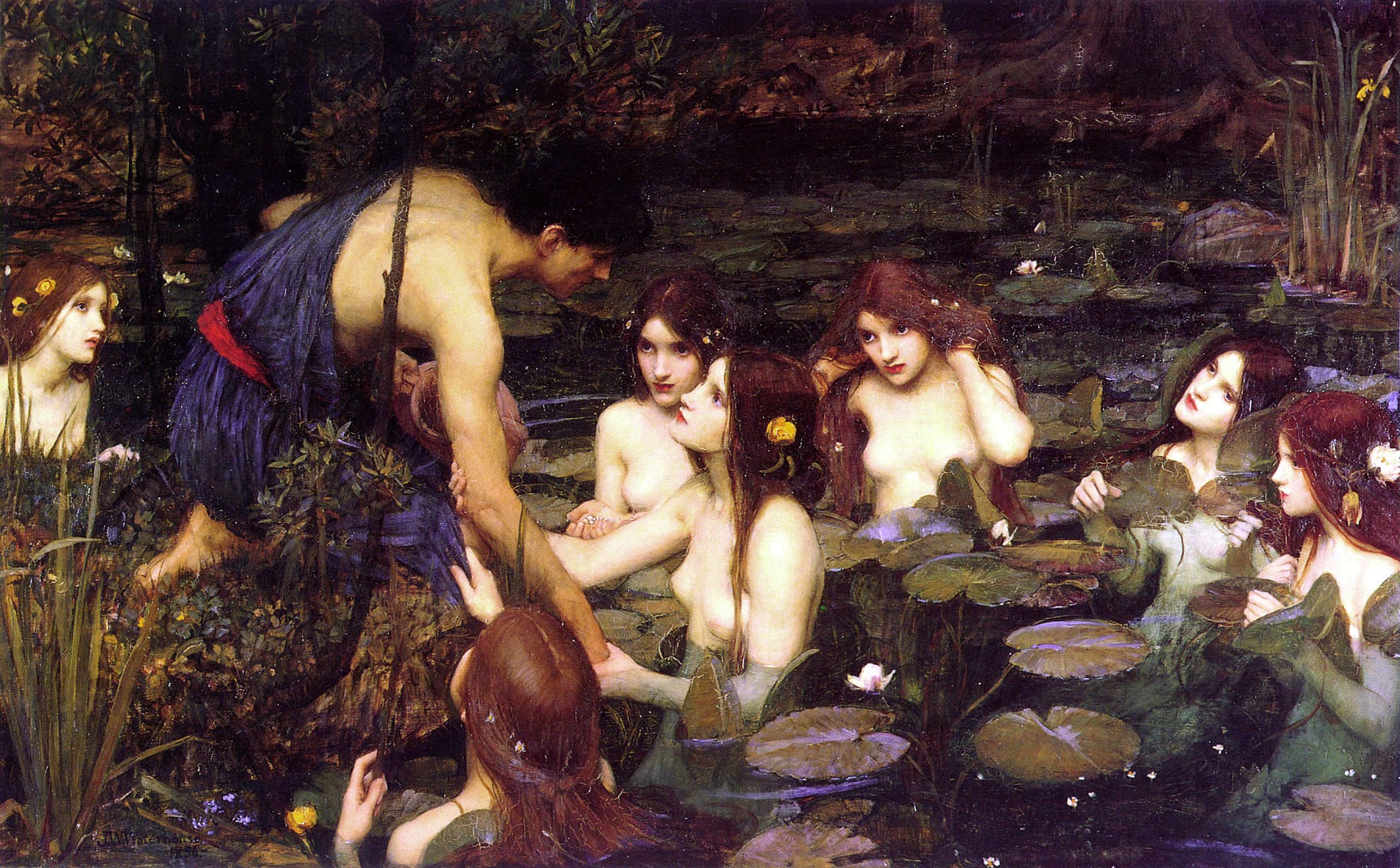
Hylas and the Nymphs
John William Waterhouse · 1896

Nymphs Dancing to Pan's Flute
Joseph Tomanek
The Soul of the Rose
John William Waterhouse · 1908

Bridge over a Pond of Water Lilies
Claude Monet · 1899

Venus de Milo
Alexandros of Antioch · c. 150–125 BC

The Scream
Edvard Munch · 1893

The Thinker
Auguste Rodin · Modeled 1880–82; enlarged 1902–03; this cast 1904