Artist
Various Artists or Collaborations
Various Artists or Collaborations groups catalogue entries that have no single maker: traditional object types such as the armillary sphere ring, anonymous or composite works like a half-skull vanitas bust, and compilations such as Windows to the Soul.
3 works in the collection
Works by Various Artists or Collaborations

Not every work in the Academia Aesthetics catalogue can be credited to one named artist. This page gathers entries that belong to a tradition rather than a person, that were made by anonymous or unidentified hands, or that combine the work of many artists into a single image. Each is linked below with what can and cannot be said about its authorship.
Why some works have no single artist
For much of history, objects were made by workshops rather than individual masters, and the names of goldsmiths, carvers and modelers were rarely recorded. Many forms, such as rings, reliquaries or emblematic still lifes, were repeated and varied by countless makers over centuries, so that the form itself matters more than any one example. In the digital age the problem returns in a new way: images are remixed, cropped and recombined, and widely shared works often lose their makers' names along the way. Where a reliable attribution exists, we give it on the work's own page; where it does not, we say so rather than guess.
Armillary Sphere Ring
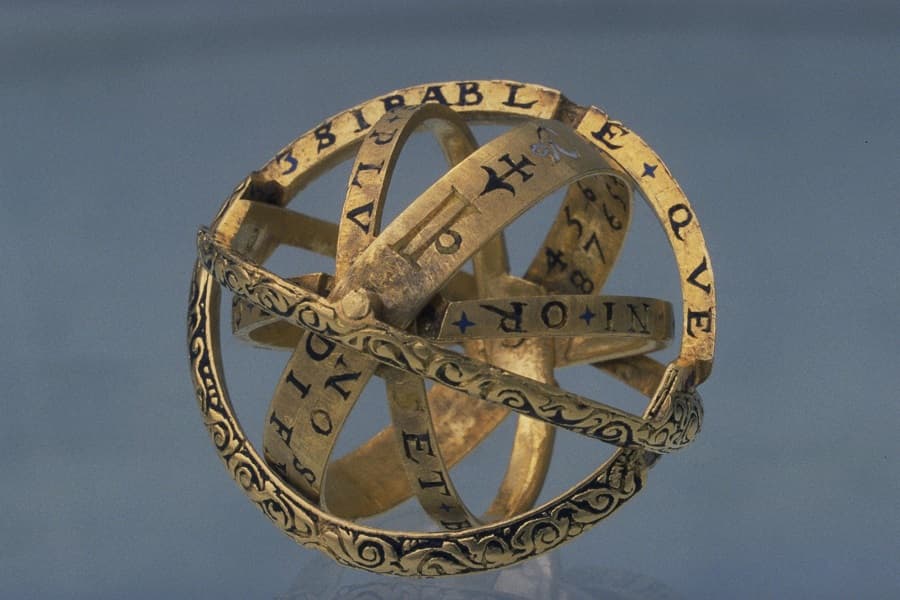
An armillary sphere ring is a finger ring made of several hinged bands. Worn closed, it looks like a single band, often engraved on the outside with the signs of the zodiac and on the inside with the days or months. Opened, the bands swing out into a small sphere, a model of the heavens with its celestial equator, tropics and meridians, like the armillary spheres astronomers used to teach the movements of the stars. The form appeared in Europe in the sixteenth and seventeenth centuries, a period fascinated by astronomy and by objects that conceal a second meaning. It belongs to the same family as the gimmel ring, whose interlocking hoops were given as betrothal tokens. Antique examples are rare and usually anonymous; modern jewelers have reproduced the design widely, which is why it appears here rather than under a single maker.
Vanitas Sculpture
The Vanitas Sculpture in the catalogue is a bust of a young woman whose head is wrapped in a hooded shawl knotted at the throat. Her eyes are closed and her expression is serene, but the left side of her face is gone: from brow to jaw it opens onto the bare bone of a skull, eye socket, cheekbone and teeth, as if the flesh had been peeled away. Rendered in an even, pale gray, the figure has the look of a modeled or digitally sculpted study, and its maker has not been reliably identified.
The idea is very old. Vanitas, from the Latin of Ecclesiastes, "vanity of vanities, all is vanity," was the name given in the seventeenth century to still lifes of skulls, hourglasses, guttering candles and wilting flowers that reminded viewers of the brevity of life. The half-face-half-skull is one of its most direct forms: a single body showing beauty and death at once. Earlier examples range from late-medieval transi tombs, which show the dead as decaying corpses, to small ivory or boxwood carvings of the seventeenth century in which a face is split between youth and skeleton. See more in Memento Mori & Vanitas.
Windows to the Soul
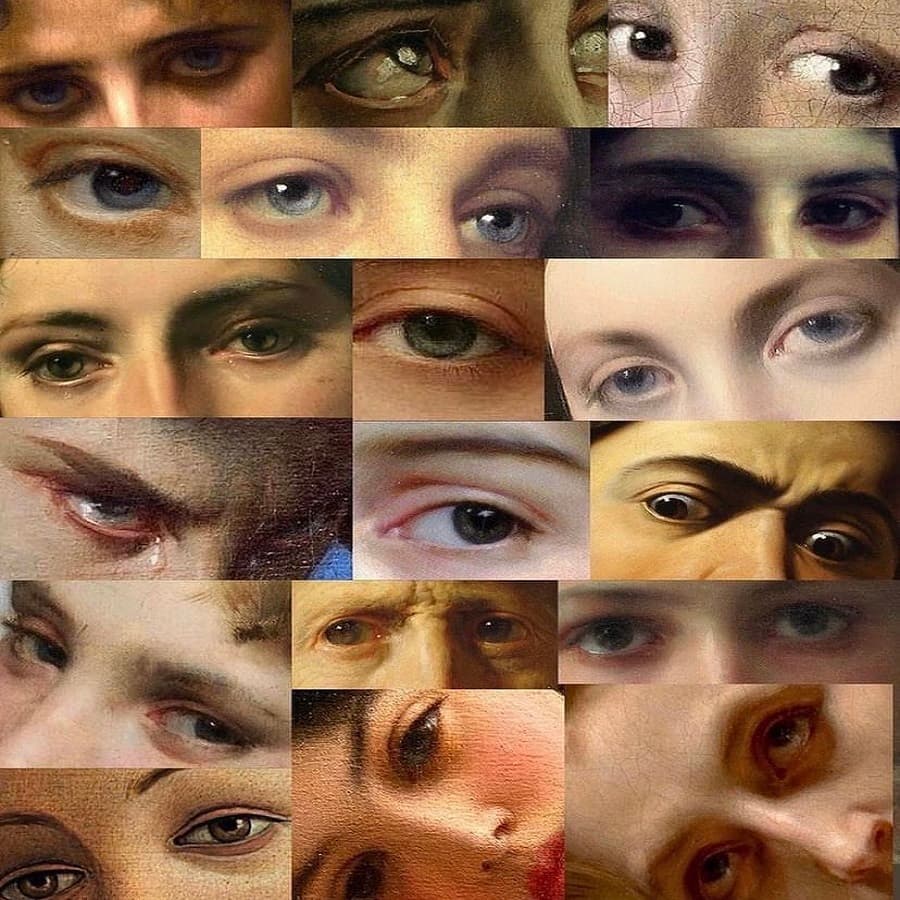
Windows to the Soul is a compilation rather than a single work: a grid of close-up details of eyes cropped from many paintings, mostly from the Baroque to the nineteenth century. Among them are the smooth, pale-irised eyes typical of William-Adolphe Bouguereau and his academic contemporaries, a reddened eye with a single tear in the manner of Alexandre Cabanel's Fallen Angel, and a pair of wide, startled eyes under raised brows that recall Caravaggio. Seen together, they show how much painters could convey with the eye alone: the angle of the lids, the catchlight on the cornea, the moisture at the rim.
The title comes from the old proverb that the eyes are the windows of the soul, a saying with roots in classical and biblical writing that became commonplace in European literature. The compilation format is a product of online image culture, where details of famous paintings circulate as mood boards; the individual sources are often not credited.
How to use these pages
If you recognize a maker or a source for any of these works, the individual artwork pages note what is known and what remains uncertain. For works whose artists are known, browse Famous Paintings and Famous Sculptures.
Questions & answers
What is an armillary sphere ring?
An armillary sphere ring is a ring of hinged bands that folds flat to wear and opens into a small model of the celestial sphere. The form dates to the sixteenth and seventeenth centuries in Europe and is widely reproduced by modern jewelers.
Who made the vanitas sculpture of a woman with half a skull face?
The bust of a hooded woman whose face is half skin and half skull has not been reliably attributed to a named artist. It belongs to the long vanitas tradition of showing youth and death in a single figure.
What does vanitas mean?
Vanitas is Latin for emptiness or vanity, from Ecclesiastes' 'vanity of vanities, all is vanity.' In art it names works, especially seventeenth-century Dutch still lifes, that use skulls, hourglasses and fading flowers to remind viewers that life and its pleasures are brief.
Which paintings are the eyes in Windows to the Soul from?
Windows to the Soul is an uncredited online compilation of eye details from many paintings. Several are in the manner of Bouguereau and other nineteenth-century academic painters, one recalls Cabanel's Fallen Angel and another Caravaggio, but the individual sources are not listed.