Contemporary figurative
Lacrimosa
Nicola Samorì
Lacrimosa is a painting by the Italian artist Nicola Samorì of a weeping, red-haired woman in the manner of a Baroque Magdalene, whose tears are real cracks opened in the paint. Its title is the Latin word for tearful, from the Requiem Mass.
- Artist
- Nicola Samorì
- Movement
- Contemporary figurative
What you are looking at
A young woman's head and bare shoulders emerge from a black ground. Her face is tipped back, her lips parted, and her reddened eyes roll upward toward something outside the frame. Long red-gold hair falls in loose waves around her neck and over her chest. The flesh is painted with the smooth, glowing finish of a seventeenth-century Italian altarpiece, lit from the upper left so that the forehead, nose and throat shine against the darkness.
Then the eye catches the tears. They are not painted as drops of water. They are dark, ragged lines where the skin of paint has opened, as if the surface itself had cracked: one runs from the inner corner of her right eye down the cheek, another from the left eye along the side of the nose, and the longest continues down her neck and across her chest, splitting into black fragments. Through these breaks the dark ground beneath shows through. Up close, the edges of the gaps look raw and flaking, like damage on an old panel.
The result is an image that seems to weep with its own material. The figure cries, and the painting breaks.
Who is Nicola Samorì?
Nicola Samorì (born 1977 in Forlì) is an Italian painter and sculptor who lives and works in Bagnacavallo, near Ravenna. He is known for paintings that look like Baroque masterpieces at first glance and then reveal that they have been deliberately damaged: the paint is scraped, peeled, stretched, torn or punctured, so that faces slide, dissolve or split open. He also paints on stone such as onyx and marble, letting the veins and fissures of the support interfere with the image, and carves sculptures in the same spirit.
His models are the painters of the Italian and Spanish seventeenth century, from Guido Reni and Guercino to the followers of Caravaggio and Jusepe de Ribera. Recent exhibitions include Classical Collapse at the Museo di Capodimonte in Naples and the Pinacoteca Ambrosiana in Milan, and Supremalia at the MAR in Ravenna (2026–27).
What does Lacrimosa mean?
Lacrimosa is Latin for tearful, or full of tears. It is the opening word of a stanza in the Dies irae, the medieval sequence once sung in the Catholic Requiem Mass: Lacrimosa dies illa, that day of tears, the day of judgment when the dead rise. Many listeners know it through the Lacrimosa movement of Mozart's unfinished Requiem.
The figure's type points the same way. The loose red hair, bare shoulders and upturned, weeping eyes belong to the long tradition of the penitent Mary Magdalene, and to the many weeping saints and Virgins of Counter-Reformation painting, where tears were a sign of grace. Samorì takes that devotional language and makes the tears literal wounds in the paint. The weeping is not only shown but enacted on the surface, so that grief and physical decay become the same thing. That doubling, the beautiful image and its ruin together, runs through his whole practice.
Date, medium and location
The image circulates online as Lacrimosa by Nicola Samorì, dated 2020. We have not been able to confirm the date, the support (canvas, panel or stone) or the dimensions against a gallery or catalogue record, and its current owner is not known. Samorì's work is represented by galleries including Monitor (Rome) and Galerie EIGEN + ART (Berlin and Leipzig), whose archives are the best place to check.
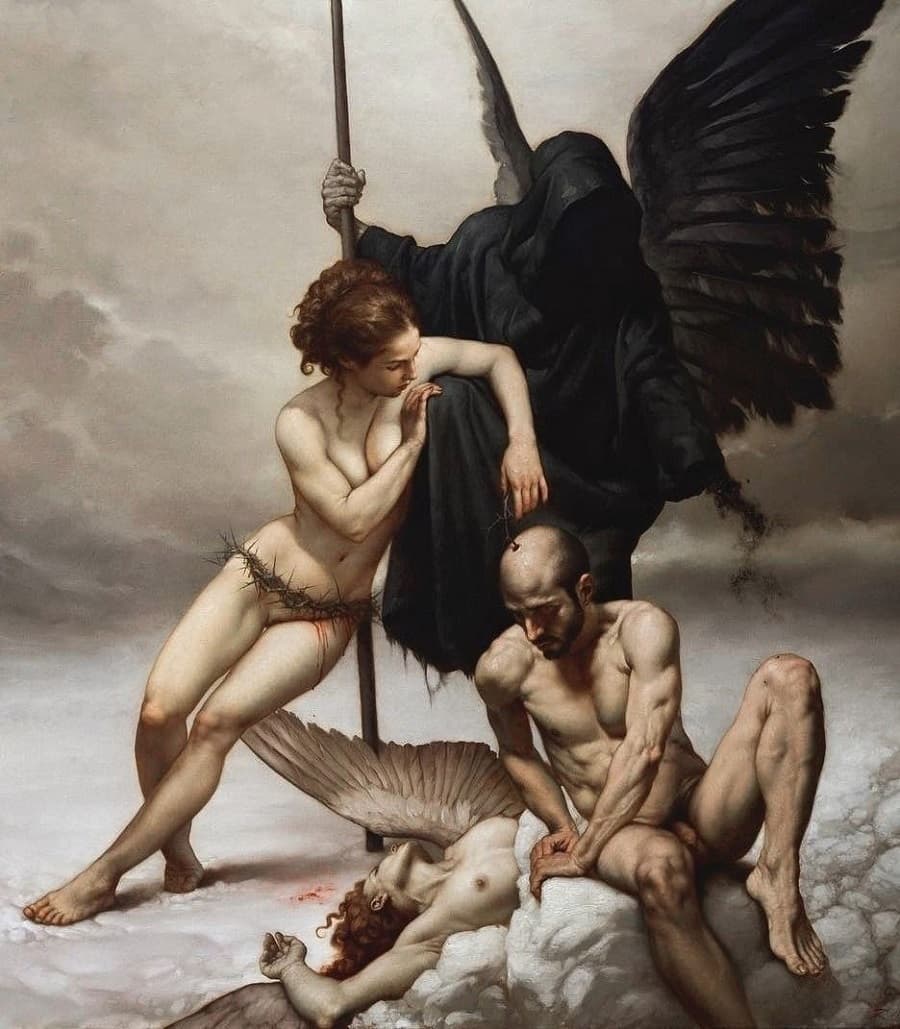
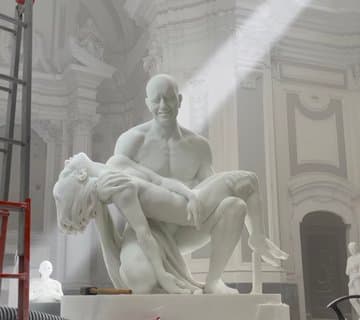
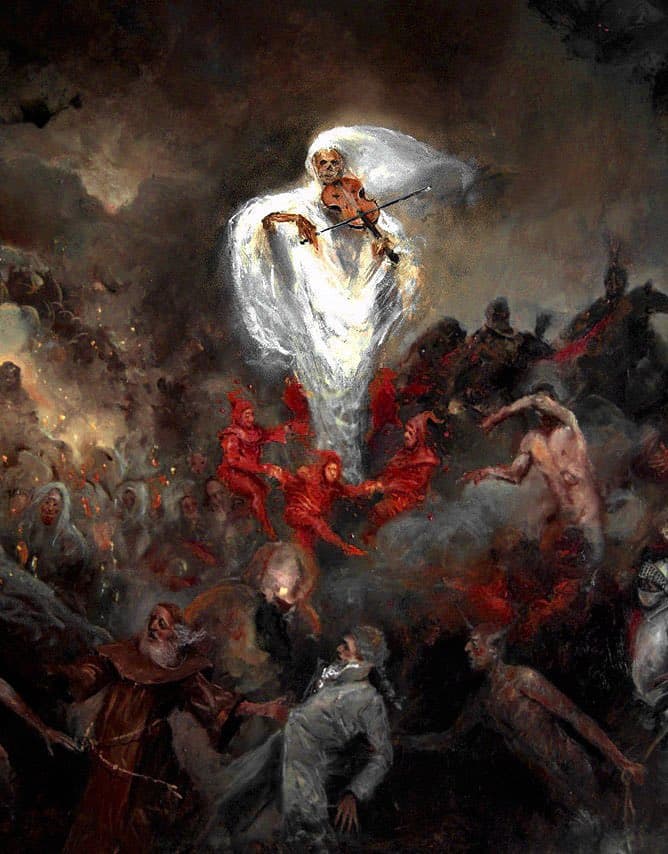
For related contemporary returns to Baroque imagery, see The Angel, the Death, and the Devil by Roberto Ferri and Jago's marble Pietà, or the Requiem theme in Requiem by Ignacio Trelis.
Questions & answers
Who painted Lacrimosa?
Lacrimosa is by Nicola Samorì, an Italian painter and sculptor born in Forlì in 1977 who works in Bagnacavallo. He is known for Baroque-style paintings whose surfaces he scrapes, peels or splits open, so that the image seems to decay before the viewer.
What does Lacrimosa mean?
Lacrimosa is Latin for tearful. It opens a stanza of the Dies irae in the Requiem Mass, describing the day of judgment as a day of tears, famously set by Mozart. Samorì pairs the word with a weeping, Magdalene-like woman whose tears are cracks in the paint itself.
How are the tears in Lacrimosa made?
The tears are not painted drops but dark breaks in the paint layer that reveal the black ground beneath, running from the eyes down the cheek, neck and chest. Opening and damaging the surface is Samorì's signature technique for joining beauty and decay.
Kindred works
You may also study
The Angel, the Death, and the Devil
Roberto Ferri · 2018
Pietà (Jago)
Jago (Jacopo Cardillo) · 2020–21
Requiem
Ignacio Trelis
Saint Catherine of Alexandria
Caravaggio · c. 1598
War Pietà
Max Ginsburg · 2007

Venus de Milo
Alexandros of Antioch · c. 150–125 BC

The Scream
Edvard Munch · 1893

Saturn Devouring His Son
Francisco Goya · c. 1819–1823