Image: Detroit Institute of Arts · Public domain · via Wikimedia Commons
Romanticism
The Nightmare
Henry Fuseli, 1781
The Nightmare painting is Henry Fuseli's 1781 oil of a sleeping woman with a demon crouched on her chest and a wild-eyed horse peering through the curtains. It caused a sensation in London in 1782 and now hangs in the Detroit Institute of Arts.
- Artist
- Henry Fuseli
- Date
- 1781
- Medium
- Oil on canvas
- Dimensions
- 101.6 × 127 cm
- Collection
- Detroit Institute of Arts, Detroit, United States
- Movement
- Romanticism
What you are looking at
A young woman lies across a bed, but not in any position a sleeper would choose. Her body is flung backward, her head and one arm dropping over the edge of the mattress toward the floor, her throat exposed. Her white gown clings and glows as if she were lit by a lamp we cannot see. On her body squats a small, dark, apelike creature, an incubus, staring straight out of the picture at us rather than at its victim. Behind it, the head of a horse pushes through a parting in the red curtains, its eyes blank white discs and its nostrils flared.
The room is otherwise almost bare: a small table at the left holds a mirror and a couple of little bottles, and a bracelet glints on the sleeper's dangling wrist. The background dissolves into brown darkness, and the contrast between the pale, horizontal body and the vertical wedge of shadow above it does most of the dramatic work. Fuseli keeps the palette narrow: cream, crimson, ochre and black. The strongest light falls on the woman's chest and face, exactly where the weight of the demon presses down.
The detail most viewers miss is the incubus's expression. It is not snarling; it looks almost thoughtful, chin propped, like a spectator. That calm is part of what makes the picture so disturbing. The terror is entirely the woman's, and the creature seems to be waiting to see what happens next.
How Fuseli made it
Henry Fuseli (Johann Heinrich Füssli, 1741–1825) was Swiss by birth and trained first for the church in Zurich before settling in London. He spent most of the 1770s in Rome studying Michelangelo, and you can see it here in the exaggerated, almost sculptural anatomy of the sleeper and in the willingness to twist a body for expressive effect. The Nightmare is painted in oil on a canvas roughly a meter by a meter and a quarter, a modest size for such a famous image.
On the back of the canvas is an unfinished portrait of a young woman. It is often linked to Anna Landolt, a niece of Fuseli's friend Johann Kaspar Lavater, whom Fuseli had hoped to marry; the identification is traditional rather than proven, but it has encouraged readings of the front as a picture of thwarted desire.
The story and context
Fuseli showed The Nightmare at the Royal Academy exhibition of 1782, and it made his name almost overnight. Within a year Thomas Burke had engraved it in mezzotint, and cheaper prints and satirical parodies followed; political cartoonists borrowed the composition for decades. Fuseli himself painted several later variants, including a vertical version of 1790–91 now in the Goethe-Haus in Frankfurt, in which the woman lies the other way round.
The imagery draws on folklore rather than on any single text. In Germanic and English tradition, the "mare" of nightmare was a spirit that sat on sleepers and smothered them. The word has nothing to do with horses etymologically, but Fuseli turns the pun into a picture: he gives us both the demon on the chest and a literal mare in the doorway. The physical sensation he paints, a crushing weight and an inability to move, matches what doctors now call sleep paralysis, and the painting is routinely used to illustrate it.
What does The Nightmare mean?
Fuseli left no explanation, and the painting has absorbed many readings.
- The supernatural. The simplest reading is that he painted a folk belief: a demon visiting a sleeper. Contemporary audiences in the age of the Gothic novel enjoyed exactly this kind of pleasurable fear.
- Desire and sexuality. The sleeper's abandoned pose, the incubus (in medieval demonology a demon that lay with sleeping women) and the possible portrait of Anna Landolt on the reverse have led many art historians to read it as an image of erotic obsession, either the woman's or the painter's.
- The mind itself. Because nothing in the room explains the visitors, the picture can be read as showing a dream from the inside, the creatures as projections of the sleeper's mind. That is why it has been so important to later writers on the unconscious.
What the painting refuses to do is reassure us. There is no saint, no moral, no waking figure, only an image of helplessness that sits halfway between horror and fascination.
Reception and legacy
Erasmus Darwin wrote verses about the image in The Botanic Garden (1789), and it is often said that Sigmund Freud kept a print of it in his Vienna apartment, though the story is repeated more often than it is documented. Many critics see its echo in Mary Shelley's Frankenstein (1818), where the murdered Elizabeth is found thrown across her bed in a strikingly similar pose. Fuseli's friend the Danish painter Nicolai Abildgaard painted his own Nightmare in 1800 with the same cast of demon and horse.
The picture belongs with the darker side of Romanticism, alongside Goya's The Sleep of Reason Produces Monsters, made less than twenty years later, and it remains one of the touchstones of dark academia imagery: the candlelit bedroom, the swooning figure, the thing in the corner.
Where is The Nightmare painting today?
The 1781 original is in the Detroit Institute of Arts, which acquired it in 1955 (accession 55.5.A). It is a public domain image, and the museum has published a high-resolution photograph, which is the version shown here.
Questions & answers
Where is The Nightmare painting by Henry Fuseli?
The original 1781 version of The Nightmare is in the Detroit Institute of Arts in Detroit, Michigan, which acquired it in 1955. Fuseli painted several later variants; the best known of these, a vertical composition of 1790–91, is in the Goethe-Haus in Frankfurt, Germany.
What is the meaning of The Nightmare painting?
Fuseli never explained it. The painting shows the folk belief that a demon, or 'mare', sat on sleepers and smothered them, and it puns on the word with a horse's head. Many scholars also read it as an image of erotic obsession, and later writers saw it as a picture of the unconscious mind.
What is the creature sitting on the woman in The Nightmare?
It is an incubus, a demon that in medieval belief lay on sleeping women. Fuseli paints it as a small, dark, apelike figure squatting on her stomach and looking out at the viewer. The pressure it represents matches the crushing feeling people describe during sleep paralysis.
Why is there a horse in The Nightmare?
The horse is a visual pun. The 'mare' in nightmare comes from an old word for a smothering spirit, not from the word for a female horse, but Fuseli includes a wild-eyed horse pushing through the curtains so that both meanings appear in the same picture.
When was The Nightmare painted and first shown?
Fuseli painted The Nightmare in 1781 and exhibited it at the Royal Academy in London in 1782, where it caused a sensation. A mezzotint by Thomas Burke followed in 1783 and spread the image across Europe.
Kindred works
You may also study
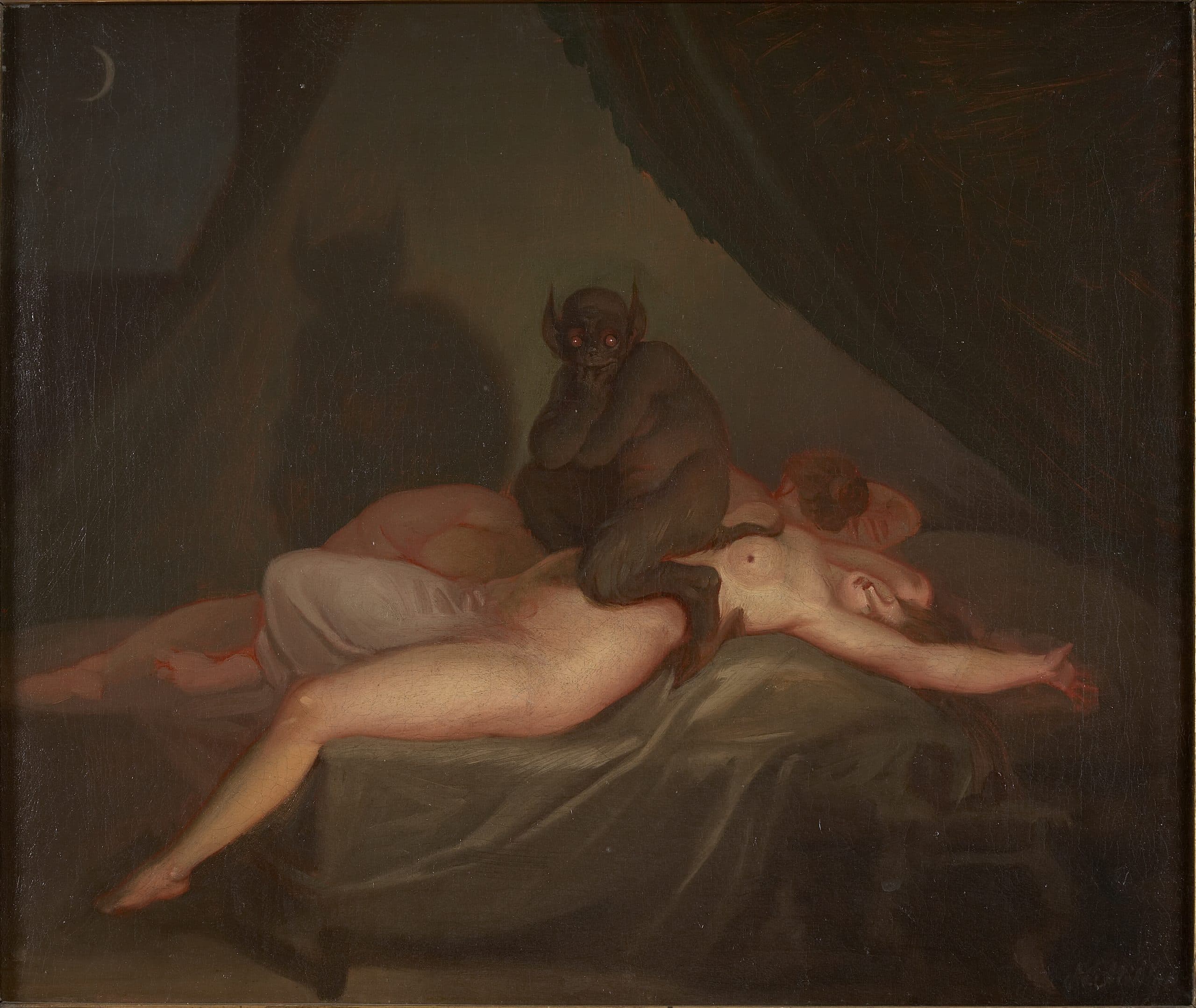
Nightmare
Nicolai Abraham Abildgaard · 1800
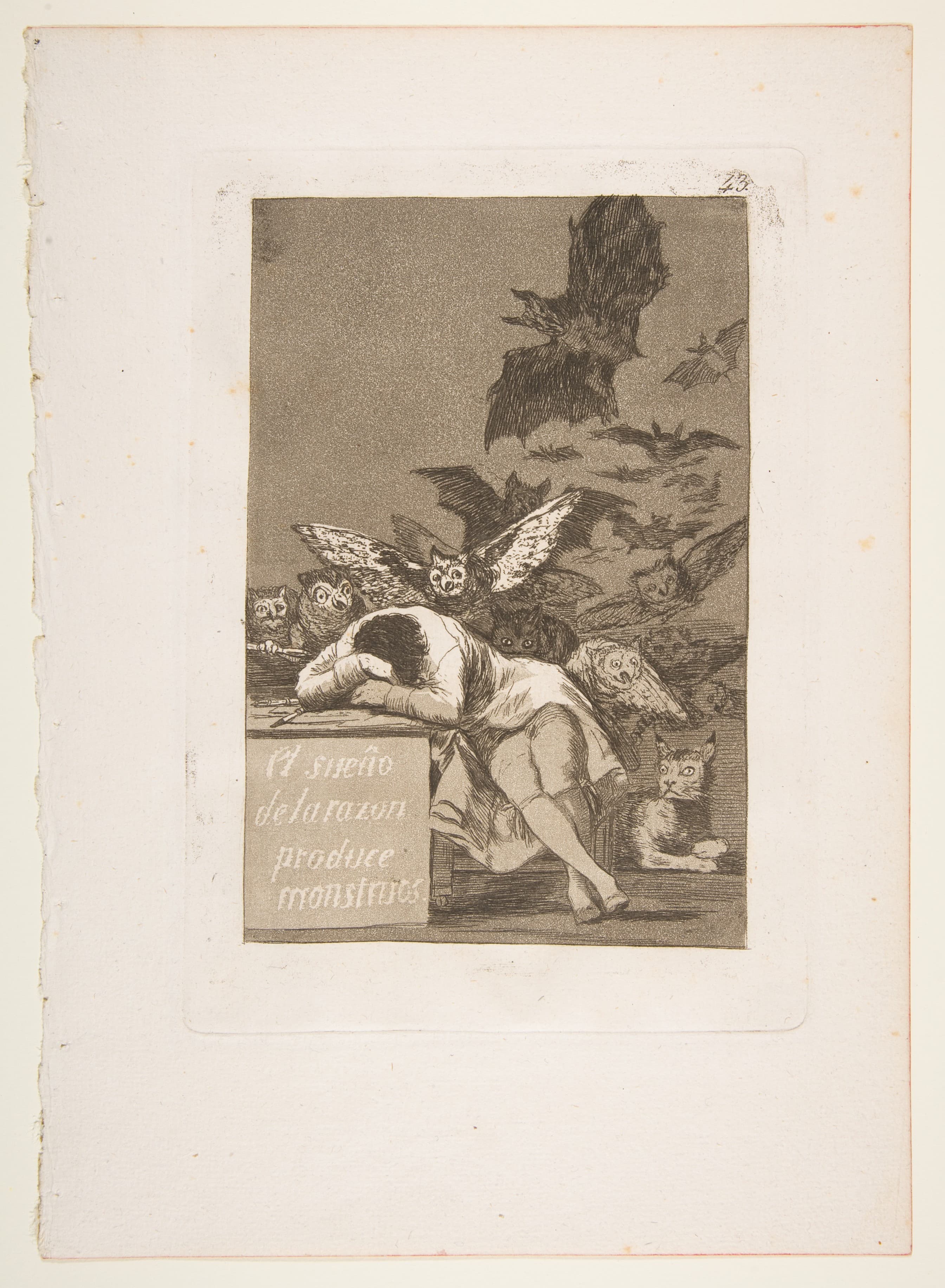
The Sleep of Reason Produces Monsters
Francisco Goya · 1797–99 (published 1799)

Saturn Devouring His Son
Francisco Goya · c. 1819–1823
The Raft of the Medusa
Théodore Géricault · 1818–1819
Isle of the Dead
Arnold Böcklin · 1880 (first version); five versions 1880–86

Venus de Milo
Alexandros of Antioch · c. 150–125 BC

Nymphs Dancing to Pan's Flute
Joseph Tomanek

The Scream
Edvard Munch · 1893