Swiss-British · Romanticism · Sturm und Drang
Henry Fuseli
b. 7 February 1741, Zürich — d. 16 April 1825, Putney Hill, London
Henry Fuseli (1741–1825) was a Swiss-born painter working in London whose dark, theatrical visions, above all The Nightmare (1781), made him a pioneer of Romantic art and the supernatural in painting.
1 work in the collection
Works by Henry Fuseli
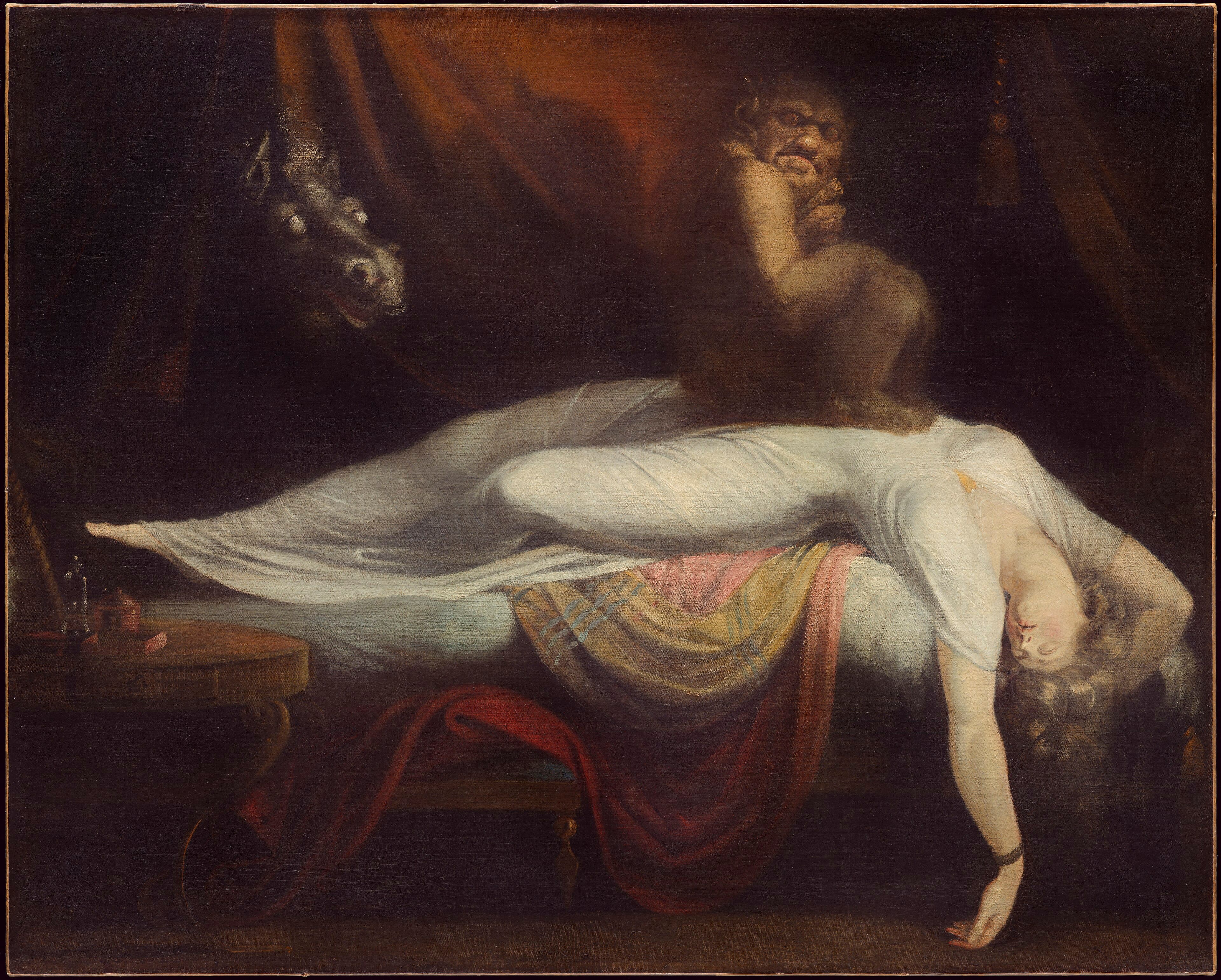
Henry Fuseli, born Johann Heinrich Füssli, was a Swiss painter, draftsman and writer who spent most of his career in London. He specialized in the strange and the terrible: ghosts, witches, dreams and the most violent scenes of Shakespeare and Milton. His most famous painting, The Nightmare (1781), is in the Detroit Institute of Arts.
Life in brief
Fuseli was born in Zürich in 1741, the son of a painter and writer on art. He was ordained a Zwinglian minister in 1761, but in 1762 he and his friend Johann Kaspar Lavater published an attack on a corrupt magistrate, and he had to leave the city. He reached London in 1764, working as a translator and writer, until Joshua Reynolds encouraged him to become a painter.
From 1770 to 1778 he lived in Rome, where Michelangelo's Sistine Chapel became his model of greatness, and where he befriended artists such as the Dane Nicolai Abraham Abildgaard. Back in London he made his name almost overnight when The Nightmare was shown at the Royal Academy in 1782. He painted for John Boydell's Shakespeare Gallery, opened his own Milton Gallery (1799–1800), and became Professor of Painting (1799) and later Keeper of the Royal Academy. Among his friends were William Blake and Mary Wollstonecraft. He died in 1825 and was buried in St Paul's Cathedral.
Style
Fuseli's figures are muscular and elongated, twisted into extreme poses borrowed from Michelangelo and Mannerism, and lit by sudden, stagey light against darkness. He drew constantly and with ferocious energy. His subjects come from literature, legend and the unconscious, treated with an erotic charge and a sense of menace that set him apart from the polite art of his time.
The Nightmare
A young woman in white lies flung backward across a bed, arms hanging toward the floor, while a squat demon, an incubus, crouches on her chest. Through the red curtain a horse with blank, glowing eyes pushes its head into the room. The picture draws on folk belief that nightmares were caused by demons sitting on sleepers. It was so successful that Fuseli painted several further versions, and it was widely reproduced and parodied in caricatures.
Where to see his work
The Detroit Institute of Arts, Tate Britain, the Kunsthaus Zürich and the Goethe-Haus in Frankfurt, which owns a later version of The Nightmare. Explore Romanticism, Angels and Demons in Art and Dark Academia.
Questions & answers
Where is The Nightmare by Henry Fuseli?
The original version of The Nightmare (1781) is in the Detroit Institute of Arts in Michigan. Fuseli painted several later versions; one of about 1790–91 is in the Goethe-Haus (Freies Deutsches Hochstift) in Frankfurt.
What does Fuseli's The Nightmare mean?
The Nightmare shows a sleeping woman with an incubus squatting on her chest and a ghostly horse looking in. It illustrates folk beliefs about demons causing bad dreams and suffocation, and is often read as an image of sleep paralysis, sexual anxiety and the irrational forces of the mind.
Was Henry Fuseli Swiss or British?
Both. Fuseli was born Johann Heinrich Füssli in Zürich, Switzerland, in 1741, but he settled in London in his twenties, anglicized his name and spent most of his career in Britain, becoming a leading member of the Royal Academy.