Image: Kunstmuseum Basel · Public domain · via Wikimedia Commons
Symbolism
Isle of the Dead
Arnold Böcklin, 1880 (first version); five versions 1880–86
The Island of the Dead (Die Toteninsel) is Arnold Böcklin's Symbolist painting of a rowboat carrying a white-shrouded figure and a coffin toward a rocky, cypress-filled island. He painted five versions between 1880 and 1886; the first is in the Kunstmuseum Basel.
- Artist
- Arnold Böcklin
- Date
- 1880 (first version); five versions 1880–86
- Medium
- Oil on canvas
- Dimensions
- 111 × 155 cm
- Collection
- Kunstmuseum Basel, Basel, Switzerland
- Movement
- Symbolism
What you are looking at
Out of a flat, black sea rises a small island of rock. Its cliffs are cut with doorways and window-like openings, as if tombs had been carved straight into the stone, and between the cliffs a grove of tall, dark cypresses rises into a gray sky. A low wall and a water gate face us at sea level.
Crossing the water toward the gate is a small rowboat. An oarsman sits at the stern. In front of him stands a figure wrapped entirely in white, facing the island, and in the bow lies a white, draped object that most viewers read as a coffin. The figure and the coffin are the brightest things in the painting, two pale accents against the dark water and the darker trees.
There is no wind, no wave, no sign of life on the island. The light is not quite day and not quite night. The stillness is total, and that stillness is what the picture is about. Böcklin himself described it as a dream picture that should create a silence so deep you would be startled by a knock at the door.
The detail people miss: in this first version, the cliffs on the right glow a warm ochre, as if catching the last of the sunset, while the cypresses swallow all light. Look also at the bottom left corner of the canvas, where Böcklin's initials "AB" are painted into the dark water.
How Böcklin made it
Arnold Böcklin (1827–1901) was a Swiss painter who spent much of his working life in Italy, and the first three versions were painted in his studio in Florence. The first, now in Basel, was begun in 1880 for his patron Alexander Günther, though Böcklin kept it himself. While it was still on the easel, a widow named Marie Berna visited the studio, was struck by it, and asked for a version of her own. Böcklin painted her a smaller version on wood (now in the Metropolitan Museum of Art, New York), adding at her request the coffin and the white figure, an allusion to her husband's death years earlier. He then added the same elements to the first painting.
The five versions are:
- May 1880, oil on canvas, 111 × 155 cm, Kunstmuseum Basel.
- June 1880, oil on wood, 74 × 122 cm, Metropolitan Museum of Art, New York.
- 1883, oil on wood, 80 × 150 cm, Alte Nationalgalerie, Berlin. From this version on, one of the tomb doors bears Böcklin's own initials.
- 1884, oil on copper, destroyed in Berlin during the Second World War.
- 1886, oil on wood, 80 × 150 cm, Museum der bildenden Künste, Leipzig.
A later version signed by Böcklin's son Carlo, dated 1901, is now in the State Hermitage in Saint Petersburg.
The title and the inspiration
Böcklin called these pictures Die Gräberinsel, "Tomb Island". The title Die Toteninsel, "Isle of the Dead", was given by his dealer Fritz Gurlitt in 1883 and stuck. Several real places have been proposed as models: the English Cemetery in Florence, close to Böcklin's studio, where his infant daughter Maria was buried; the island of Pontikonisi near Corfu; and the islet of Saint George off Perast in Montenegro. None is certain, and the island in the painting is plainly a composite.
What does the Island of the Dead mean?
Böcklin gave no explanation, which has left the painting wide open. The most common reading treats the oarsman as Charon, the ferryman of Greek myth, the water as the river Styx, and the white figure as a soul arriving in the underworld. That reading fits the painting's mood but not quite its history, since the figure and coffin began as a private reference for a grieving widow.
More broadly, the picture is about death as a place of rest rather than terror. Cypresses were traditional cemetery trees in Italy; the tomb doors and the gate suggest a burial ground. Böcklin lost eight of his fourteen children, and it is hard not to see personal grief behind the image. As a Symbolist painting, it works by mood and suggestion rather than by story, which is why so many viewers have projected their own meaning onto it.
Reception and legacy
In the early 20th century the painting was everywhere. Vladimir Nabokov wrote in his 1936 novel Despair that reproductions could be found in every Berlin home. Sigmund Freud and Lenin both kept reproductions; Adolf Hitler, an admirer of Böcklin, bought the third version in 1933. Sergei Rachmaninoff composed his symphonic poem Isle of the Dead (1909) after seeing a black-and-white print, and Salvador Dalí painted variations on it.
It remains one of the defining images of death in art, and a quieter companion to Bruegel's The Triumph of Death and Hugo Simberg's The Garden of Death. Its brooding mood has also made it a favorite of dark academia.
Where is the Island of the Dead today?
The first version, shown here, is in the Kunstmuseum Basel. You can also see the 1880 wood version at the Metropolitan Museum of Art in New York, the 1883 version at the Alte Nationalgalerie in Berlin, and the 1886 version in Leipzig. All are in the public domain.
Questions & answers
Where is the Isle of the Dead painting?
There are several versions. The first (1880) is in the Kunstmuseum Basel; the second (1880) is in the Metropolitan Museum of Art, New York; the third (1883) is in the Alte Nationalgalerie, Berlin; and the fifth (1886) is in Leipzig's Museum der bildenden Künste. The fourth was destroyed in World War II.
What is the meaning of the Island of the Dead?
Böcklin never explained it, calling it a dream picture meant to create deep stillness. Viewers often read the oarsman as Charon ferrying a soul to the underworld. The cypresses and rock-cut tombs suggest a cemetery, and the coffin and white figure were first added for a widow mourning her husband.
How many versions of Isle of the Dead are there?
Arnold Böcklin painted five versions between 1880 and 1886. A sixth, signed by his son Carlo Böcklin and dated 1901, is in the State Hermitage in Saint Petersburg. Böcklin also painted a contrasting picture, Isle of Life, in 1888.
Which island inspired the Isle of the Dead?
No one knows for certain. Suggested models include the English Cemetery in Florence near Böcklin's studio, where his daughter was buried, the island of Pontikonisi near Corfu, and Saint George island off Perast in Montenegro. The painted island is almost certainly a composite.
What music was inspired by Isle of the Dead?
Sergei Rachmaninoff wrote his symphonic poem Isle of the Dead, Op. 29 (1909), after seeing a black-and-white reproduction of the painting. Max Reger and other composers also wrote works inspired by it.
Kindred works
You may also study
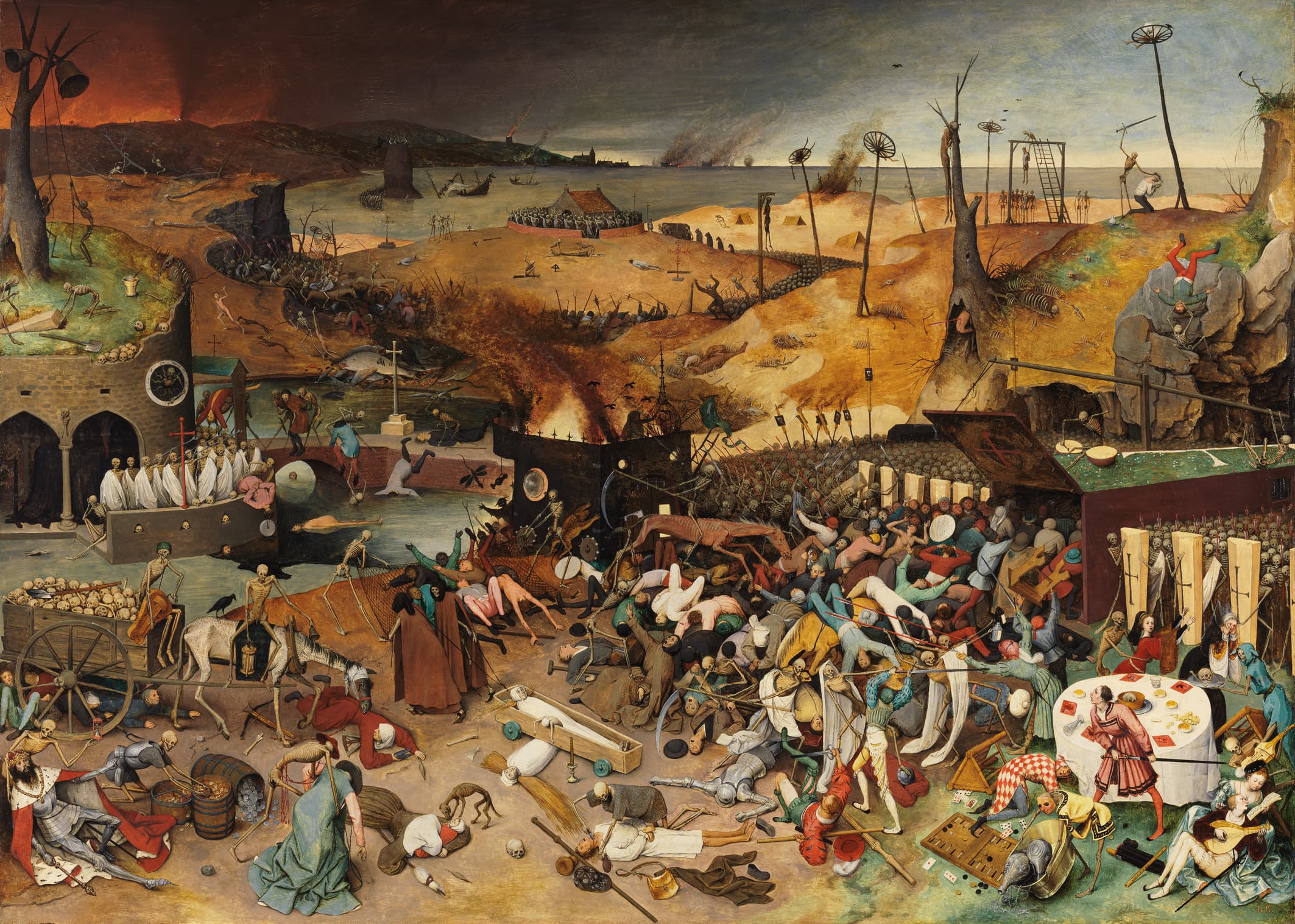
The Triumph of Death
Pieter Bruegel the Elder · c. 1562
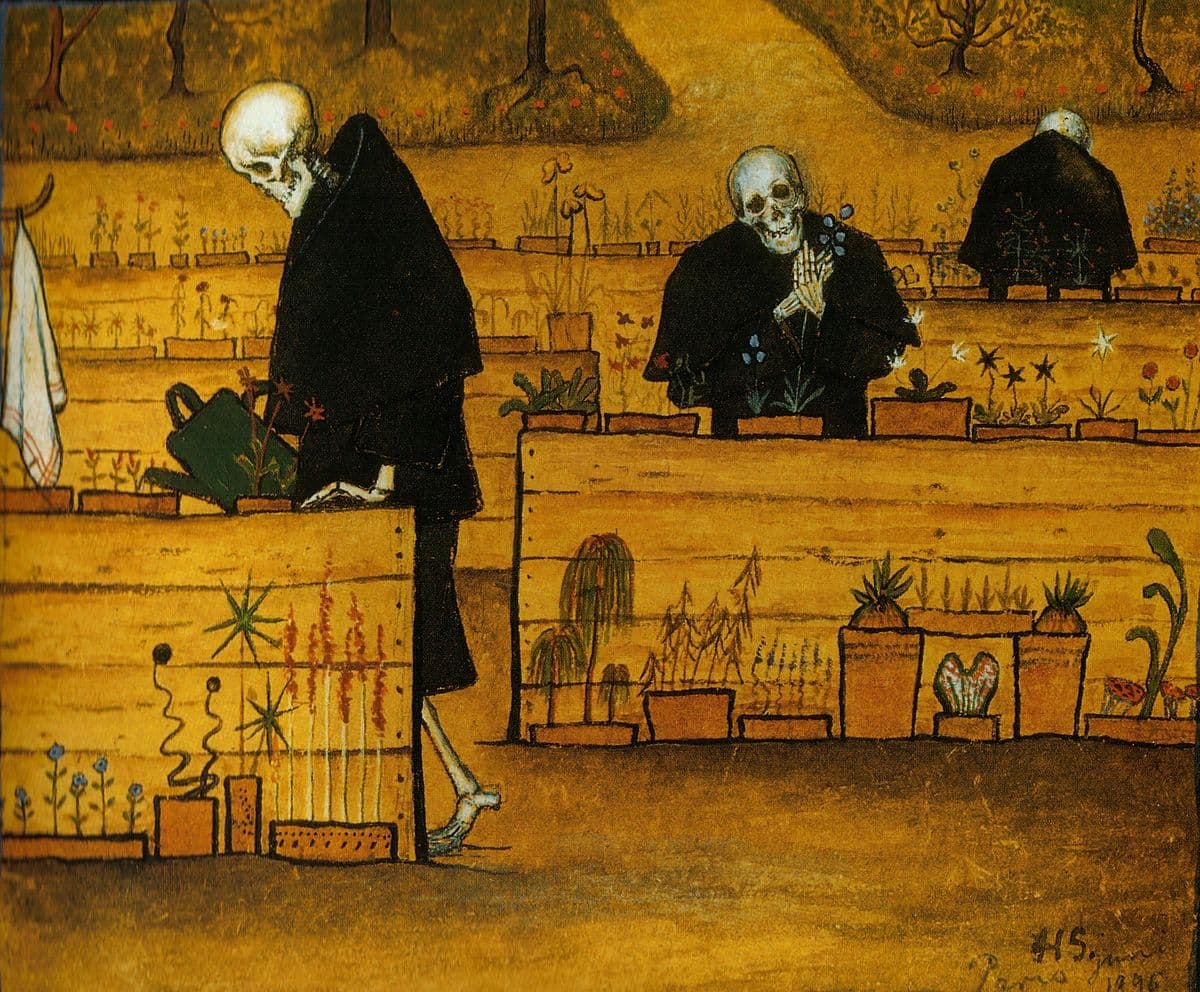
The Garden of Death
Hugo Simberg · 1896
The Nightmare
Henry Fuseli · 1781
Wanderer above the Sea of Fog
Caspar David Friedrich · c. 1817
The Course of Empire: Destruction
Thomas Cole · 1836

Bridge over a Pond of Water Lilies
Claude Monet · 1899

Nymphs Dancing to Pan's Flute
Joseph Tomanek

The Scream
Edvard Munch · 1893