Image: Musée du Louvre · Public domain · via Wikimedia Commons
Romanticism
The Raft of the Medusa
Théodore Géricault, 1818–1819
The Raft of the Medusa is Théodore Géricault's 1818–19 painting of survivors of the French frigate Méduse, adrift on a makeshift raft and signaling a distant ship. The vast canvas hangs in the Louvre in Paris.
- Artist
- Théodore Géricault
- Date
- 1818–1819
- Medium
- Oil on canvas
- Dimensions
- 491 × 716 cm
- Collection
- Musée du Louvre, Paris, France
- Movement
- Romanticism
What you are looking at
A raft of lashed timbers pitches on a heaving green sea under a stormy sky. On it, a mass of bodies, some dead, some dying, some straining upward, rises from left to right toward a single figure at the top: a man held up by others, waving a cloth at a tiny ship on the horizon. That speck is the brig Argus, and the question the painting asks is whether it has seen them.
At the lower left an older man sits with a young corpse across his lap, staring away from the hope at the other end of the raft. Bodies hang into the water. The makeshift sail fills with a wind that drives the raft away from the rescuers. Géricault splits the picture into two movements, despair on the left and hope on the right, and makes the viewer feel both at once.
The true story of the Méduse
In June 1816 the French frigate Méduse sailed for Senegal, recently returned to France, carrying officials and settlers. Its captain, Hugues Duroy de Chaumareys, was a returned royalist émigré with almost no sea experience, appointed through political favor. On 2 July he ran the ship aground on a sandbank off the coast of present-day Mauritania. There were not enough lifeboats. About 150 people were put on a hastily built raft to be towed by the boats; the tow lines were cut and the raft was abandoned.
For thirteen days the people on the raft endured storms, mutiny, killings, starvation and, by the survivors' own account, cannibalism. When the Argus found them on 17 July, fifteen were alive, and several of those died soon after. Two survivors, the surgeon Henri Savigny and the engineer Alexandre Corréard, published an account in 1817 that turned the disaster into a national scandal and an attack on the restored monarchy of Louis XVIII.
How Géricault made it
Théodore Géricault (1791–1824) was twenty-seven and determined to make his name with a monumental modern subject. He spent more than a year researching. He interviewed Savigny and Corréard, who both posed and appear in the picture near the mast. He had the raft's carpenter build him a scale model. He studied the sick and dying in hospitals and brought severed limbs and heads from the morgue to his studio to observe the color of decaying flesh. He took a studio near a hospital and shaved his head to avoid distraction.
The young Eugène Delacroix, a friend, posed for the figure lying face down in the foreground with an arm outstretched. Géricault made dozens of studies before settling on the moment of first sighting of the Argus, rather than earlier episodes of mutiny or cannibalism. He painted directly onto the huge canvas figure by figure, using bitumen to deepen his shadows, a pigment that has since darkened and cracked the surface.
What does The Raft of the Medusa mean?
The painting is at once a history painting, a modern news story and a political act. Its subject was government incompetence, the abandonment of ordinary people by those in charge, and viewers in 1819 knew it. Géricault gave it the timeless title Scène de naufrage (Scene of Shipwreck) at the Salon, but no one was fooled.
It also draws on older art. The father mourning his son recalls Dante's Count Ugolino; the heaped, muscular bodies reflect Géricault's study of Michelangelo's Last Judgment. And the figure at the summit of the pyramid, waving with his back to us, is a Black man, Jean Charles, one of the survivors. Placing him at the apex was a striking choice in a France still debating the slave trade, and many historians read the painting as sympathetic to abolition.
Reception and legacy
At the Salon of 1819 the painting divided critics: some saw a masterpiece, others a heap of corpses. It traveled to London, where it was exhibited to paying crowds. The Louvre bought it after Géricault's early death in 1824. It became a founding work of French Romanticism, directly shaping Delacroix's Liberty Leading the People, and its image of humanity adrift has been quoted ever since, from political cartoons to album covers. Compare its vision of catastrophe with Karl Bryullov's The Last Day of Pompeii and Rembrandt's Storm on the Sea of Galilee.
Details most viewers miss
- The tiny ship. The Argus is barely a few strokes on the horizon at the right; many visitors never find it.
- The bitumen. Large areas have darkened and cracked because of the bitumen Géricault used for rich shadows, so the painting is darker today than in 1819.
- The real survivors. The figures near the mast pointing toward the rescue ship are Savigny and Corréard, painted from life.
Where to see The Raft of the Medusa
The painting is in the Musée du Louvre in Paris, in the Mollien room of large French nineteenth-century paintings on the first floor of the Denon wing, near Liberty Leading the People. At almost five by seven meters, the figures in the foreground are larger than life, and the lower edge of the raft sits near eye level, so the viewer feels on the edge of the water.
Questions & answers
Where is The Raft of the Medusa?
It is in the Musée du Louvre in Paris, in the Denon wing's gallery of large French nineteenth-century paintings, near Delacroix's Liberty Leading the People. The Louvre acquired it after Géricault's death in 1824.
What is the true story behind The Raft of the Medusa?
In July 1816 the French frigate Méduse ran aground off West Africa under an inexperienced captain. About 150 people were set adrift on a raft; after thirteen days of starvation, violence and cannibalism, only fifteen were rescued by the Argus.
What does The Raft of the Medusa mean?
It shows the moment survivors sight a rescue ship, balancing despair and hope. It was also a political indictment of the restored French monarchy's incompetence, and the Black survivor at its peak has been read as a statement against slavery.
How big is The Raft of the Medusa?
It measures 491 × 716 cm, almost five by seven meters. The foreground figures are larger than life and the raft is set low, so viewers feel close to the water.
Did Delacroix pose for The Raft of the Medusa?
Yes. The young Eugène Delacroix, a friend of Géricault, posed for the figure lying face down in the foreground with one arm stretched out. Survivors Savigny and Corréard also posed for figures near the mast.
Kindred works
You may also study
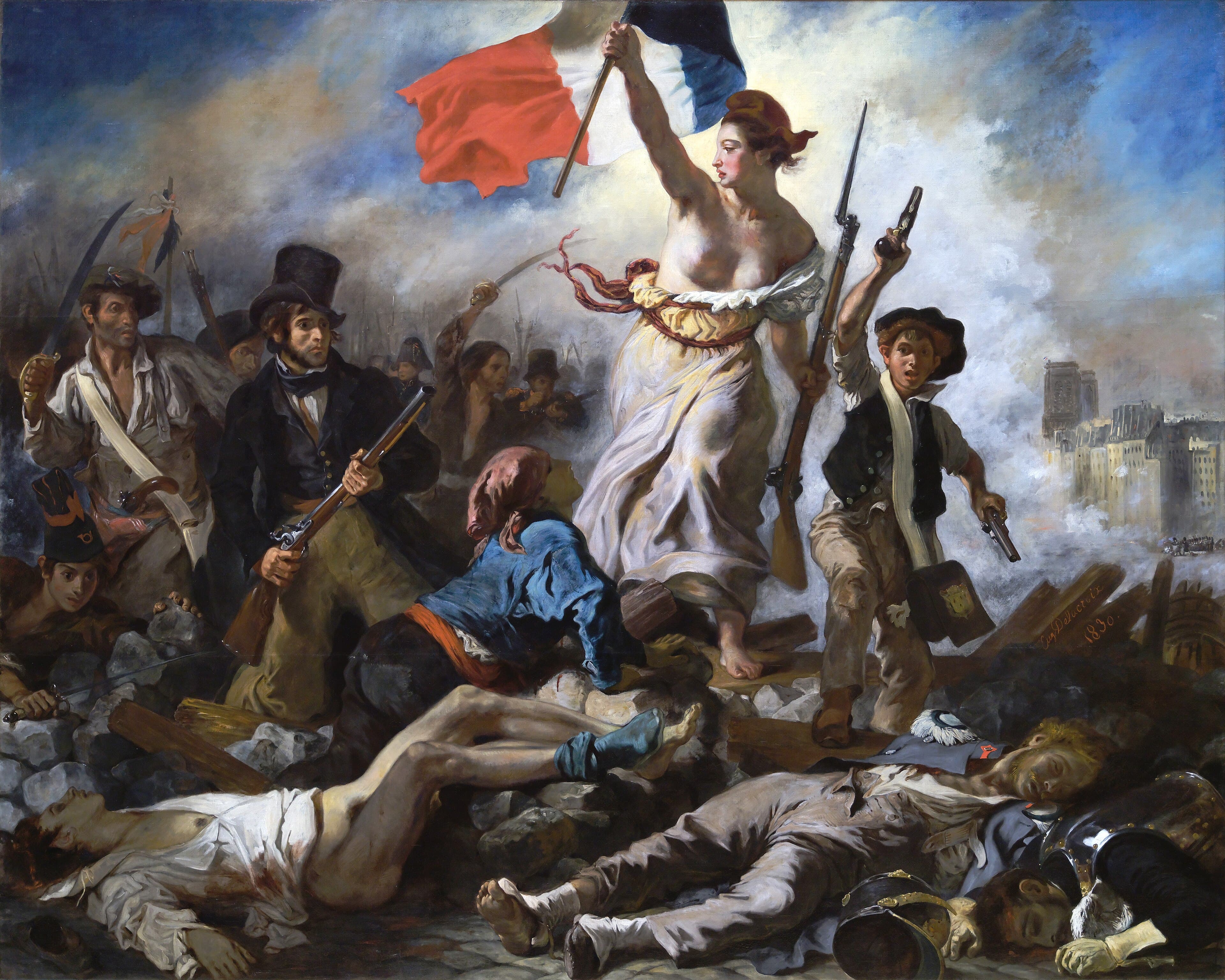
Liberty Leading the People
Eugène Delacroix · 1830

The Death of Marat
Jacques-Louis David · 1793
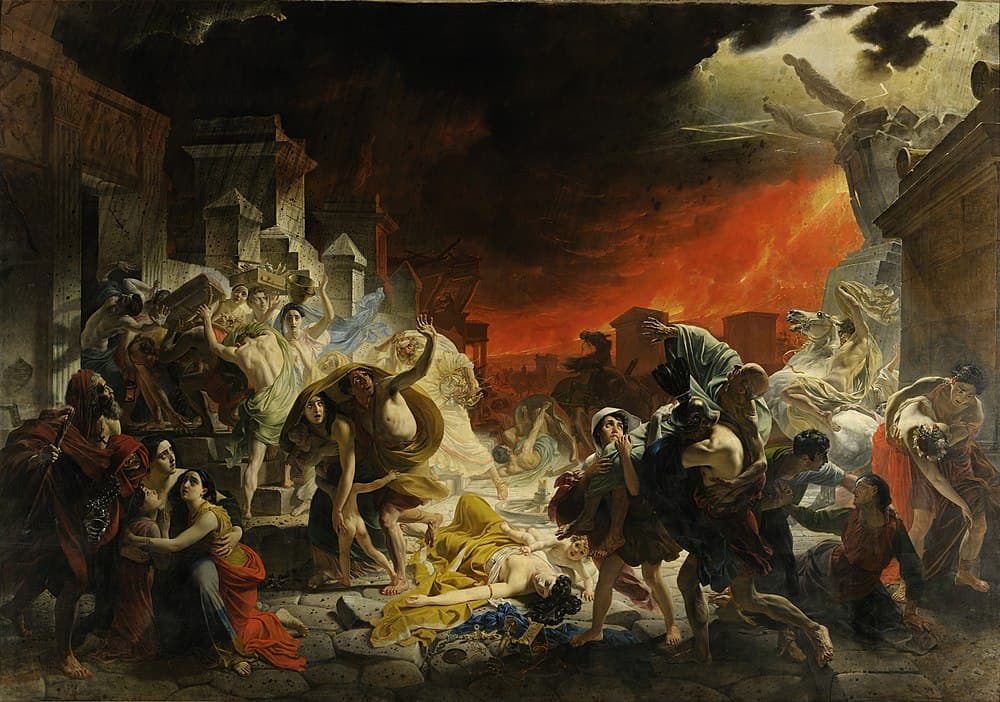
The Last Day of Pompeii
Karl Bryullov · 1830–33
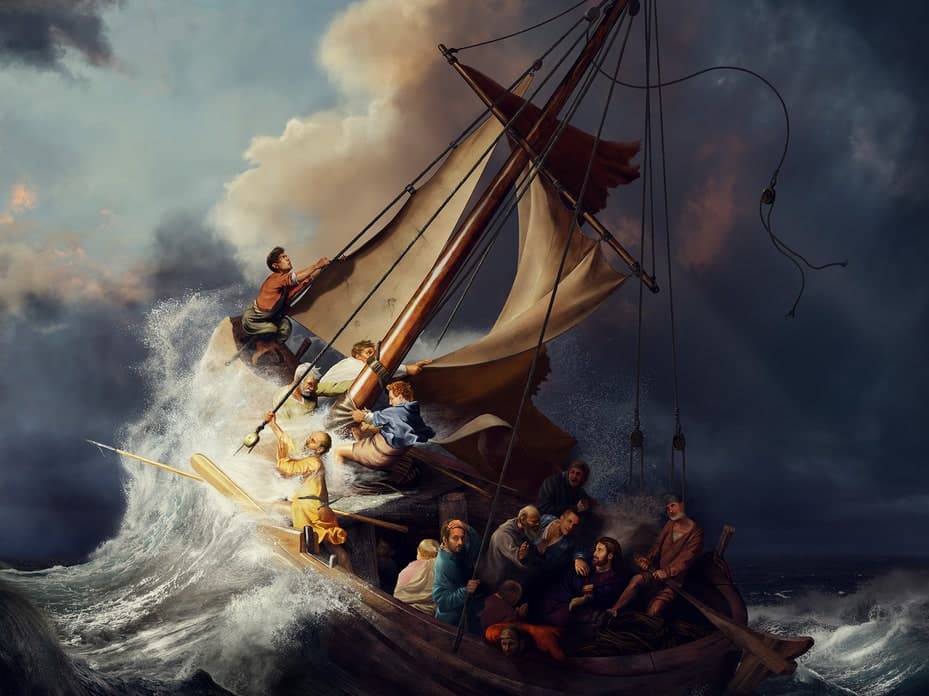
The Storm on the Sea of Galilee
Rembrandt · 1633

Wanderer above the Sea of Fog
Caspar David Friedrich · c. 1817

Bridge over a Pond of Water Lilies
Claude Monet · 1899

The Scream
Edvard Munch · 1893

The Thinker
Auguste Rodin · Modeled 1880–82; enlarged 1902–03; this cast 1904