Romanticism
Nightmare
Nicolai Abraham Abildgaard, 1800
Nightmare (Mareridt) is an 1800 oil painting by the Danish artist Nicolai Abildgaard showing a demon crouched on a sleeping woman beside her companion. It is in the Sorø Kunstmuseum, Denmark.
- Date
- 1800
- Medium
- Oil on canvas
- Dimensions
- c. 35 × 42 cm
- Collection
- Sorø Kunstmuseum, Sorø, Denmark
- Movement
- Romanticism
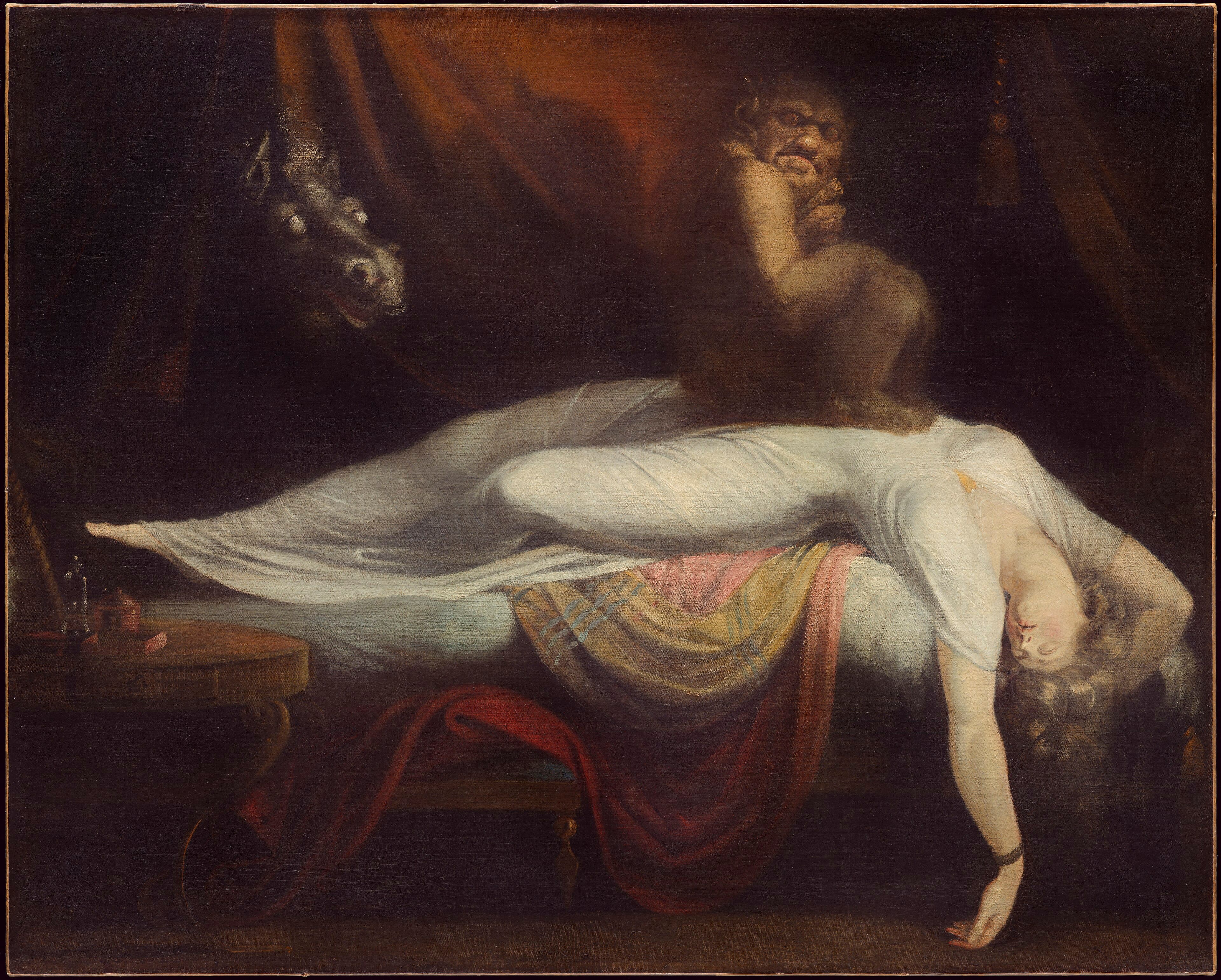
Nightmare (in Danish Mareridt) is a small oil on canvas painted in 1800 by Nicolai Abraham Abildgaard, the leading Danish painter of his generation and professor at the Royal Danish Academy of Fine Arts in Copenhagen. It shows two nude young women asleep on a bed while a squat, horned demon sits on one of them. The painting, roughly 35 by 42 centimeters, is in the collection of the Sorø Kunstmuseum (formerly the Vestsjællands Kunstmuseum) in Sorø, Denmark. It is Abildgaard's response to Henry Fuseli's famous The Nightmare of 1781.
What you are looking at
The scene is a bedroom at night. A heavy curtain is drawn back at the right, and through an opening at the upper left a thin crescent moon hangs in a dark blue sky. On a bed covered with greenish drapery lie two women. The one in the foreground stretches out on her back, her head thrown back over the edge of the pillow, her arms flung wide, her body arched in a way that reads as restless rather than peaceful. Behind her, the second woman lies turned away, her face buried in the pillow, apparently sleeping undisturbed.
Squatting on the foreground woman's belly is the nightmare itself: a small, dark, hairy demon with pointed ears and horns, its chin resting on its fist as it stares straight out at the viewer. It is grinning. Behind it, on the wall, its shadow is thrown large, the horned head magnified into something far more menacing than the creature itself.
That shadow is the detail most viewers miss. It suggests that the real terror is not the little goblin but the dark shape it casts, the fear it brings, which fills the room.
The folklore behind the image
In northern European folklore, the mare (Danish mare, Old Norse mara) was a spirit that sat on the chest of sleepers and caused bad dreams, a feeling of suffocation and paralysis. The word survives in the English "nightmare" and the Danish "mareridt", literally "mare-ride". Doctors of the eighteenth century described the same experience as incubus; today it would be recognized as sleep paralysis with hallucinations.
Fuseli's painting of 1781 had turned this belief into one of the most famous images of the age: a single woman sprawled across a bed, an incubus on her chest and a wild-eyed horse peering through the curtains. Abildgaard and Fuseli were both in Rome in the 1770s and moved in the same circle of northern artists there, sharing an interest in Shakespeare, Ossian and the classical sublime.
How Abildgaard changed the subject
Abildgaard keeps Fuseli's basic idea but alters almost everything around it. He removes the horse, adds a second sleeper, and gives the demon a crude, almost comic presence. The doubling of the women is the key change: one is ridden by the nightmare and one is not, which sharpens the contrast between peaceful sleep and terror. He also introduces the moon and the projected shadow, so that the effect depends on light and darkness as much as on the monster.
The handling is smooth and polished, in keeping with Abildgaard's Neoclassical training. The bodies are modeled in pale, cool flesh tones against the darker bedding, and the light falls from the left as though from a lamp or the moon, catching the arched torso and throat.
Meaning and interpretation
Like Fuseli's painting, Nightmare combines horror with eroticism. The demon sitting on a naked, arched woman carries obvious sexual overtones, rooted in the incubus legend, and that charge was part of the image's popularity. Later critics have read it as a picture of repressed desire or of anxiety, and in the early twentieth century Fuseli's version was famously connected with psychoanalysis.
The pairing of a disturbed and a peaceful sleeper invites a moral or psychological reading: two people in the same bed can live in entirely different nights. Abildgaard left no written explanation, so these readings remain interpretations.
Reception and legacy
Abildgaard is best known today for his large history paintings and for training a generation of Danish artists, including the sculptor Bertel Thorvaldsen. Nightmare shows another side of him, the Romantic fascination with dreams, the supernatural and the irrational that runs from Fuseli and Goya to the Symbolists. It is one of the strangest images of Danish Golden Age art.
Small scale, big effect
Part of the painting's strangeness comes from its size. At about the dimensions of a large book, it is a cabinet picture, meant to be looked at closely, perhaps privately, rather than displayed in a public hall. Abildgaard's large public commissions, including the history cycle painted for Christiansborg Palace, were monumental and official. Nightmare belongs to another category of his work, a group of smaller literary and fantastic pictures in which he could experiment with mood and subject matter far removed from royal propaganda.
Where to see it
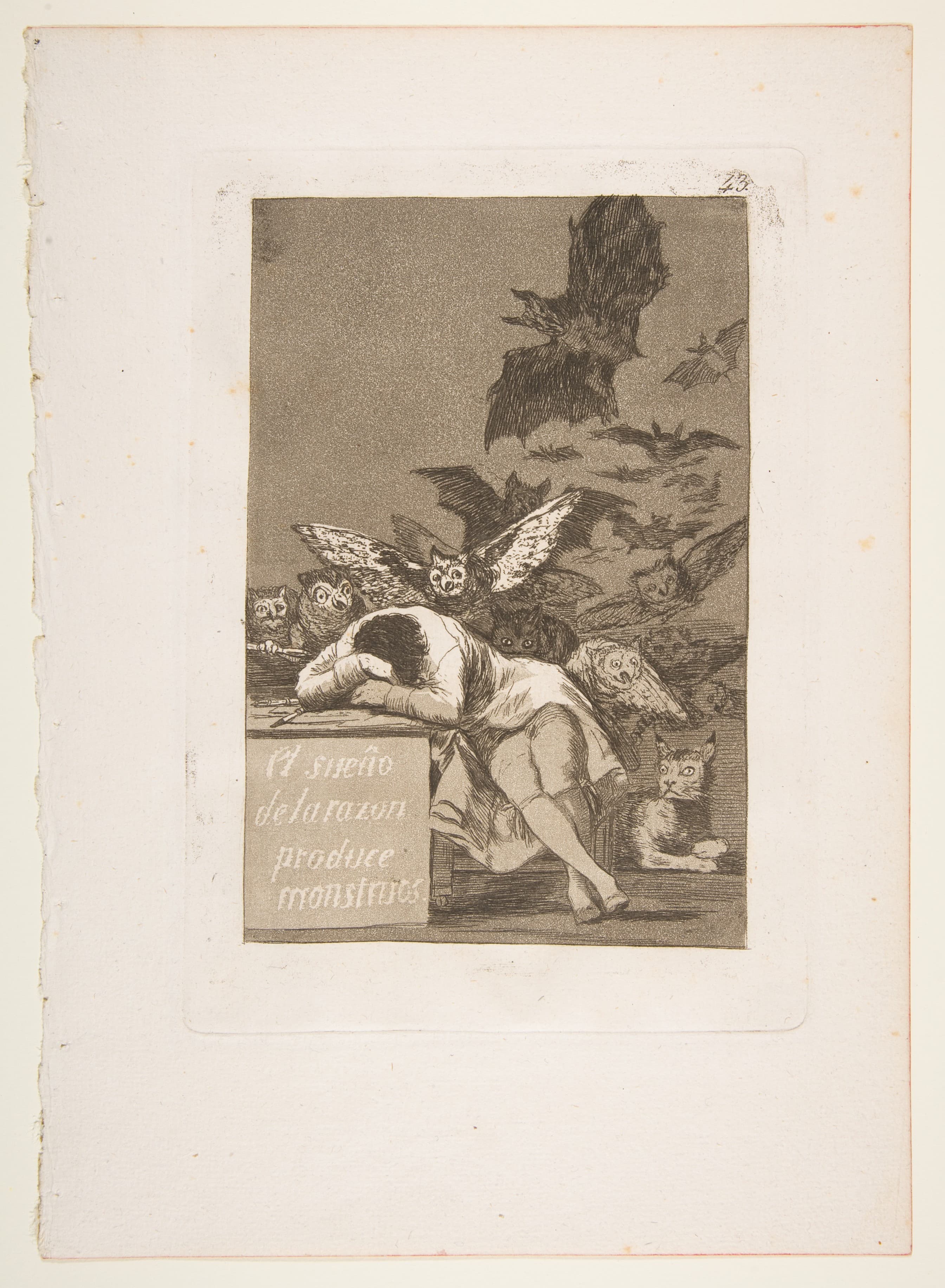
The painting belongs to the Sorø Kunstmuseum in Sorø, about an hour west of Copenhagen. For more art of dreams and demons, see Goya's The Sleep of Reason Produces Monsters, our guide to angels and demons in art and the Romanticism collection.
Questions & answers
Where is Abildgaard's Nightmare?
Abildgaard's Nightmare of 1800 belongs to the Sorø Kunstmuseum in Sorø, Denmark, formerly called the Vestsjællands Kunstmuseum. It is a small canvas, about 35 by 42 centimeters, much smaller than Fuseli's famous Nightmare in the Detroit Institute of Arts. It is not always on display.
What is the meaning of Abildgaard's Nightmare?
It draws on the folk belief in the mare, a spirit that sits on sleepers' chests and causes bad dreams. By showing one woman tormented and one sleeping peacefully, Abildgaard contrasts terror and calm in the same bed. The demon's huge shadow suggests that fear itself is the true monster.
How is Abildgaard's Nightmare different from Fuseli's?
Fuseli's 1781 painting shows one woman, an incubus on her chest and a horse's head looking through the curtains. Abildgaard removes the horse, adds a second sleeping woman, a crescent moon and a large shadow of the demon on the wall.
Who was Nicolai Abildgaard?
Nicolai Abraham Abildgaard (1743–1809) was a Danish history painter, architect and director of the Royal Danish Academy of Fine Arts. He studied in Rome, where he knew Henry Fuseli, and taught many younger Danish artists, among them the sculptor Bertel Thorvaldsen.
Kindred works
You may also study
The Nightmare
Henry Fuseli · 1781
The Sleep of Reason Produces Monsters
Francisco Goya · 1797–99 (published 1799)
Tamara and Demon
Konstantin Makovsky · 1889

Saturn Devouring His Son
Francisco Goya · c. 1819–1823
Fallen Angel
Alexandre Cabanel · 1847

Venus de Milo
Alexandros of Antioch · c. 150–125 BC

Nymphs Dancing to Pan's Flute
Joseph Tomanek

The Scream
Edvard Munch · 1893