Romanticism / Academic art
The Last Day of Pompeii
Karl Bryullov, 1830–33
The Last Day of Pompeii is a huge history painting by Karl Bryullov, made in Rome in 1830–33, showing the inhabitants of Pompeii fleeing the eruption of Vesuvius in AD 79. It is in the State Russian Museum, Saint Petersburg.
- Artist
- Karl Bryullov
- Date
- 1830–33
- Medium
- Oil on canvas
- Dimensions
- 456.5 × 651 cm
- Collection
- State Russian Museum, Saint Petersburg, Russia
- Movement
- Romanticism / Academic art
What you are looking at
A street in Pompeii at the moment of catastrophe. Behind, Vesuvius erupts in a wall of red fire under a black sky, and a flash of lightning picks out statues toppling from the rooftops. In the foreground, the people of the city flee in groups, each a separate drama. Two sons carry their old father; a young man begs his mother to rise; a family shelters under a cloak; a mother clutches her daughters; a priest runs with the temple treasures; and at the center, a young woman lies dead on the paving stones, fallen from a chariot, her baby crawling beside her. Near the left, a painter carries a box of brushes and colors on his head and looks up at the sky.
The painting is by Karl Bryullov (1799–1852), made in Rome between 1830 and 1833. It is enormous, about 4.6 by 6.5 meters, and is in the State Russian Museum in Saint Petersburg.
How it was made
Bryullov visited the excavations at Pompeii in 1827 with his brother, the architect Alexander Bryullov, and drew the Street of the Tombs, the setting of the picture. The archaeology is careful: the buildings, the paving and many objects are based on finds. Pliny the Younger's letters describing the eruption, in which his uncle Pliny the Elder died, gave the literary source; some of the groups echo his account.
The painter carrying his box is a self-portrait. Several of the women share the features of Countess Yulia Samoylova, Bryullov's friend and patron.
Looking closely
The composition is theatrical, arranged like a stage with a frieze of figures across the front. Notice the two kinds of light: the red glow of the volcano from behind, and the cold, bluish flash of lightning from the front, which lights the bodies like marble. The figures have the idealized beauty of Neoclassical sculpture, but the subject, the drama and the color are Romantic. That blend is what made the picture so powerful in its day.
Reception
Shown in Rome and Milan in 1833, the painting caused a sensation. At the Paris Salon of 1834 it won a gold medal, and it was then sent to Saint Petersburg, where it was celebrated as proof that a Russian painter could match the best in Europe. The English novelist Edward Bulwer-Lytton saw it in Milan, and it is often said to have inspired his novel The Last Days of Pompeii (1834).
Where to see it
The painting is in the State Russian Museum. See also Ilya Repin's Ivan the Terrible and our Romanticism guide.
Questions & answers
Where is The Last Day of Pompeii painting?
Karl Bryullov's The Last Day of Pompeii (1830–33) is in the State Russian Museum in Saint Petersburg. It is one of the largest paintings in the museum, about 4.6 by 6.5 meters, and has been on public display there since the nineteenth century.
Is Bryullov in The Last Day of Pompeii?
Yes. The man at the left carrying a box of painting materials on his head and gazing up at the sky is a self-portrait of Karl Bryullov. Several of the women resemble his patron and friend, Countess Yulia Samoylova.
Did The Last Day of Pompeii inspire Bulwer-Lytton's novel?
It is often said so. Edward Bulwer-Lytton saw Bryullov's painting in Milan in 1833, and his novel The Last Days of Pompeii appeared in 1834. The painting is widely credited as one of the inspirations for the book.
Kindred works
You may also study
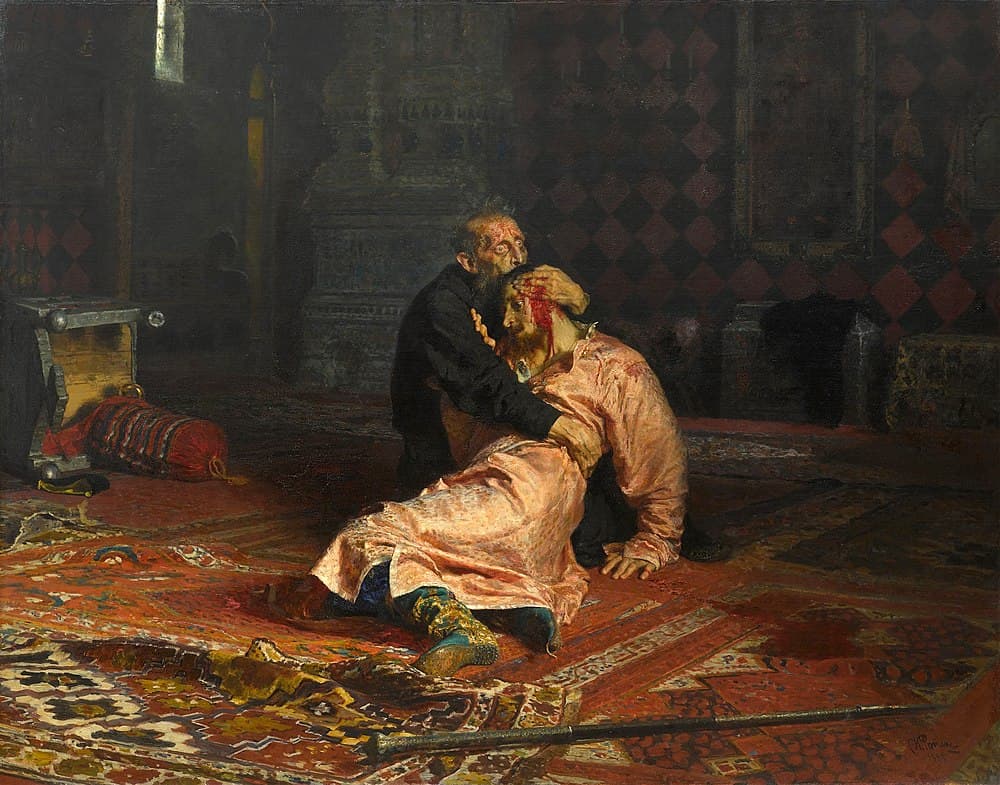
Ivan the Terrible and His Son Ivan
Ilya Repin · 1883–85
Tamara and Demon
Konstantin Makovsky · 1889
The Fall of the Damned
Guy Head · before 1799

The Scream
Edvard Munch · 1893

Saturn Devouring His Son
Francisco Goya · c. 1819–1823

Ophelia
John Everett Millais · 1851–52
Las Meninas
Diego Velázquez · 1656
Head of a Skeleton with a Burning Cigarette
Vincent van Gogh · 1886