Russian · Neoclassicism · Romanticism
Karl Bryullov
b. 23 December 1799, Saint Petersburg, Russia — d. 23 June 1852, Manziana, near Rome
Karl Bryullov (1799–1852) was a Russian painter whose vast canvas The Last Day of Pompeii (1830–33) made him the first Russian artist with a European reputation and marked Russian painting's turn from Neoclassicism toward Romanticism.
1 work in the collection
Works by Karl Bryullov
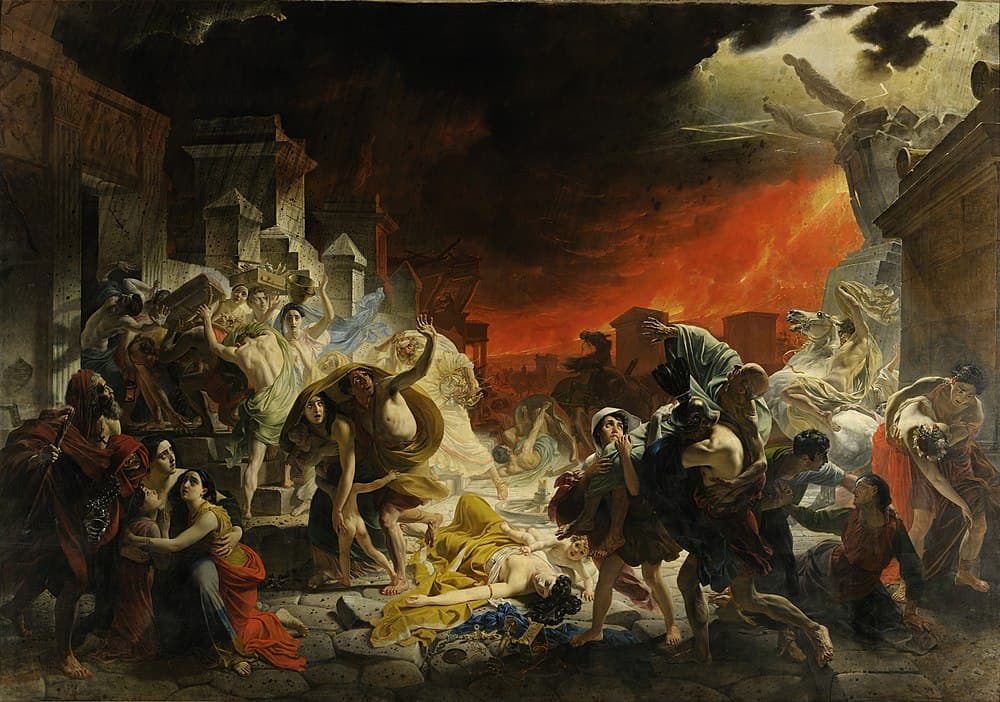
Karl Pavlovich Bryullov was a Russian painter, born in Saint Petersburg in 1799, who is remembered above all for The Last Day of Pompeii, an enormous history painting finished in Rome in 1833. Its triumph in Italy, in Paris and then in Russia made him the first Russian painter to win a European reputation, and he is seen as the key figure in the passage from Russian Neoclassicism to Romanticism.
Life in brief
Bryullov was the son of Pavel Brullo, a woodcarver and engraver of French Huguenot descent; the family name was later Russified. He trained at the Imperial Academy of Arts from 1809 to 1821 and in 1822 went to Italy with his brother Alexander, an architect, on a scholarship from the Society for the Encouragement of Artists. He stayed for more than a decade, painting portraits and sunny genre scenes such as Italian Midday and the large Horsewoman (1832, Tretyakov Gallery), before turning to history. Back in Russia from 1836, he became a professor at the Academy, painted portraits of writers and aristocrats and worked on the decoration of St Isaac's Cathedral in Saint Petersburg. Ill health sent him abroad in 1849, first to Madeira and then to Italy; he died at Manziana, near Rome, in 1852 and is buried in the Protestant Cemetery in Rome.
Style
Bryullov kept the firm drawing, sculptural figures and balanced groups he learned at the Academy, but he filled them with movement, strong color and dramatic light. His portraits are lively and informal, his history paintings theatrical.
The Last Day of Pompeii
After visiting the excavations at Pompeii in 1827, Bryullov spent years planning a picture of the eruption of Vesuvius in AD 79. In the finished canvas, more than six meters wide, families flee down a street of collapsing temples under a red sky split by lightning: a mother clutches her daughters, sons carry their father, a young woman lies dead on the paving. Among the crowd Bryullov painted himself, carrying a box of painting materials on his head. Shown in Rome and at the Paris Salon of 1834, where it won a gold medal, it is now in the State Russian Museum in Saint Petersburg.
Where to see his work
The State Russian Museum in Saint Petersburg and the Tretyakov Gallery in Moscow hold his major works. See more drama in Romanticism and Death in Art.
Questions & answers
Who painted The Last Day of Pompeii?
The Last Day of Pompeii (1830–33) was painted by the Russian artist Karl Bryullov in Rome. It shows the eruption of Vesuvius in AD 79 and is now in the State Russian Museum, Saint Petersburg.
Why is Karl Bryullov important?
Bryullov was the first Russian painter to win a major European reputation, thanks to The Last Day of Pompeii, and his work marks Russian painting's move from academic Neoclassicism toward Romanticism. He was also an influential professor at the Imperial Academy of Arts.
Did Bryullov paint himself in The Last Day of Pompeii?
Yes. Among the fleeing crowd on the left is a young man carrying a box of brushes and paints on his head, generally identified as Bryullov's self-portrait.