Image: Tate, via Google Arts & Culture · Public domain · via Wikimedia Commons
Pre-Raphaelite
The Lady of Shalott
John William Waterhouse, 1888
The Lady of Shalott is John William Waterhouse's 1888 painting of Tennyson's doomed heroine drifting downriver toward Camelot in a boat, a woven cloth trailing in the water. It is in Tate Britain, London, and is one of the most loved Victorian paintings.
- Artist
- John William Waterhouse
- Date
- 1888
- Medium
- Oil on canvas
- Dimensions
- 153 × 200 cm
- Collection
- Tate Britain, London, United Kingdom
- Movement
- Pre-Raphaelite
What you are looking at
A young woman with loose red-brown hair sits upright in a narrow wooden boat on a reedy river at dusk. She wears a long white dress, and her lips are parted as if she is singing or about to speak. One hand loosely holds the chain that moored the boat; she is letting it go. Draped over the boat and spilling into the water is a large woven cloth, the web she has spent her life weaving, its pattern of figures and tiny scenes now soaking up the river.
At the prow stand three candles in a holder. Two have already gone out; one still burns. A crucifix lies beside them and a lantern hangs from the carved prow.
Lettering runs along the side of the black hull, the name she writes on the boat in the poem. The banks are thick with reeds and autumn trees, small birds dart through the reeds at left, and the sky behind is a cool evening gray. The color is restrained, mostly greens and browns, so the white of the dress and the warm hair become the focus.
The detail people miss is how much of the story Waterhouse loads into the boat. The woven cloth is the evidence of her old life; the candles count down the life she has left; the chain is the last thing tying her to the shore. It is a narrative painting that reads in a single glance.
The poem behind the painting
The subject comes from Alfred, Lord Tennyson's poem "The Lady of Shalott", first published in 1832 and revised in 1842. The Lady lives in a tower on the island of Shalott, upstream from Camelot. A curse forbids her to look directly at the world, so she watches it in a mirror and weaves what she sees into a web.
When Sir Lancelot rides past singing, she turns to the window. The mirror cracks, the curse falls, and she leaves the tower, finds a boat, writes her name on it and lets the river carry her to Camelot. She dies singing before she arrives.
Waterhouse paints the moment just after she has pushed off, which is described in the fourth part of the poem: she loosens the chain and lies down in the boat. In the painting she is still sitting up, her face turned toward Camelot, alive for a few moments longer.
How Waterhouse made it
John William Waterhouse (1849–1917) was born in Rome to English painter parents and trained at the Royal Academy Schools. By 1888 he was painting in a style that combined the literary subjects and detailed nature of the Pre-Raphaelites with the looser handling he had absorbed from French plein-air painting. The landscape here has the freshness of observation: he is often said to have painted the river setting outdoors before working up the figure in the studio. The canvas is large, about 1.5 by 2 meters, so the figure is nearly life-size.
He was painting a generation after the Pre-Raphaelite Brotherhood broke up, but the subject was a Pre-Raphaelite favorite. William Holman Hunt, Dante Gabriel Rossetti and Elizabeth Siddal all drew or painted the Lady, and Millais's Ophelia, another doomed woman in water, is the obvious ancestor of this picture.
What does The Lady of Shalott mean?
Victorian readers took Tennyson's poem in several ways, and the painting carries all of them.
- Art and life. The Lady sees the world only as reflections and turns it into art. Many critics read her as an image of the artist, who must stay apart from life to create, and who is destroyed when she enters it.
- Desire. Her fatal look is triggered by Lancelot. The painting is also a picture of longing, and of a woman who chooses the world even though it will kill her.
- Fate. The extinguished candles and the crucifix frame her journey as a death already in progress. The single flame still burning gives the image its ache.
Waterhouse does not moralize. His Lady is not punished so much as released, and the mood is closer to elegy than to warning.
Waterhouse's three versions
Waterhouse returned to the subject twice. The Lady of Shalott Looking at Lancelot (1894, Leeds Art Gallery) shows the moment she turns from the loom and the threads wrap around her knees. I Am Half-Sick of Shadows, Said the Lady of Shalott (1915, Art Gallery of Ontario, Toronto) shows her earlier, weary of the mirror. The 1888 picture, the boat scene, is by far the best known.
Reception and where to see it
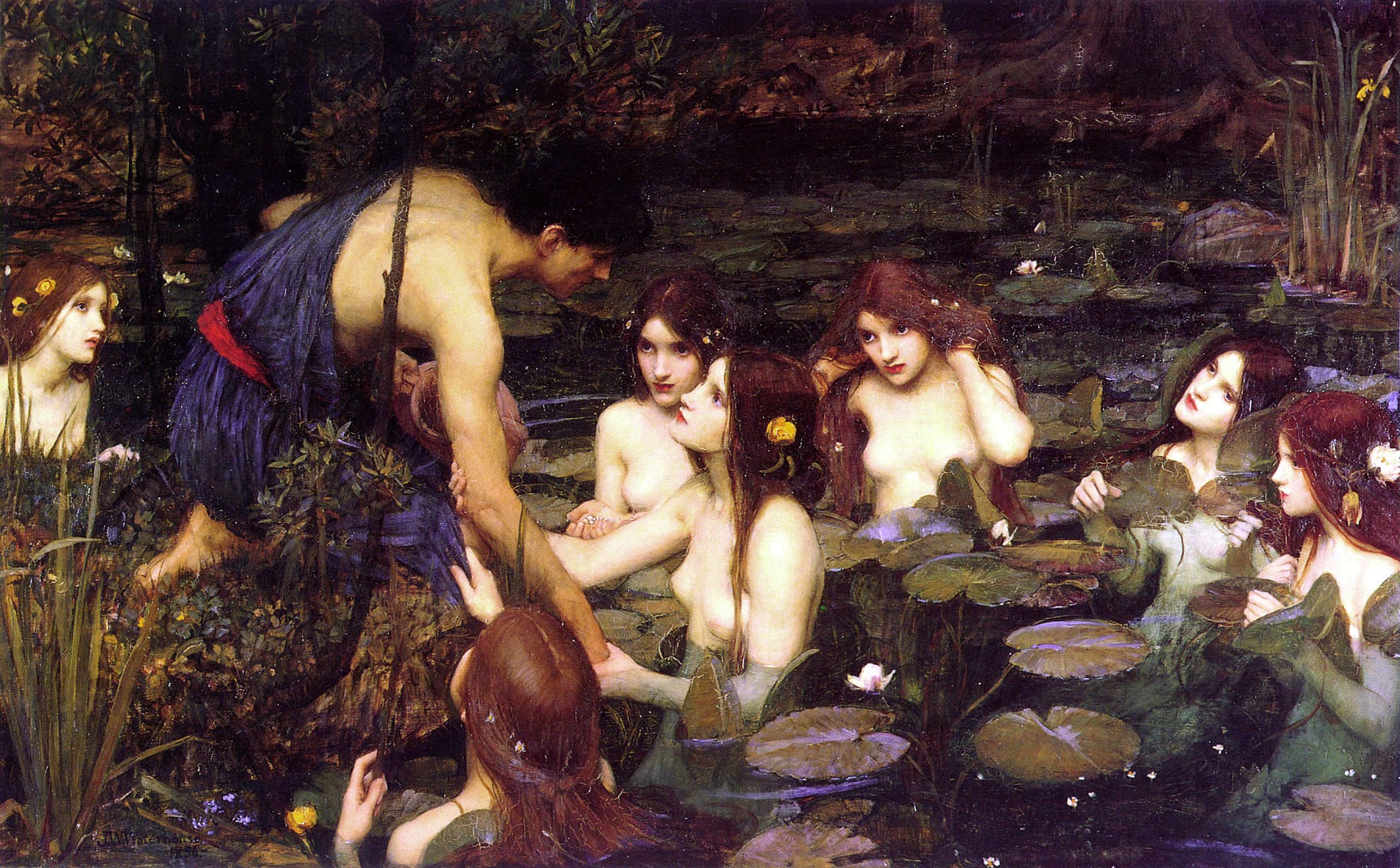
The painting was bought by Sir Henry Tate and given to the nation in 1894 as part of the founding gift of what became Tate Britain. It has been on almost continuous display since, and it is one of the most reproduced paintings in the collection. For anyone exploring the Pre-Raphaelites and their circle, it is an essential stop, and it sits naturally beside Waterhouse's other water-haunted subjects such as Hylas and the Nymphs.
The painting is in the public domain, and the high-resolution image here comes from Tate's own photography via Google Arts & Culture.
Questions & answers
Where is The Lady of Shalott painting?
Waterhouse's 1888 The Lady of Shalott is in Tate Britain in London. Sir Henry Tate bought it and gave it to the nation in 1894, and it is usually on display in the gallery's Victorian rooms. Check Tate's website before visiting, as works sometimes travel.
What is The Lady of Shalott about?
It illustrates Tennyson's poem 'The Lady of Shalott' (1832, revised 1842). A woman cursed to see the world only in a mirror looks out at Sir Lancelot, the curse falls, and she drifts downriver to Camelot in a boat, dying before she arrives. Waterhouse paints her setting off.
What do the candles in The Lady of Shalott mean?
Three candles stand at the prow of the boat. Two have blown out and one still burns, a symbol of her life running out as she drifts toward Camelot. Together with the crucifix beside them, they mark the journey as a death already under way.
How many Lady of Shalott paintings did Waterhouse make?
Three. The boat scene of 1888 (Tate Britain), The Lady of Shalott Looking at Lancelot of 1894 (Leeds Art Gallery), and I Am Half-Sick of Shadows, Said the Lady of Shalott of 1915 (Art Gallery of Ontario).
Is The Lady of Shalott a Pre-Raphaelite painting?
Strictly, no: Waterhouse painted it decades after the Pre-Raphaelite Brotherhood dissolved. But it takes their favorite subjects, Arthurian legend and Tennyson, and their close attention to nature, so it is usually grouped with the later Pre-Raphaelite tradition.
More by the artist
John William Waterhouse
Kindred works
You may also study

Ophelia
John Everett Millais · 1851–52
La Belle Dame sans Merci
Sir Frank Dicksee · 1901
The Martyr of the Solway
John Everett Millais · 1871

Bridge over a Pond of Water Lilies
Claude Monet · 1899

Venus de Milo
Alexandros of Antioch · c. 150–125 BC

The Scream
Edvard Munch · 1893
The Thinker
Auguste Rodin · Modeled 1880–82; enlarged 1902–03; this cast 1904

Saturn Devouring His Son
Francisco Goya · c. 1819–1823