Netherlandish (Brabantine) · Early Netherlandish painting · Northern Renaissance
Hieronymus Bosch
b. c. 1450, 's-Hertogenbosch, Duchy of Brabant — d. August 1516 (buried 9 August), 's-Hertogenbosch
Hieronymus Bosch (c. 1450–1516) was a Netherlandish painter from 's-Hertogenbosch whose crowded visions of sin, hell and paradise, above all The Garden of Earthly Delights in the Prado, made him the most original image-maker of his age.
1 work in the collection
Works by Hieronymus Bosch
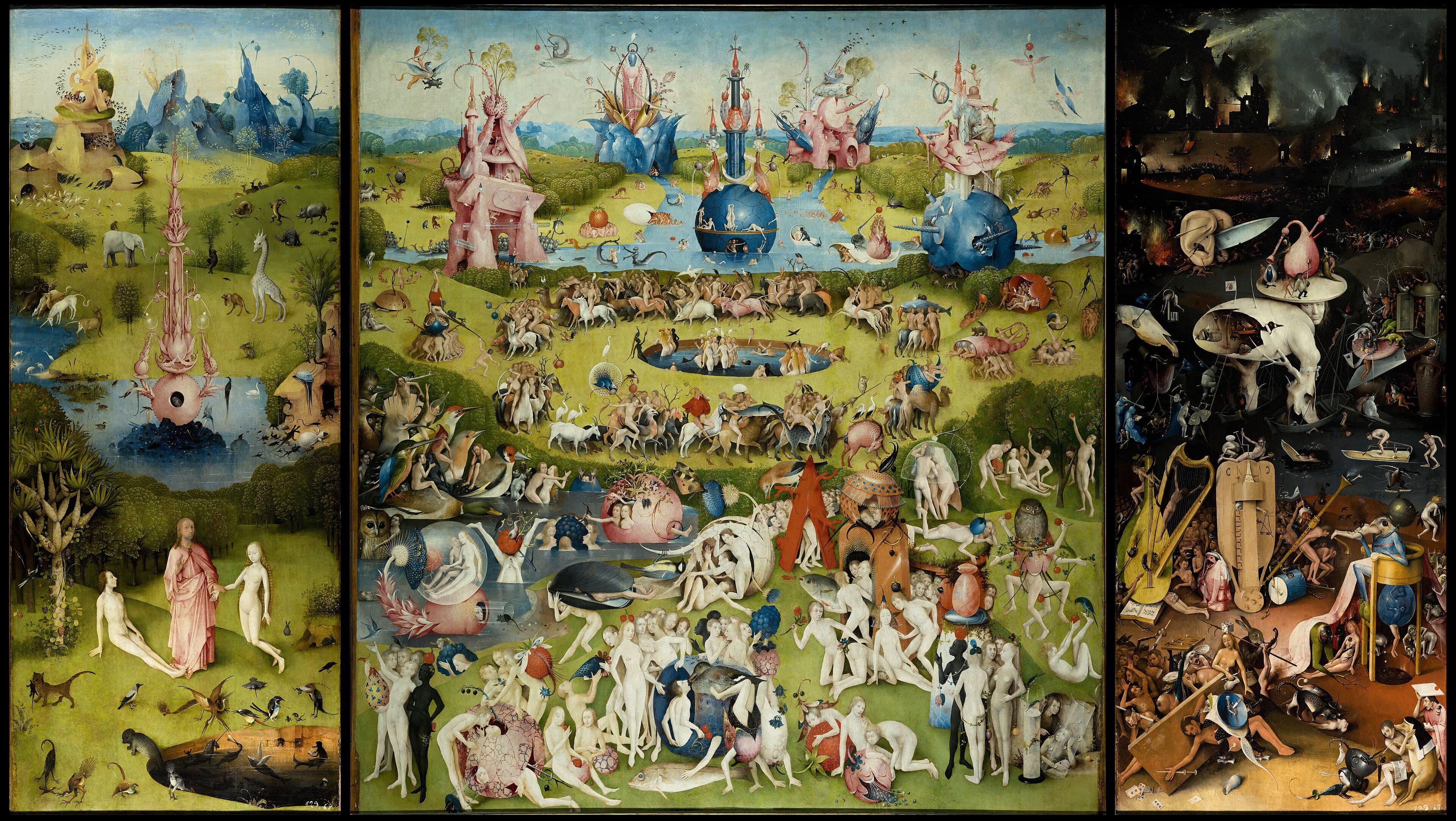
Hieronymus Bosch was a painter from 's-Hertogenbosch, a prosperous town in the Duchy of Brabant, now in the southern Netherlands. Working around 1480 to 1516, he filled altarpieces and panels with hybrid monsters, tiny naked crowds and burning cities, and his best-known work, The Garden of Earthly Delights, hangs in the Museo del Prado in Madrid. Fewer than thirty paintings are now accepted as his, yet few artists have been copied, imitated and argued over so much.
Life in brief
His real name was Jheronimus (Jeroen) van Aken. The family came from Aachen and had been painters for at least three generations: his grandfather, father and brothers ran a workshop on the market square of 's-Hertogenbosch. He signed some works Jheronimus bosch, taking the short form of his town's name as his own.
Around 1480 he married Aleid van de Meervenne, a woman of property, which gave him independence and status. In 1488 he became a sworn member of the Illustrious Brotherhood of Our Lady, a wealthy religious confraternity whose account books are among the few documents of his life. They record designs he supplied for stained glass and other works, and they record his funeral mass, held in the cathedral of Saint John in August 1516.
That is almost all the archive tells us. There are no letters, no theoretical writings and no contemporary account of his intentions. His dates of birth and training are inferred from his family and from the earliest panels.
Style and technique
Bosch painted in oil on oak panel, but his handling differs from the enamel-smooth finish of Jan van Eyck and his followers. He often worked quickly, wet into wet, with thin, transparent layers and visible touches of the brush. Infrared studies show a free, searching underdrawing, with figures moved and invented as he went.
His pictures are built from multitudes. A single panel can hold hundreds of figures, each small enough to sit on a fingernail and each doing something specific. Landscapes recede in bands of green and blue, and against them he set creatures assembled from incompatible parts: a bird's head on a jug, a fish with legs, a man whose body is a cracked eggshell. These hybrids drew on marginal drawings in manuscripts, on proverbs and on the imagery of sermons, but no one before him had brought them to such scale and conviction.
The subject beneath them is moral. Bosch was a devout artist working for devout patrons, and his paintings show the consequences of sin: folly, greed, lust and the punishments that await them. Humor and horror sit side by side.
The Garden of Earthly Delights
The great triptych in our catalogue was painted around 1490–1510 and first recorded in 1517 in the Brussels palace of the counts of Nassau. Closed, its shutters show the world on the third day of creation, a gray-green globe inside a glass sphere. Opened, the left wing shows God presenting Eve to Adam in Eden; the central panel, a vast meadow of nude men and women playing with giant fruit, birds and strange glass structures; and the right wing, a night-black hell where musical instruments become instruments of torture.
The most common reading treats the central panel as a warning: a false paradise of earthly pleasure sliding toward the damnation on the right. Other scholars have proposed alchemical, astrological or more optimistic interpretations, and none has settled the question. That uncertainty is part of its pull.
Other key works
- The Haywain Triptych (c. 1510–16, Prado), built on the proverb that the world is a haystack from which each grabs what he can.
- The Temptation of Saint Anthony (c. 1500, Museu Nacional de Arte Antiga, Lisbon), with the hermit saint beset by demons.
- The Last Judgment triptych (Academy of Fine Arts, Vienna).
- The Ship of Fools (Louvre, Paris) and Death and the Miser (National Gallery of Art, Washington).
- The Wayfarer (Museum Boijmans Van Beuningen, Rotterdam).
The tabletop of The Seven Deadly Sins in the Prado is traditionally his, though some specialists give it to his workshop.
Influence
Bosch was famous in his lifetime and imitated for decades after his death; many “Bosch” paintings in old collections are pastiches. King Philip II of Spain collected him with passion, which is why Madrid holds the richest group of his works. Pieter Bruegel the Elder adapted his crowds and monsters, most terribly in The Triumph of Death. In the twentieth century the Surrealists, Salvador Dalí among them, claimed him as an ancestor.
Where to see his work
The Prado in Madrid has the largest group, including the Garden, the Haywain and the Adoration of the Magi. Other key works are in Lisbon, Vienna, Venice (Gallerie dell'Accademia), Rotterdam, Paris and Washington. The Noordbrabants Museum in 's-Hertogenbosch, which owns no original painting, staged the landmark 500th-anniversary exhibition in 2016. Continue with Famous Paintings, Angels and Demons in Art and Death in Art.
Questions & answers
What is Hieronymus Bosch famous for?
Bosch is famous for crowded, fantastical religious paintings filled with hybrid monsters, tiny nude figures and visions of hell. His best-known work is The Garden of Earthly Delights (c. 1490–1510) in the Prado, Madrid. His imagery made him one of the most original artists of the Northern Renaissance.
Where is The Garden of Earthly Delights?
The Garden of Earthly Delights is in the Museo del Prado in Madrid. Philip II of Spain acquired it in the late sixteenth century and sent it to the monastery of El Escorial, and it was transferred to the Prado in 1939, after the Spanish Civil War.
How many paintings did Bosch make?
Only about 25 paintings and some 20 drawings are now accepted as his. Many works once given to him are by followers and imitators. The Bosch Research and Conservation Project, published in 2016, reassessed the attributions using technical study of the panels.
What do Bosch's paintings mean?
Most scholars read Bosch's paintings as moral warnings about sin and its punishment, rooted in late medieval sermons, proverbs and devotional texts. Alchemical, astrological and heretical readings have also been proposed, but Bosch left no writings, so many details remain open to interpretation.
Was Bosch a Surrealist?
No. Bosch died in 1516, four centuries before Surrealism. The Surrealists of the 1920s and 1930s admired his dreamlike hybrids and treated him as a forerunner, but his paintings were made for devout Christian patrons and served religious and moral purposes.