Academic art
The Birth of Venus
William-Adolphe Bouguereau, 1879
The Birth of Venus (La Naissance de Vénus) is William-Adolphe Bouguereau's 1879 Salon painting of the goddess standing on a scallop shell amid sea nymphs, tritons and cupids. It hangs in the Musée d'Orsay, Paris.
- Date
- 1879
- Medium
- Oil on canvas
- Dimensions
- 300 × 218 cm
- Collection
- Musée d'Orsay, Paris, France
- Movement
- Academic art
The Birth of Venus is the most famous painting by William-Adolphe Bouguereau, the leading academic painter of late nineteenth-century France. Shown at the Paris Salon of 1879 and bought by the French state, the canvas is three meters tall and hangs in the Musée d'Orsay in Paris.
What you are looking at
Venus stands at the center on a large scallop shell carried across the sea. She is nude, her weight on one leg, her body turned in a slow S-curve, and she lifts both arms to her head to wring out her long auburn hair, which falls past her hips. Her face is lowered and calm, her eyes half closed.
Around her the sea teems with attendants. At left, a muscular triton blows a conch shell to announce her, and a nereid leans back against him, gazing up at the goddess; another sea nymph with a wreath in her hair watches from the far left. At right, a triton embraces a nymph, and in the lower right corner a bearded sea god, seen from behind, rises from the water. At the bottom, two winged cupids ride a dolphin, one turning to look up at Venus.
Above, a cloud of putti and cupids swirls through the pale sky, tumbling and gesturing toward her. The whole composition forms a pyramid with Venus at its apex.
How it was made
Bouguereau was a master of the polished academic finish taught at the École des Beaux-Arts: invisible brushstrokes, smooth porcelain flesh, anatomy studied from life models and drawn with absolute precision. The pose of Venus derives from the ancient type of Venus Anadyomene, "rising from the sea," who wrings out her hair. The crowded marine procession and the putti in the sky openly quote Raphael's fresco The Triumph of Galatea in the Villa Farnesina in Rome, which Bouguereau had studied as a young prize winner in Italy.
Meaning and context
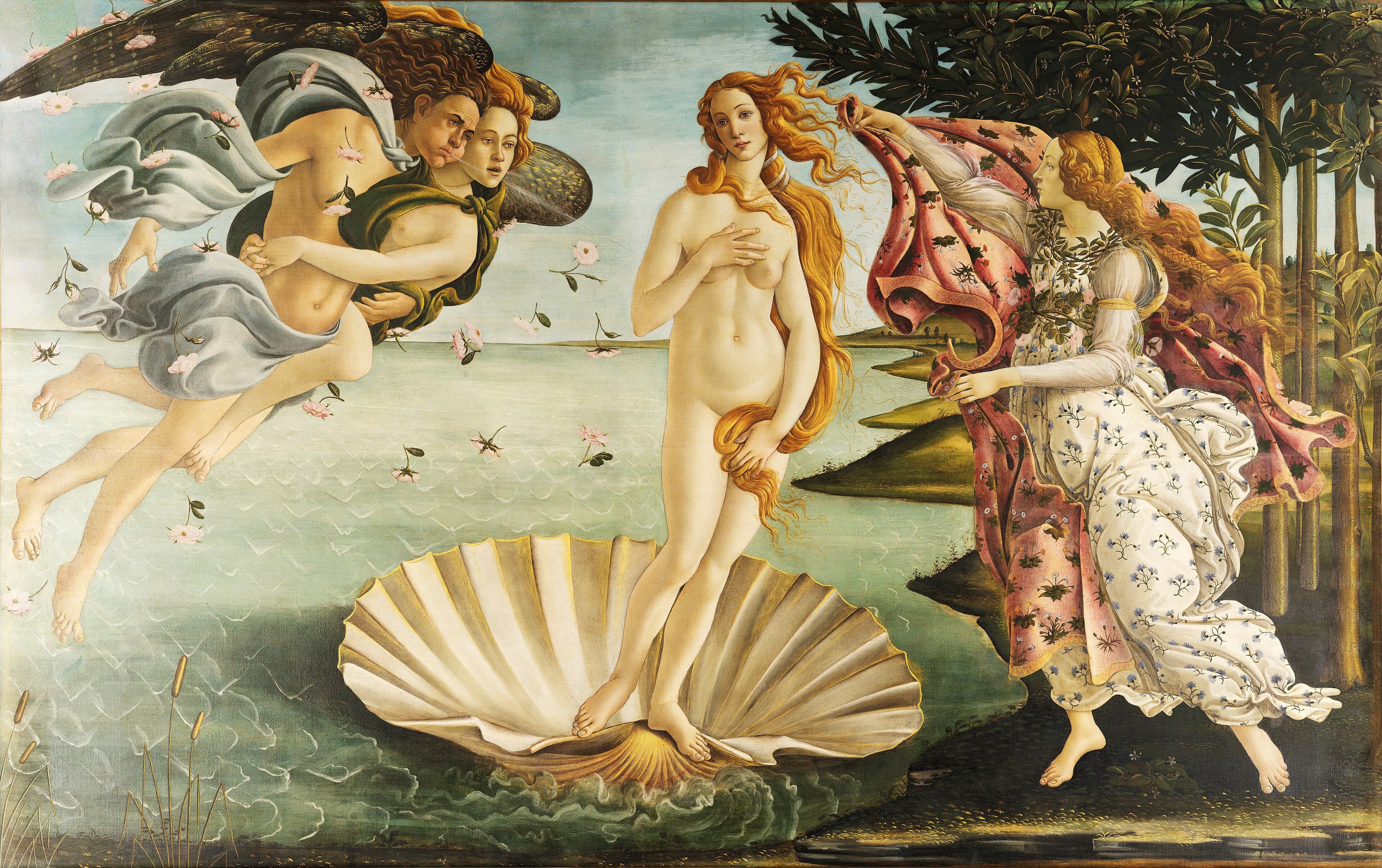
Strictly, the subject is not Venus's birth but her arrival: carried on her shell to the shore of Cyprus after being born from the foam of the sea, as told by Hesiod. It belongs to a long tradition, from antiquity to Botticelli's Birth of Venus and Cabanel's sensational version at the Salon of 1863.
For Bouguereau's admirers, the painting represented timeless ideal beauty. For the avant-garde, including the Impressionists, it stood for everything they rejected: polished surfaces, mythological pretexts for erotic nudes, and official taste. His reputation collapsed in the twentieth century and has partly recovered since the 1980s.
Where to see it
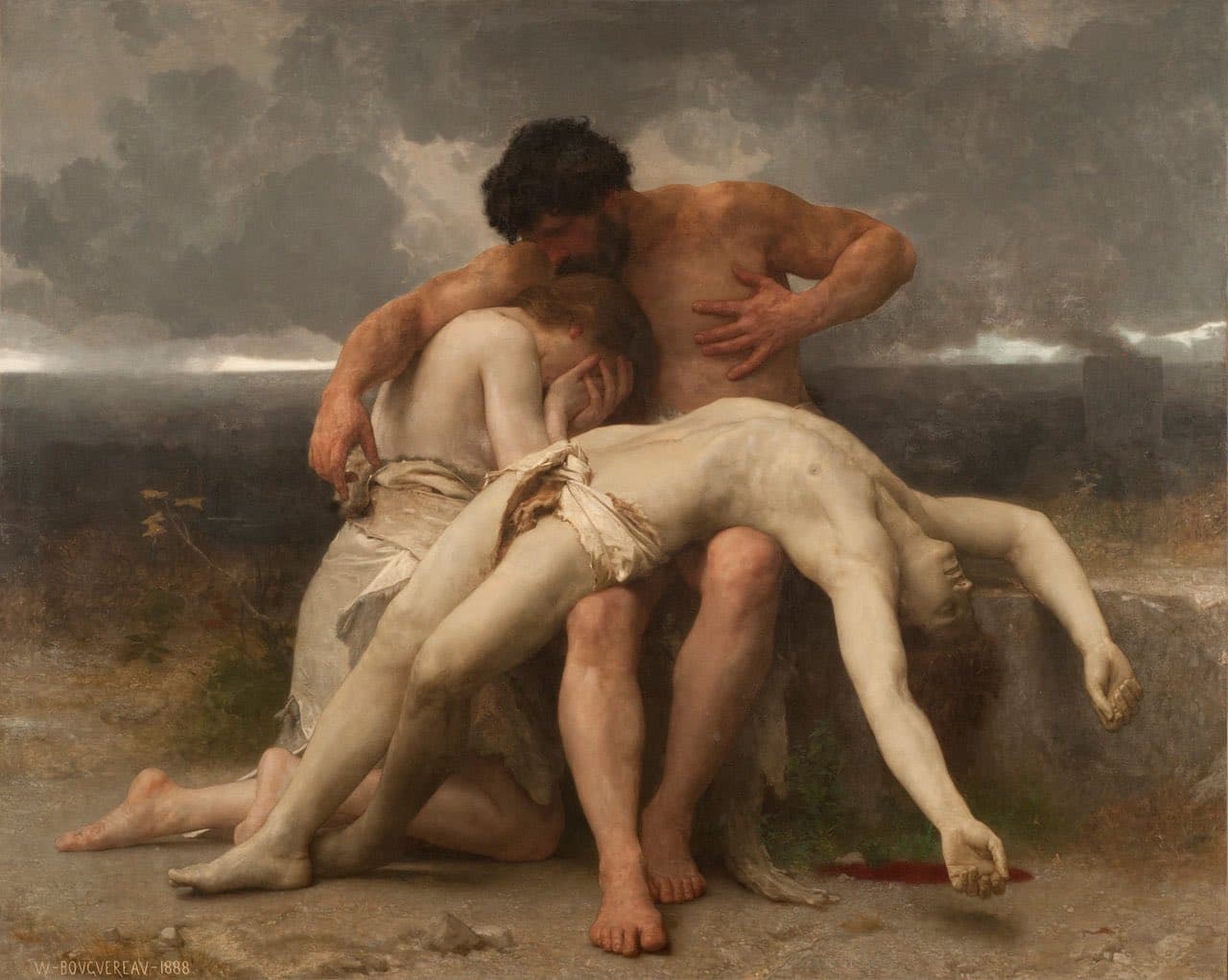
The painting hangs in the Musée d'Orsay in Paris. See also Bouguereau's Premier Deuil, our Academic Art and Greek Mythology in Art collections.
Questions & answers
Where is Bouguereau's Birth of Venus?
It hangs in the Musée d'Orsay in Paris. Bouguereau exhibited the painting at the Salon of 1879, and the French state bought it. The canvas is three meters tall and remains one of the best-known academic paintings in the museum.
What is the difference between Bouguereau's and Botticelli's Birth of Venus?
Botticelli's painting of about 1485, in the Uffizi, is a delicate, linear Renaissance image with Venus alone on her shell, blown ashore by winds. Bouguereau's 1879 version is a crowded, high-finish academic composition with nymphs, tritons and cupids around her, inspired by Raphael.
What does Bouguereau's Birth of Venus show?
It shows Venus, goddess of love, standing on a scallop shell after her birth from the sea foam, wringing out her hair. Sea nymphs and tritons surround her, one blowing a conch, while cupids fly overhead and ride a dolphin below, celebrating her arrival.
More by the artist
William-Adolphe Bouguereau
Kindred works
You may also study
The Birth of Venus
Sandro Botticelli · c. 1484–1486
Psyche in the Temple of Love
Edward John Poynter · 1882
The Three Graces
Antonio Canova · 1814–17
Fallen Angel
Alexandre Cabanel · 1847

Bridge over a Pond of Water Lilies
Claude Monet · 1899

Venus de Milo
Alexandros of Antioch · c. 150–125 BC

Nymphs Dancing to Pan's Flute
Joseph Tomanek

The Thinker
Auguste Rodin · Modeled 1880–82; enlarged 1902–03; this cast 1904