Italian (Florentine) · Early Renaissance
Sandro Botticelli
b. c. 1445, Florence — d. 17 May 1510, Florence
Sandro Botticelli (c. 1445–1510) was the Florentine Renaissance painter of The Birth of Venus and Primavera, both in the Uffizi, whose flowing line and melancholy grace made him the favorite artist of Medici Florence.
1 work in the collection
Works by Sandro Botticelli
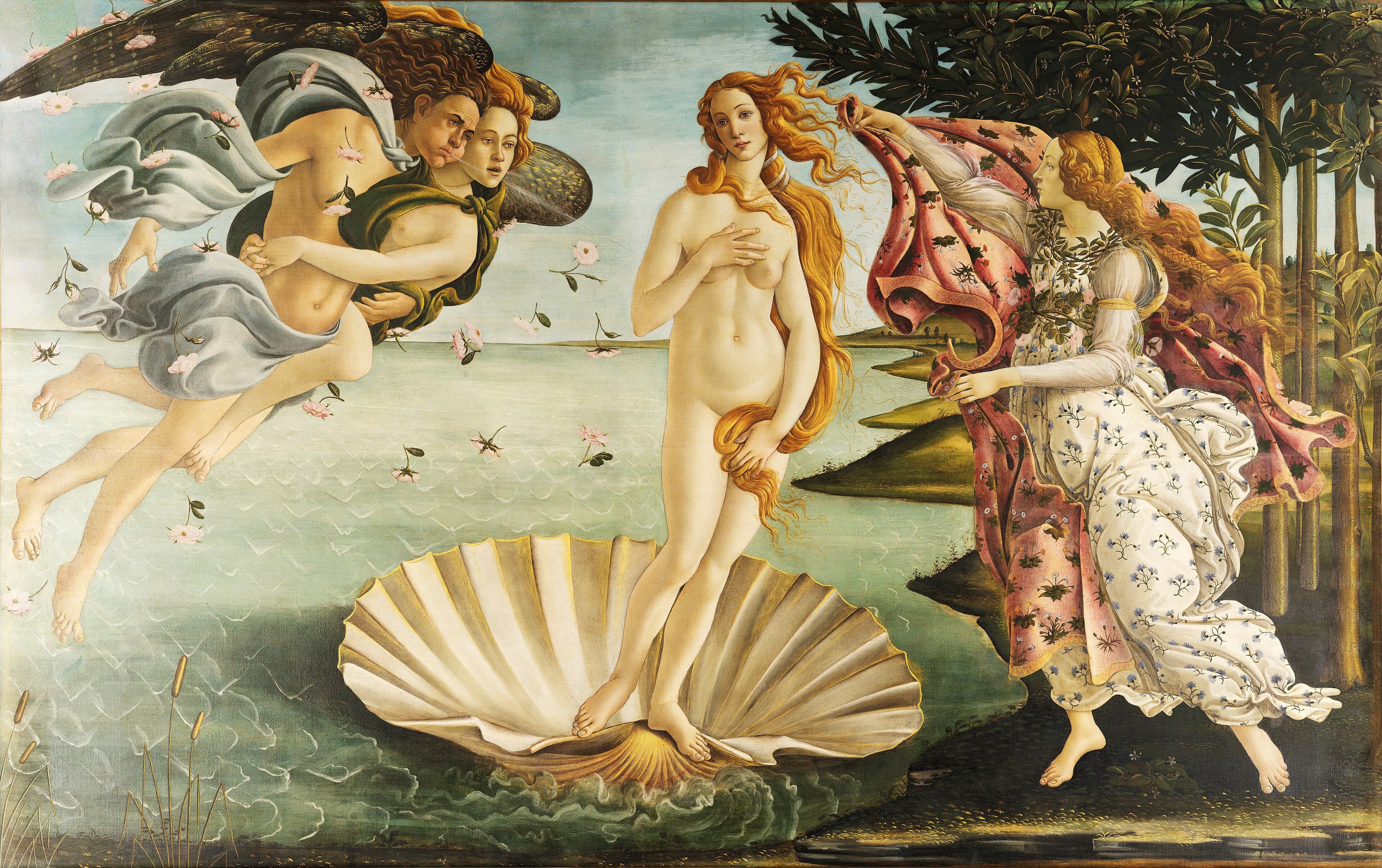
Sandro Botticelli was a painter of the Early Renaissance in Florence, working for the Medici family and their circle in the last decades of the fifteenth century. His two most famous paintings, The Birth of Venus (c. 1484–86) and Primavera (c. 1480), hang in the Uffizi Gallery in Florence, where they draw some of the largest crowds of any paintings in Italy.
Life in brief
Alessandro di Mariano di Vanni Filipepi was born in Florence around 1445, the son of a tanner, and lived almost his whole life in the same neighborhood near the church of Ognissanti. The name Botticelli, “little barrel,” seems to have come from the nickname of his elder brother Giovanni. He may have begun as an apprentice goldsmith before entering the workshop of the painter Fra Filippo Lippi in the early 1460s, and he was also close to the circle of Andrea del Verrocchio, where Leonardo da Vinci trained. By 1470 he had his own workshop and his first public commission, the figure of Fortitude for the merchants' tribunal (now Uffizi).
The Medici and their relatives became his chief patrons. His Adoration of the Magi (c. 1475, Uffizi) includes portraits of members of the family and, at the right edge, a young man in a yellow cloak looking straight at us, generally accepted as a self-portrait. In 1481–82 he was one of the painters summoned to Rome to fresco the walls of the new Sistine Chapel, decades before Michelangelo painted the ceiling above; Botticelli contributed three large scenes, including The Punishment of Korah.
In the 1490s Florence was shaken by the preaching of the Dominican friar Girolamo Savonarola, who attacked luxury and pagan art. Botticelli's late paintings turn intense and devotional, and Vasari claimed he became one of Savonarola's followers, though how far he did is debated. His Mystic Nativity (1500–01, National Gallery, London), with a Greek inscription referring to the troubles of Italy and the Apocalypse, is his only signed and dated painting. He worked less in his last years and died in 1510, buried in Ognissanti.
Style and technique
Botticelli's art is built on line. Contours flow and curl; hair, drapery and ribbons move in rhythmic arabesques, often more decorative than real. His figures have elongated necks, sloping shoulders and pale, wistful faces, and they seem to float rather than stand. He paid little attention to the scientific perspective and anatomy that fascinated many contemporaries; Leonardo even mocked his perfunctory landscapes in his notes. What Botticelli offered instead was poetic mood.
He painted mainly in tempera, egg-bound pigment, often finished with gold highlights. The Birth of Venus is unusual in being painted on canvas, then a cheaper support often used for decoration in country villas.
The Birth of Venus and Primavera
In The Birth of Venus, the goddess of love, newly born from the sea, stands on a scallop shell as it is blown ashore by the wind god Zephyr, embraced by a female companion, while a Hora (goddess of the seasons) waits on land to cover her with a flowered cloak. Her pose, one hand at her breast and one at her groin, adapts the ancient Venus pudica type known from classical sculpture. Details reward close looking: the sea is drawn as rows of small V-shaped strokes rather than painted as water, pink roses tumble through the air on Zephyr's breath, and touches of real gold pick out strands of Venus's hair and the leaves of the trees.
Primavera shows Venus in an orange grove with the Three Graces, Mercury, Flora and Zephyr seizing the nymph Chloris. Both paintings are usually connected with the Neoplatonic philosophy of Marsilio Ficino and the poetry of Angelo Poliziano, in which earthly beauty leads the soul toward divine love. The popular claim that Venus portrays the Florentine beauty Simonetta Vespucci is a nineteenth-century romance without evidence.
Other key works
- Pallas and the Centaur (c. 1482, Uffizi).
- Venus and Mars (c. 1485, National Gallery, London), the god of war asleep while baby satyrs play with his armor.
- The Calumny of Apelles (c. 1494–95, Uffizi), reconstructing a lost ancient painting.
- Drawings illustrating Dante's Divine Comedy, now divided between Berlin and the Vatican, including the famous map of Hell.
Influence
After his death Botticelli was largely forgotten, overshadowed by the High Renaissance. He was rediscovered in Victorian England, where the Pre-Raphaelites, John Ruskin and Walter Pater praised his linear grace; Dante Gabriel Rossetti owned a Botticelli portrait. His Venus has since become one of the most quoted images in art, echoed in paintings such as Bouguereau's Birth of Venus and in endless modern parodies.
Where to see his work
The Uffizi holds the greatest concentration, including The Birth of Venus, Primavera and the Adoration of the Magi. The Sistine Chapel frescoes are in the Vatican; the National Gallery in London, the Gemäldegalerie in Berlin and the National Gallery of Art in Washington also own major works. Explore Renaissance Paintings, Greek Mythology in Art and The Pre-Raphaelites.
Questions & answers
What is Botticelli most famous for?
Botticelli is most famous for The Birth of Venus (c. 1484–86) and Primavera (c. 1480), mythological paintings of unprecedented grace made for the Medici circle, both now in the Uffizi, Florence. He also painted frescoes in the Sistine Chapel and many altarpieces and Madonnas.
Where is The Birth of Venus?
The Birth of Venus is in the Uffizi Gallery in Florence, Italy. Painted in tempera on canvas and measuring about 172.5 by 278.5 cm, it is first recorded in the sixteenth century at the Medici villa of Castello and entered the Uffizi in 1815.
Who was the model for Botticelli's Venus?
There is no evidence for any single model. The idea that Venus portrays Simonetta Vespucci, a celebrated Florentine beauty who died in 1476, became popular in the nineteenth century, but historians regard it as legend. Her face follows Botticelli's ideal type, which recurs across his work.
Did Botticelli burn his paintings?
According to a tradition reported by Vasari, Botticelli became a follower of Savonarola and may have destroyed some of his own secular works in the bonfires of the vanities of 1497–98. There is no firm evidence that he burned his own paintings, and his great mythologies survived.
Where can I see Botticelli's paintings?
The Uffizi Gallery in Florence has the largest collection, including The Birth of Venus and Primavera. His frescoes are in the Sistine Chapel in the Vatican, and the National Gallery in London, the Gemäldegalerie in Berlin and the National Gallery of Art in Washington hold major works.