British · Pre-Raphaelite
John Everett Millais
b. 8 June 1829, Southampton, England — d. 13 August 1896, London, England
Sir John Everett Millais (1829–1896) was an English painter, a child prodigy who co-founded the Pre-Raphaelite Brotherhood in 1848, painted Ophelia, and ended his life as the most successful artist in Britain and President of the Royal Academy.
2 works in the collection
Works by John Everett Millais

John Everett Millais was born in Southampton in 1829 and was one of the founders of the Pre-Raphaelite Brotherhood, the group of young painters who set out to replace academic convention with sharp, truthful observation of nature. He later became the wealthiest and most popular painter in Victorian Britain, and in the last months of his life he was President of the Royal Academy.
Life in brief
Millais was a prodigy. At eleven he became the youngest student ever admitted to the Royal Academy Schools. In 1848, with William Holman Hunt and Dante Gabriel Rossetti, he founded the Pre-Raphaelite Brotherhood at his family's house on Gower Street, London. His Christ in the House of His Parents (1849–50) was attacked for showing the Holy Family as ordinary working people; Charles Dickens was among its fiercest critics. In 1855 he married Effie Gray, whose earlier marriage to the critic John Ruskin had been annulled. From the 1860s he moved toward broader brushwork, portraits and popular subjects, was made a baronet in 1885, and was elected President of the Royal Academy in 1896, shortly before his death from throat cancer.
Style
Early Millais is all precision: every leaf, petal and fold painted from life over a wet white ground so the colors glow. Ophelia (1851–52, Tate Britain), its riverbank painted outdoors in Surrey over months, is the purest example of the Pre-Raphaelite method. His later style is looser and warmer, closer to Velázquez and Reynolds, and aimed at a wide public, as in Bubbles (1886), used to advertise Pears soap.
Key works
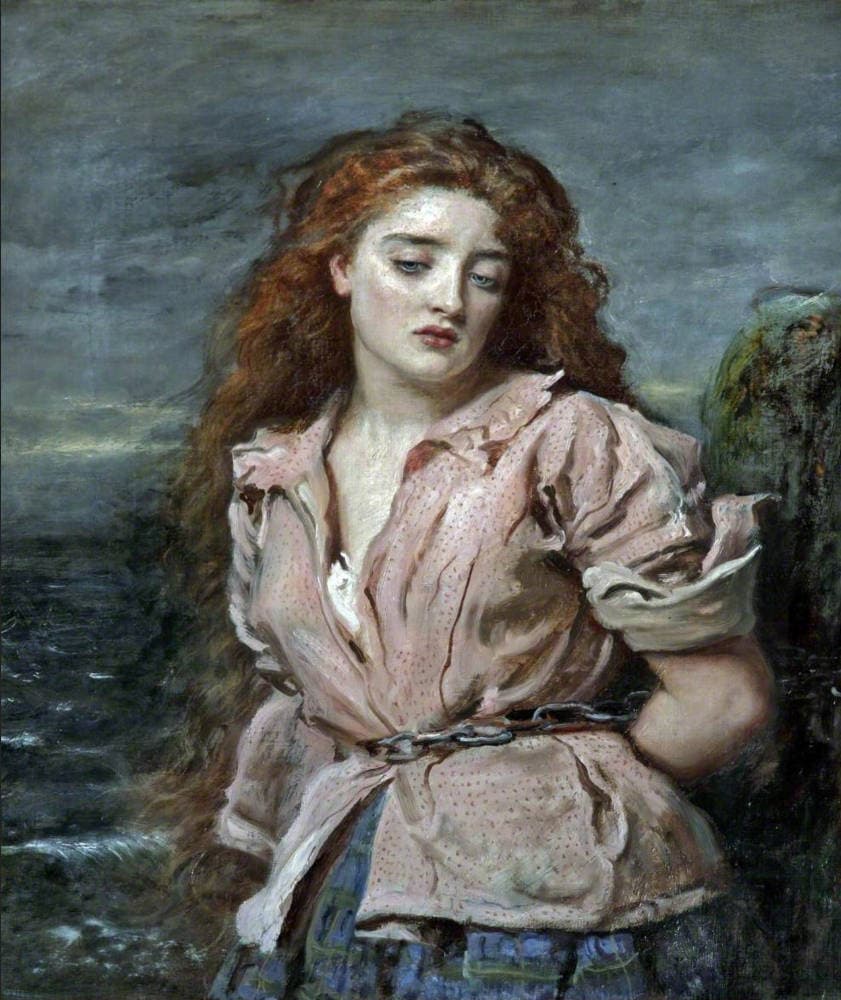
Beyond Ophelia, his best-known pictures include Mariana (1851), The Blind Girl (1856) and The Boyhood of Raleigh (1870). The Martyr of the Solway (1871, Walker Art Gallery, Liverpool) shows Margaret Wilson, a young Scottish Covenanter chained to a stake in 1685 to drown in the rising tide; Millais makes the picture a single still figure, her calm set against the cold water.
Where to see his work
Tate Britain in London has the largest group, including Ophelia and Christ in the House of His Parents. The Walker Art Gallery in Liverpool, the Lady Lever Art Gallery and Manchester Art Gallery also hold major works. See more in The Pre-Raphaelites.
Questions & answers
What is John Everett Millais famous for?
Millais is famous as a founder of the Pre-Raphaelite Brotherhood in 1848 and for Ophelia (1851–52), now in Tate Britain. He later became the most successful painter in Victorian Britain and President of the Royal Academy in 1896.
Where is The Martyr of the Solway?
Millais's The Martyr of the Solway (1871) is in the Walker Art Gallery, Liverpool. It shows Margaret Wilson, a young Covenanter executed by drowning in the Solway Firth in 1685.
Who did Millais marry?
In 1855 Millais married Effie Gray, after her marriage to the critic John Ruskin was annulled. They had eight children, and Effie often managed his business affairs.