French · Academic art
William-Adolphe Bouguereau
b. 30 November 1825, La Rochelle, France — d. 19 August 1905, La Rochelle, France
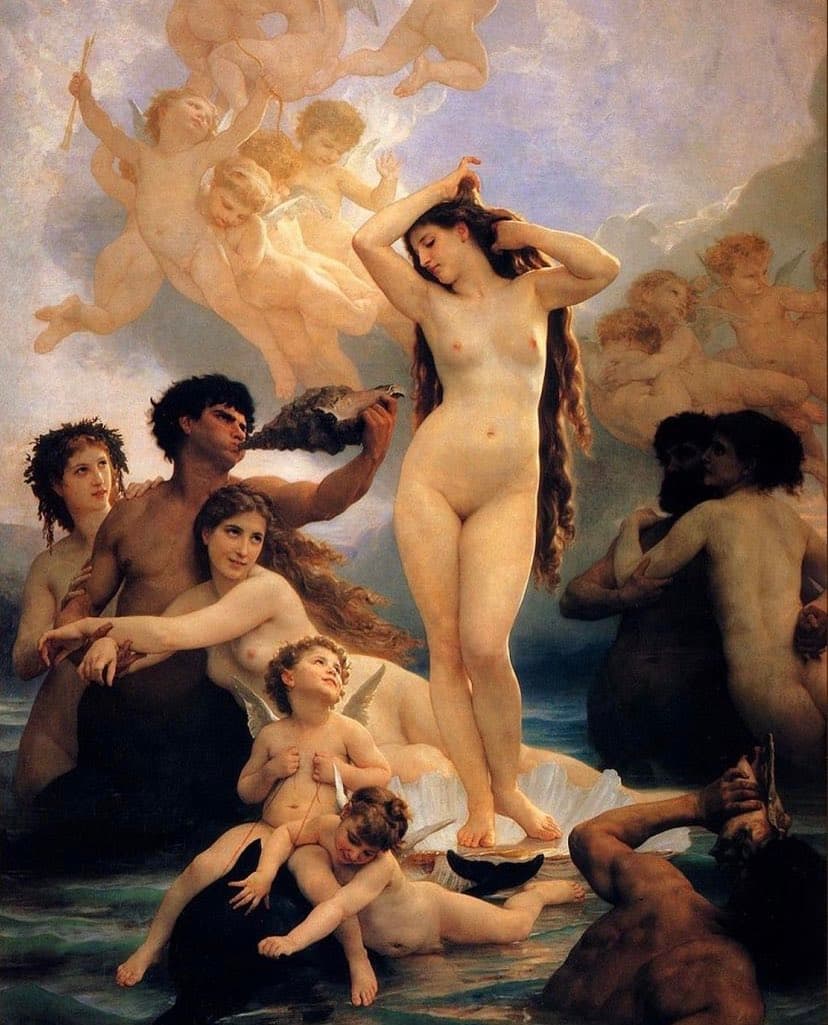
William-Adolphe Bouguereau (1825–1905) was the leading French academic painter of his age, famed for flawless, luminous nudes and mythological scenes such as The Birth of Venus (1879), and later dismissed, then rediscovered, as modernism's foil.
2 works in the collection
Works by William-Adolphe Bouguereau
William-Adolphe Bouguereau was a French painter born in La Rochelle in 1825 who became the most successful academic artist of nineteenth-century France. His mythological nudes, religious scenes and sentimental pictures of peasant children, painted with porcelain-smooth finish and idealized anatomy, dominated the Paris Salon for decades and sold for high prices, especially to American collectors.
Life in brief
Bouguereau trained in Bordeaux and then at the École des Beaux-Arts in Paris under François-Édouard Picot. In 1850 he won the Prix de Rome and spent several years at the French Academy in Rome, studying Raphael and antiquity. Back in Paris, Salon medals and state commissions followed; he decorated churches and mansions, became a member of the Académie des Beaux-Arts in 1876 and taught for many years at the Académie Julian, where many foreign students, including women, trained under him. His private life was marked by loss: several of his children died young, and his first wife died in 1877. In 1896 he married his pupil, the American painter Elizabeth Jane Gardner. He died in La Rochelle in 1905.
Style and reputation
Bouguereau worked slowly from careful drawings, building up smooth layers so that no brushstroke shows. His figures are drawn with complete anatomical assurance, lit evenly and set in clear compositions derived from Raphael. To the Impressionists and their supporters this finish stood for everything stale in official art, and after his death his reputation collapsed. Since the 1980s exhibitions and the market have restored him as a superb technician and a key figure for understanding the period.
Key works
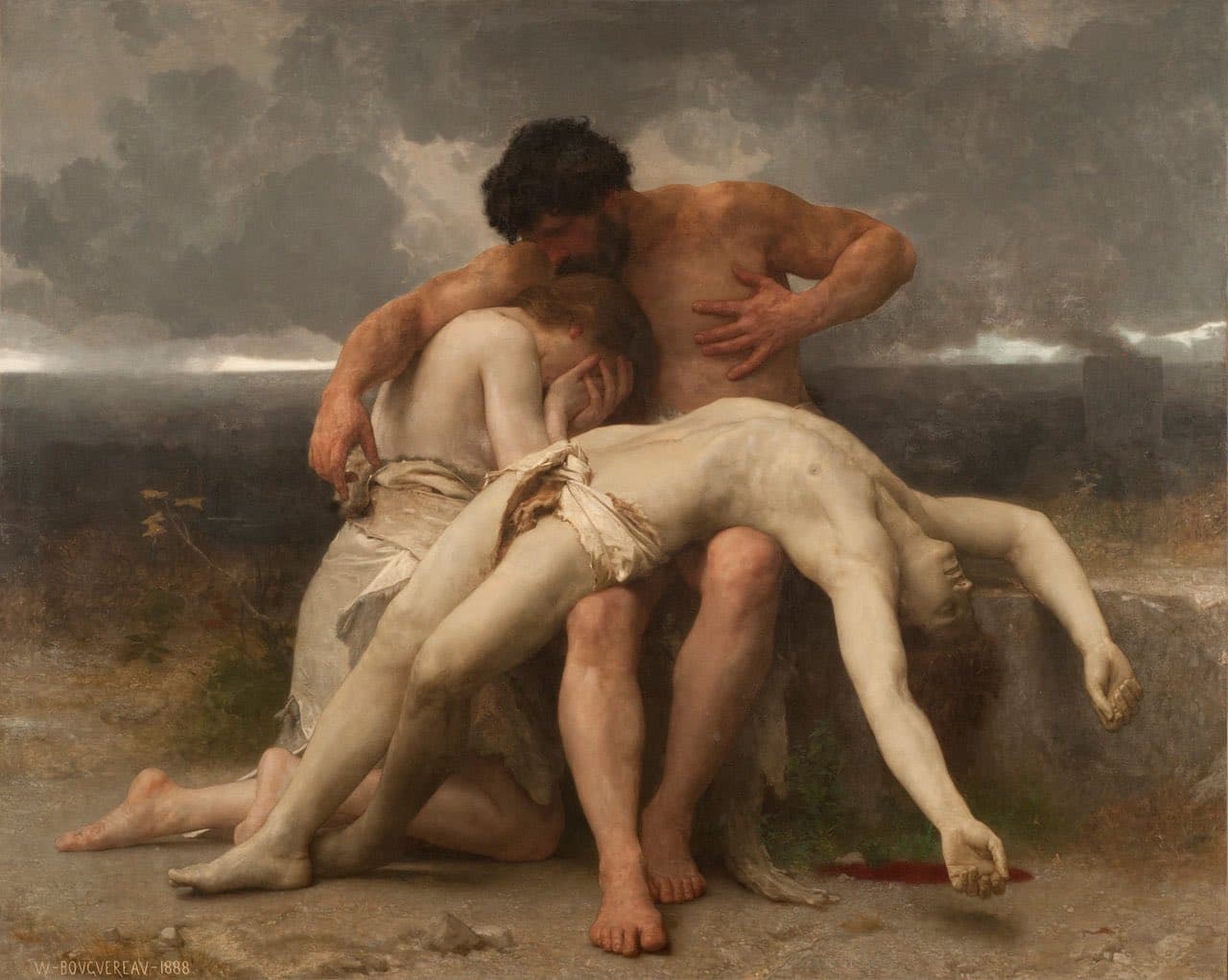
The Birth of Venus (1879, Musée d'Orsay, Paris) shows Venus standing on a scallop shell, wringing out her hair, surrounded by nymphs, tritons and cupids. Despite the title, she has already been born from the sea; the picture shows her arrival, carried toward Cyprus. Compare Botticelli's Birth of Venus and Alexandre Cabanel's version of 1863. The First Mourning (Premier Deuil, 1888, Museo Nacional de Bellas Artes, Buenos Aires) shows Adam and Eve grieving over the body of Abel, the first human death in the Bible; Adam holds his son's limp body while Eve buries her face in his shoulder. Painted after his own bereavements, it is among his most deeply felt works.
Where to see his work
The Musée d'Orsay in Paris, the Musée des Beaux-Arts in La Rochelle, the Clark Art Institute in Williamstown, the Metropolitan Museum of Art and many American museums hold his paintings. See more in Academic Art and Greek Mythology in Art.
Questions & answers
What is Bouguereau's most famous painting?
Bouguereau's most famous painting is The Birth of Venus (1879), in the Musée d'Orsay, Paris, showing Venus on a shell surrounded by nymphs and tritons. Nymphs and Satyr (1873) and The First Mourning (1888) are also widely known.
Where is Bouguereau's Premier Deuil (The First Mourning)?
The First Mourning (1888), showing Adam and Eve grieving over the dead Abel, is in the Museo Nacional de Bellas Artes in Buenos Aires, Argentina.
Why was Bouguereau's reputation lost?
As the leading academic painter, Bouguereau came to stand for everything the Impressionists and modernists rejected: polished finish, idealized figures and official taste. After his death critics dismissed him, but since the 1980s exhibitions and scholarship have restored his standing as a master technician.