Neoclassicism
The Three Graces
Antonio Canova, 1814–17
The Three Graces is a marble group by Antonio Canova of Zeus's daughters in an embrace. This 1814–17 version, made for the Duke of Bedford, is jointly owned by the V&A and National Galleries of Scotland; the first is in the Hermitage.
- Artist
- Antonio Canova
- Date
- 1814–17
- Medium
- Marble
- Dimensions
- 173 × 97.2 × 57 cm
- Collection
- Scottish National Gallery and Victoria and Albert Museum (jointly owned), Edinburgh / London, United Kingdom
- Movement
- Neoclassicism
Antonio Canova's The Three Graces is a life-size marble group of the three daughters of Zeus, the Charites, wrapped in a single embrace. Canova carved it twice. The version on this page, made between 1814 and 1817 for John Russell, 6th Duke of Bedford, stands 173 centimeters high and is jointly owned by the Victoria and Albert Museum in London and the National Galleries of Scotland, which display it in turn. The first version, made in 1813–16 and commissioned by the Empress Joséphine, is in the State Hermitage Museum in St Petersburg.
Who the Three Graces were
In Greek myth, the Graces (Charites) were minor goddesses of charm, beauty and joy, usually named as the daughters of Zeus and the sea nymph Eurynome. The poet Hesiod names them Aglaea (splendor or elegance), Euphrosyne (mirth) and Thalia (youth, good cheer and abundance). They attended Aphrodite and the Muses and presided over banquets, dance and festivity. From antiquity on, they were shown together, often naked and holding one another, as an image of generosity: grace given, received and returned.
Canova follows the identification found on early engravings of the work, which name the figures from left to right as Euphrosyne, Aglaea and Thalia. The sculpture itself carries no labels.
What you are looking at
The three young women stand close together on a low oval base. The two outer figures turn inward toward the central one, and all three lean their heads together so that their faces almost touch. Their arms cross and interlace: one Grace rests her hand on another's shoulder, a third reaches across to touch a cheek. A single long scarf passes between them, falling down the center and looping around the hips, the only covering in the group.
Behind the left-hand figure stands a small, square pillar or altar, which steadies the composition and, in practical terms, helps support the weight of marble. The figures' weight shifts from foot to foot, giving the group a gentle sway, and the curves of hips, backs and arms repeat each other like a slow dance.
The surface is the real achievement. Canova's workshop polished the skin to a soft sheen and, according to accounts of his practice, he finished his marbles with a thin wax or tinted patina to warm their tone. The hair, tied up in classical knots, is carved crisply and left slightly rougher, so that it catches light differently. Walk around the group and the poses change completely: the work was designed to be seen in the round, and Canova liked his marbles to be shown by lamplight and on turning stands so that viewers could follow the contours.
How it was made
Canova, the most celebrated sculptor in Europe, began the first version for Joséphine de Beauharnais, the former wife of Napoleon. After her death in 1814 it passed to her son Eugène de Beauharnais and eventually to the Russian imperial collection. The Duke of Bedford visited Canova's studio in Rome, admired the group, and commissioned a second version, begun in 1814 and completed in 1817. It was installed in 1819 in a purpose-built Temple of the Graces at Woburn Abbey, the Bedford family seat.
The two versions differ in small details: the position of the altar, the arrangement of the drapery, the treatment of the hair. Canova was not making a copy but revisiting and refining his own design.
Meaning and interpretation
For Canova and his patrons, the Graces represented ideal beauty in the Neoclassical sense: calm, harmonious, timeless, drawn from ancient models but more refined than any of them. The group can also be read as an image of friendship and harmony, three bodies forming one unit. Its sensuality was always part of its appeal, and critics have long debated where its cool idealism ends and its intimacy begins.
The fight to keep it in Britain
In 1989 the Woburn Graces were sold to an overseas buyer, and the British government placed an export bar on them. After a long public campaign, the sculpture was bought in 1994 for the nation, jointly by the V&A and the National Galleries of Scotland, with support from the Art Fund, the Heritage Lottery Fund and private donors. Since then it has alternated between Edinburgh and London.
Canova and the Graces tradition
Canova was working in a long line. The best-known ancient prototype, a Roman marble group in which the outer Graces face us and the central one turns her back, was copied endlessly in the Renaissance, and painters from Raphael to Rubens reinterpreted it. Canova broke with that formula. He turned all three figures inward, toward each other and away from the viewer, so that the group seems absorbed in its own private moment. That inward turn, together with the softness of the carving, is what made contemporaries describe the work as more tender and more modern than its classical sources.
Where to see it
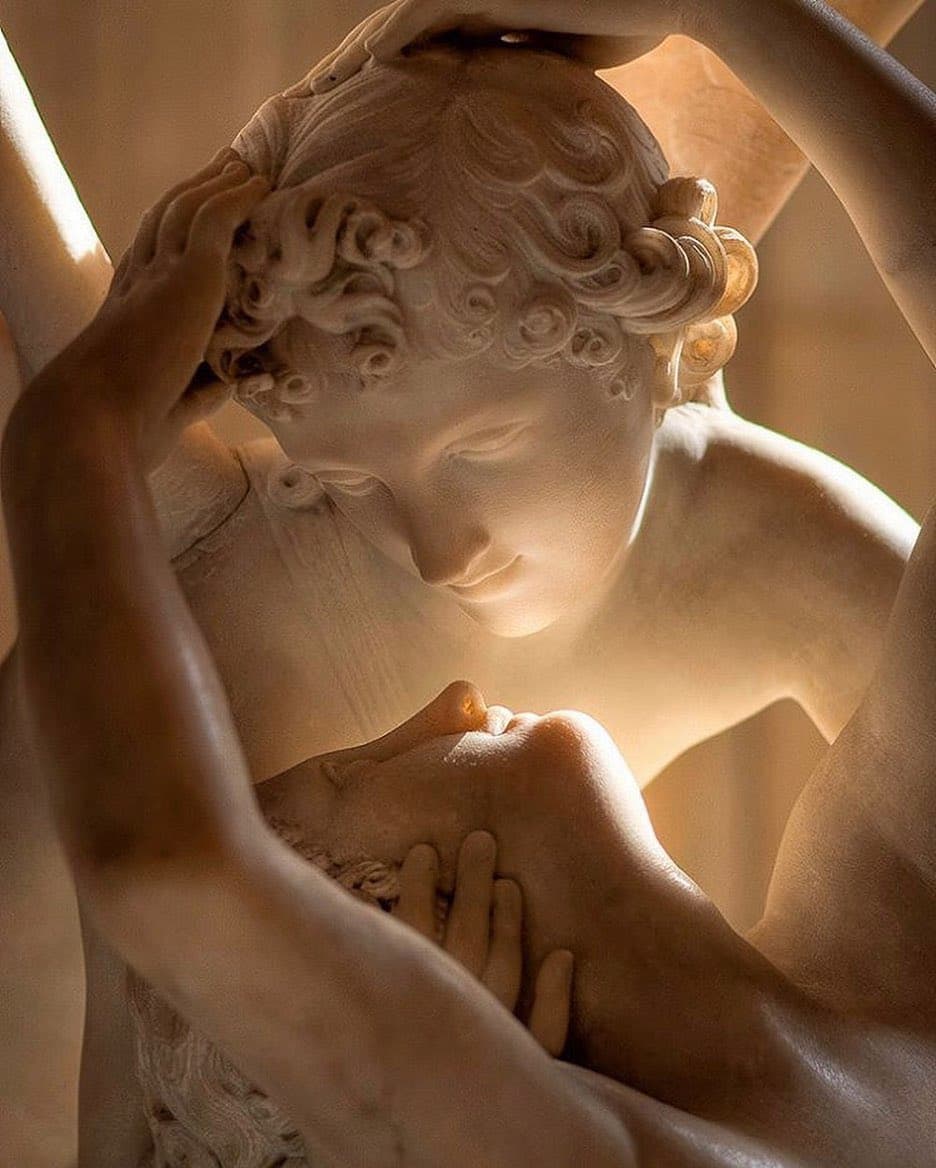
The Woburn version is displayed in rotation at the Scottish National Gallery in Edinburgh and the V&A in London. The first version is in the Hermitage, St Petersburg. For other works by Canova in the catalogue, see Psyche Revived by Cupid's Kiss, Cupid and Psyche, and compare Jean-Jacques Pradier's Les Trois Graces. More in famous sculptures.
Questions & answers
Where is Canova's The Three Graces?
There are two versions. The 1814–17 marble made for the Duke of Bedford is jointly owned by the Victoria and Albert Museum in London and the National Galleries of Scotland, and alternates between them. The first version, made for the Empress Joséphine, is in the Hermitage in St Petersburg.
Who are the Three Graces in Canova's sculpture?
They are the Charites, daughters of Zeus: Euphrosyne (mirth), Aglaea (elegance or splendor) and Thalia (youth and good cheer). Early engravings name them in that order from left to right, although the sculpture itself has no inscriptions identifying the figures.
What does Canova's The Three Graces symbolize?
The group stands for beauty, joy and generosity, the gifts the Graces were believed to give humankind. Their interlocking embrace also suggests harmony and friendship, and for Canova it embodied the Neoclassical ideal of calm, perfected beauty drawn from ancient art.
How tall is Canova's The Three Graces?
The Woburn version measures about 173 centimeters high, 97 centimeters wide and 57 centimeters deep, slightly under life size. It is carved in white marble and was designed to be viewed from all sides, so that the poses change as you walk around it.
More by the artist
Antonio Canova
Kindred works
You may also study
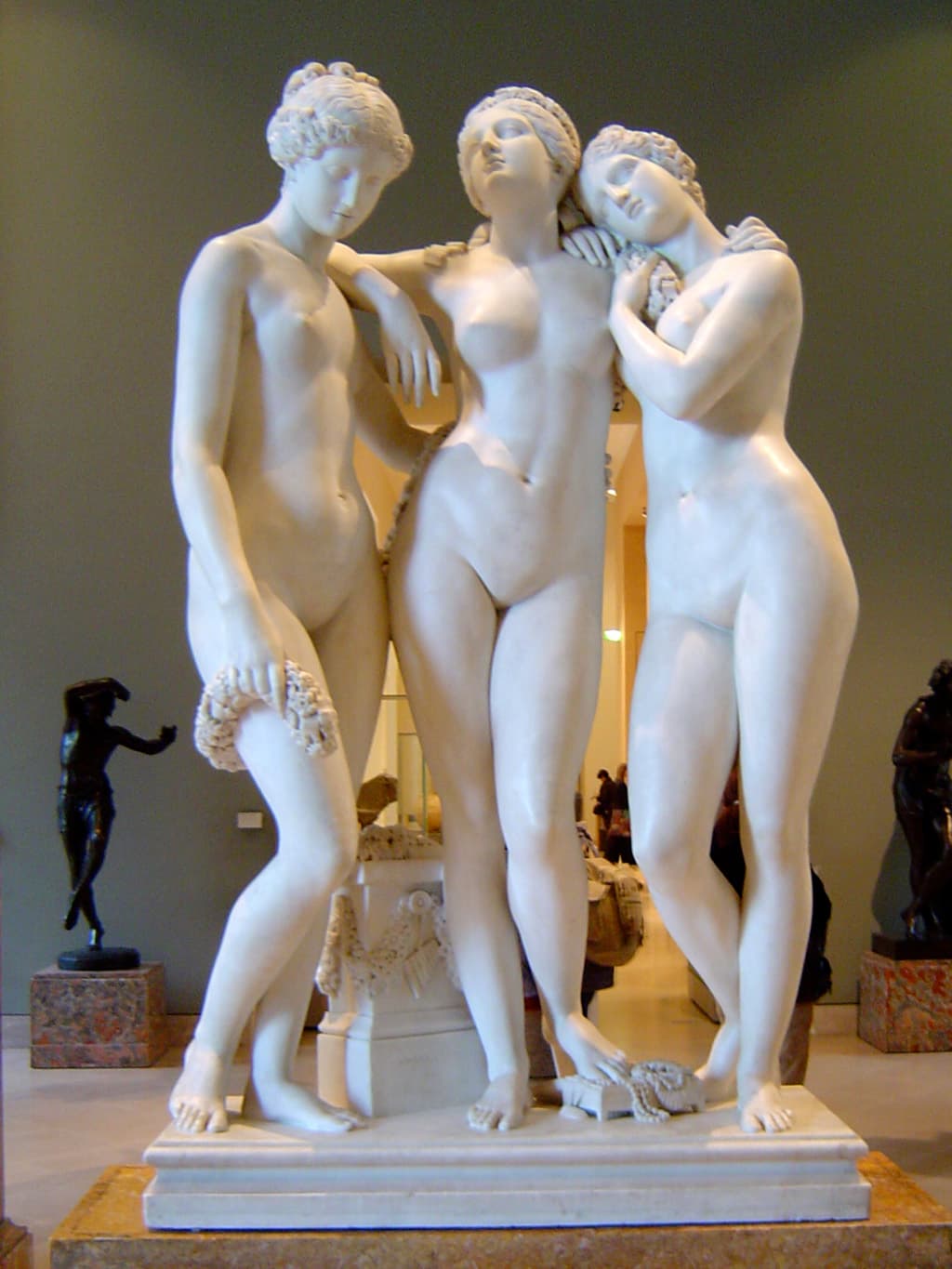
The Three Graces
James Pradier · 1831
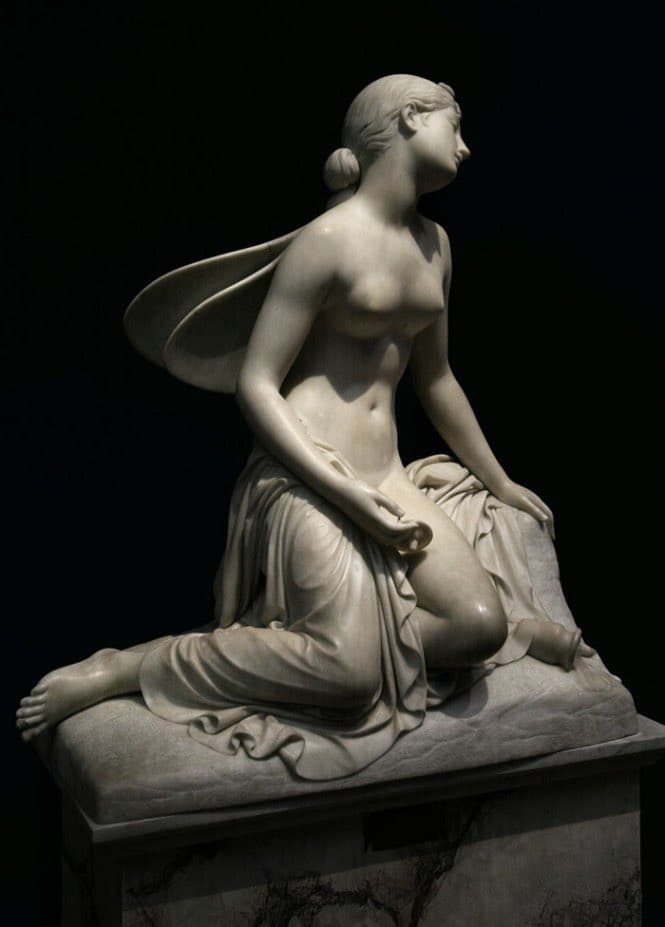
Psyche in a Faint
Pietro Tenerani · composition c. 1822
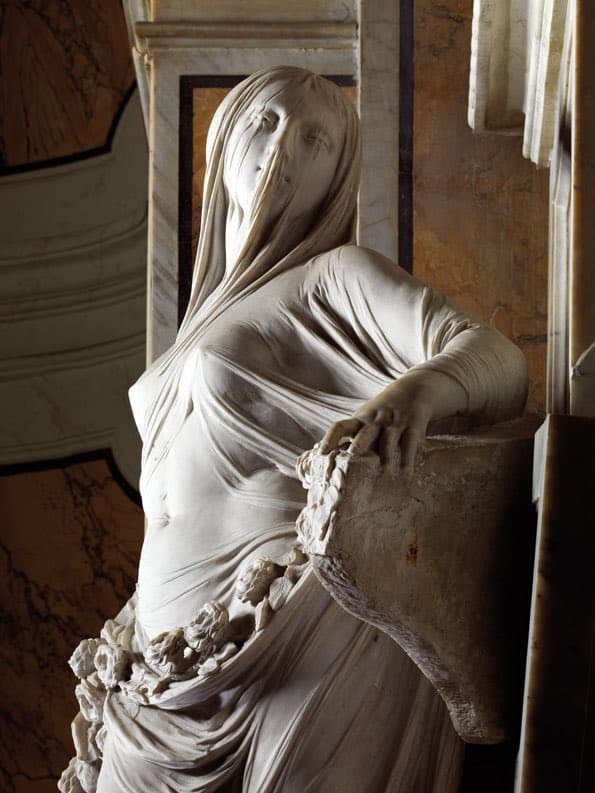
Modesty (La Pudicizia)
Antonio Corradini · 1752

Venus de Milo
Alexandros of Antioch · c. 150–125 BC

Nymphs Dancing to Pan's Flute
Joseph Tomanek

The Thinker
Auguste Rodin · Modeled 1880–82; enlarged 1902–03; this cast 1904

Saturn Devouring His Son
Francisco Goya · c. 1819–1823
The Creation of Adam
Michelangelo · c. 1511–12