Neoclassicism
Psyche Revived by Cupid's Kiss
Antonio Canova, 1787–1793
Psyche Revived by Cupid's Kiss is a marble group by Antonio Canova, carved 1787–1793, showing Cupid lifting the unconscious Psyche to wake her with a kiss. The first version is in the Louvre, Paris; a second is in the Hermitage.
- Artist
- Antonio Canova
- Date
- 1787–1793
- Medium
- Marble
- Dimensions
- 155 × 168 × 101 cm
- Collection
- Musée du Louvre, Paris, France
- Movement
- Neoclassicism
What you are looking at
Psyche lies half-reclined on a rock, her body twisting upward, her arms raised to encircle the head of the winged god bending over her. Cupid has just landed: his wings are still spread high behind him, one hand cradles her head, the other supports her breast. Their faces are about to meet. The photograph on this page is a close detail of that moment.
Cupid's head, framed by tight curls, tilts down over Psyche's upturned face; his eyes are lowered, his lips almost touching hers. Her fingers spread across his hair and the back of his head, pulling him in. The light catches his cheek, nose and lips and leaves the space between the two faces in soft shadow.
That space is the subject. Canova shows the instant before the kiss, when Psyche is returning to life but has not yet opened her eyes.
The story
The tale comes from The Golden Ass (also called the Metamorphoses) by the second-century Roman writer Apuleius. Psyche, a mortal princess so beautiful that people neglected the worship of Venus, became the secret wife of Cupid, the goddess's son, on condition that she never look at him. When she broke the promise he fled, and Psyche had to perform a series of impossible tasks set by Venus. The last was to fetch a box of beauty from Proserpina in the underworld.
Opening it out of curiosity, Psyche fell into a deathlike sleep. Cupid found her, wiped the sleep from her face and woke her with a prick of his arrow; later writers and artists turned the awakening into a kiss. Psyche was eventually made immortal and united with Cupid.
Psyche's name means "soul" in Greek, and the story was long read as an allegory of the soul purified by trials and brought to divine love.
Commission and history
The group was commissioned in 1787 by the Scottish collector Colonel John Campbell, later Lord Cawdor, and carved in Canova's studio in Rome between 1787 and 1793. Campbell never took delivery. In 1800–1801 it was bought by Joachim Murat, Napoleon's brother-in-law and later King of Naples, and after his death it entered the Louvre in 1824. Canova made a second version, now in the State Hermitage Museum in Saint Petersburg.
How it was made
Canova began with small terracotta sketches and a full-size plaster model; studio assistants then roughed out the marble using a pointing machine, and Canova himself carried out the final carving. He was famous for the finish: he worked the marble with fine rasps and pumice and is reported to have applied a thin wax patina so that the surface took on a warm, skin-like glow, often studied by candlelight. The group was also designed to be seen in the round; Canova's works were sometimes displayed on rotating stands.
Close looking
The composition is built from two crossing diagonals: Cupid's wings and body form one line from upper right to lower left, Psyche's raised arms and torso another. Where they cross, at the faces, is the heart of the piece. Around this point everything is open. Light passes between the arms, between the faces, through the gap under Cupid's wing, so the marble seems weightless.
In the detail shown here, notice the hands. Cupid's fingers support Psyche's head so lightly they barely press the hair. Psyche's fingers, in contrast, are spread wide and firm against his skull: she is the one holding on. Notice too the curls on Cupid's head, each a separate drilled spiral, set against the smooth, polished planes of his face.
Canova in Rome
Antonio Canova (1757–1822) was born in Possagno in the Veneto and trained in Venice before moving to Rome in 1781, where he quickly became the leading sculptor in Europe. His clients included popes, Napoleon and his family, and British collectors on the Grand Tour, like Colonel Campbell. Canova's studio was itself a sight for visitors, who came to watch the work in progress and see finished pieces by torchlight. Psyche Revived was one of the works that made his international reputation and fixed the image of Neoclassical sculpture for a generation.
What does it mean?
For Canova's contemporaries the group was a perfect example of Neoclassicism: a subject from antiquity treated with clarity, restraint and idealized beauty, influenced by Winckelmann's call for "noble simplicity and quiet grandeur." Yet it is also intensely sensual, and that tension is why it still affects viewers. It is about love as rescue and awakening, the moment of passing from death to life, and it trusts the viewer to supply the kiss that never quite happens.
Related works
Compare Canova's other treatments of the theme in Cupid and Psyche and his The Three Graces. For the moment before the awakening, see Psyche in a Faint by Pietro Tenerani and Edward Poynter's Psyche in the Temple of Love. Rodin's very different kiss is on The Eternal Idol. More in Famous Sculptures.
Where to see it
The first version is in the Louvre, Department of Sculptures, Denon wing, ground floor (inventory MR 1777). The second version is in the Hermitage, Saint Petersburg.
Questions & answers
Where is Psyche Revived by Cupid's Kiss?
The first version is in the Musée du Louvre in Paris, in the Department of Sculptures on the ground floor of the Denon wing (inventory MR 1777). It entered the Louvre in 1824. A second version by Canova is in the State Hermitage Museum, Saint Petersburg.
What is the story of Cupid and Psyche?
In Apuleius's Golden Ass, the mortal Psyche marries Cupid but loses him after breaking his rule never to look at him. Venus sets her impossible tasks; the last leaves her in a deathlike sleep, from which Cupid revives her. She is then made immortal and united with him.
When did Canova make Psyche Revived by Cupid's Kiss?
Canova carved it in Rome between 1787 and 1793, after a commission from the Scottish collector Colonel John Campbell. Joachim Murat bought it around 1800–1801, and it entered the Louvre in 1824.
How big is Psyche Revived by Cupid's Kiss?
The Louvre's marble measures 155 cm high, 168 cm wide and 101 cm deep, so the figures are roughly life-size. It is carved from a single block of white marble.
What does the sculpture mean?
Psyche means 'soul' in Greek, and the story was read as the soul tested by suffering and awakened by divine love. Canova shows the instant before the kiss, when Psyche returns to life, combining Neoclassical restraint with intense tenderness.
More by the artist
Antonio Canova
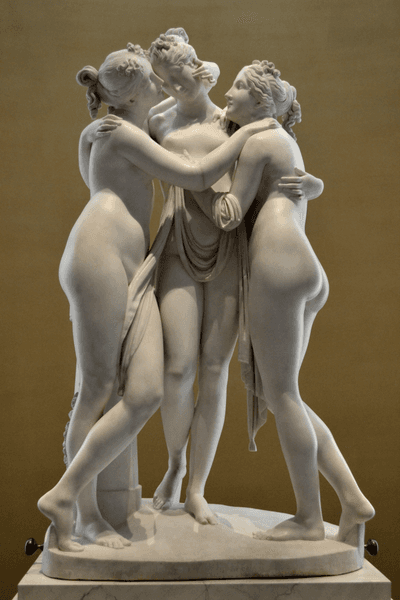
Kindred works
You may also study
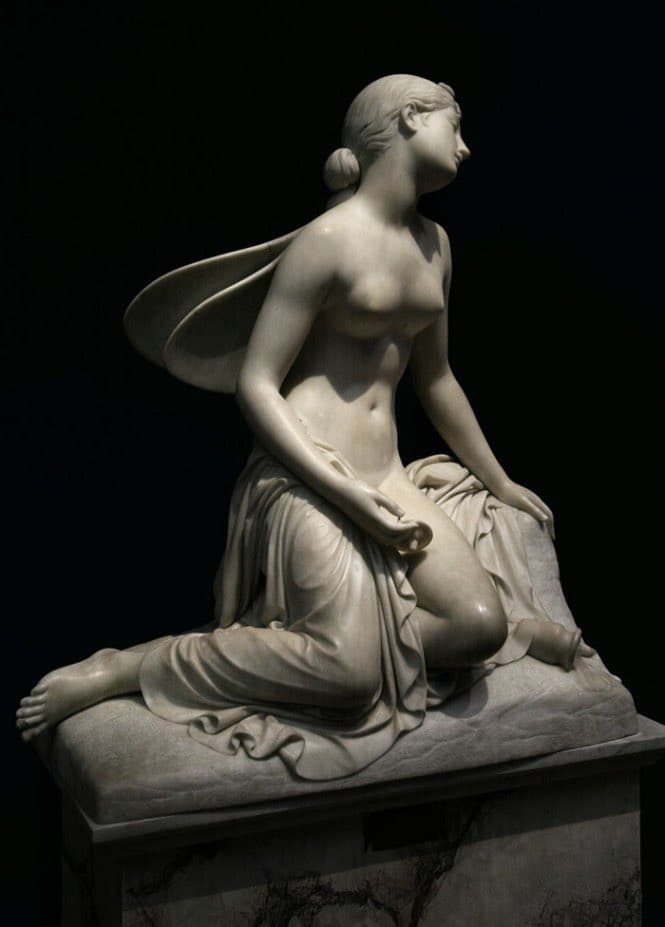
Psyche in a Faint
Pietro Tenerani · composition c. 1822
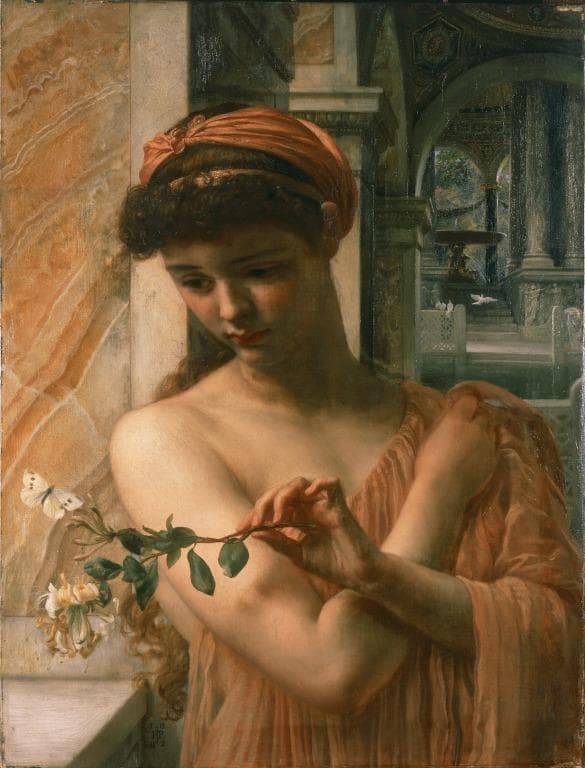
Psyche in the Temple of Love
Edward John Poynter · 1882
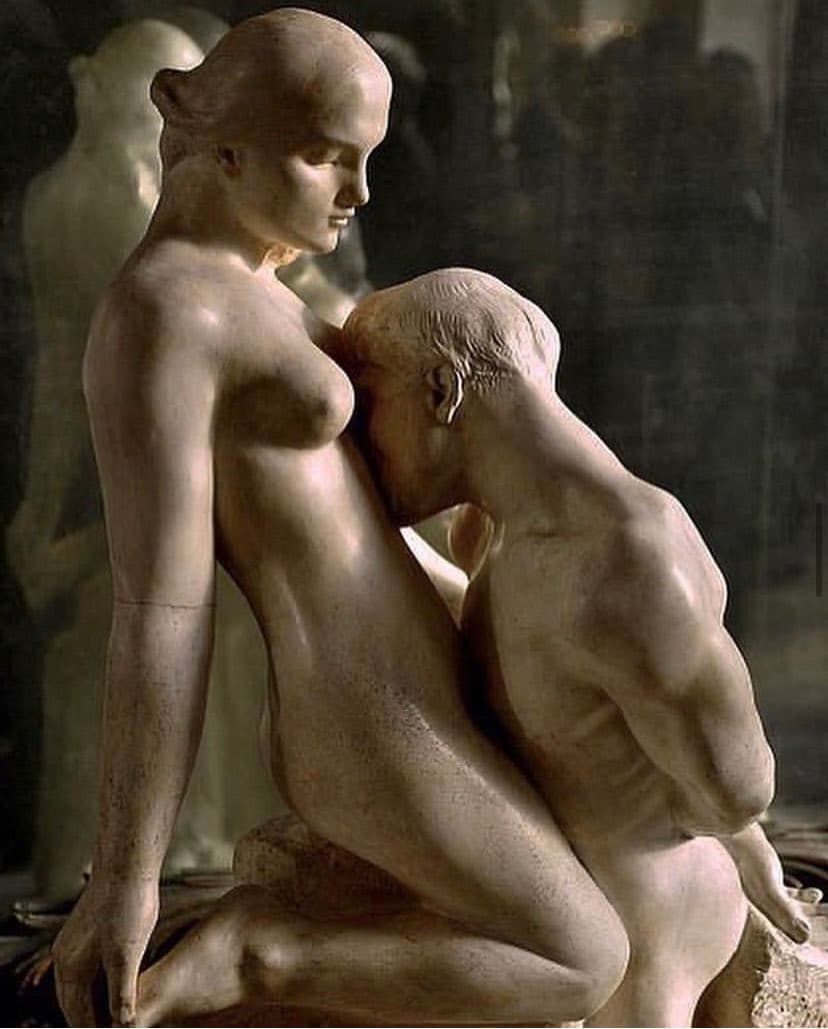
The Eternal Idol
Auguste Rodin · c. 1889 (first marble 1893)

Venus de Milo
Alexandros of Antioch · c. 150–125 BC

Nymphs Dancing to Pan's Flute
Joseph Tomanek

The Thinker
Auguste Rodin · Modeled 1880–82; enlarged 1902–03; this cast 1904

Saturn Devouring His Son
Francisco Goya · c. 1819–1823
The Creation of Adam
Michelangelo · c. 1511–12