Neoclassicism (Purismo)
Psyche in a Faint
Pietro Tenerani, composition c. 1822
Psyche in a Faint (Psiche svenuta) is a marble by the Italian sculptor Pietro Tenerani, showing Psyche sinking to the ground after opening Proserpina's casket of beauty. Devised around 1822, it survives in several versions; one is in Rome's Galleria Nazionale d'Arte Moderna.
- Artist
- Pietro Tenerani
- Date
- composition c. 1822
- Medium
- Marble
- Collection
- Galleria Nazionale d'Arte Moderna e Contemporanea, Rome, Italy
- Movement
- Neoclassicism (Purismo)
What you are looking at
A young woman kneels on a rocky ground spread with drapery, half-sinking, half-turning, her body twisting upward while her legs fold beneath her. She is nude to the hips; a loose cloth slips around her thighs and pools on the rock. Her head is thrown back and turned to one side, eyes heavy, lips parted, as if consciousness is draining out of her. From her shoulders spring two delicate butterfly wings, the attribute that identifies her as Psyche, whose name in Greek means both "soul" and "butterfly." At her knee lies a small vessel on its side, and in one lowered hand she still holds its lid.
That detail is the key to the subject. Everything in the pose follows from the moment just after she has opened the vessel. Her free hand rests on the rock to stop her fall; her torso arches; the drapery has begun to slide. Tenerani catches the instant between standing and collapse, which is why the figure seems to move even in stone. Walk around a version of the statue and the wings, carved thin enough to look translucent at their edges, become the most surprising passage of carving: marble made to look as light as membrane.
The story: Psyche and Proserpina's box
The subject comes from The Golden Ass (also called Metamorphoses) by the Roman writer Apuleius, written in the second century AD. Psyche, a mortal princess of such beauty that she drew worship away from Venus, became the secret wife of Cupid, then lost him when she broke his command never to look at his face. To win him back she had to pass a series of trials set by the jealous Venus. The last was to descend to the underworld and bring back, in a small box, a portion of the beauty of Proserpina, queen of the dead. On the way home, curiosity and the wish to be more beautiful for Cupid got the better of her. She opened the box. Inside there was no beauty, only a deathlike sleep, which overcame her at once. Cupid found her, wiped the sleep away and returned it to the box, and Jupiter finally made Psyche immortal so that the two could marry.
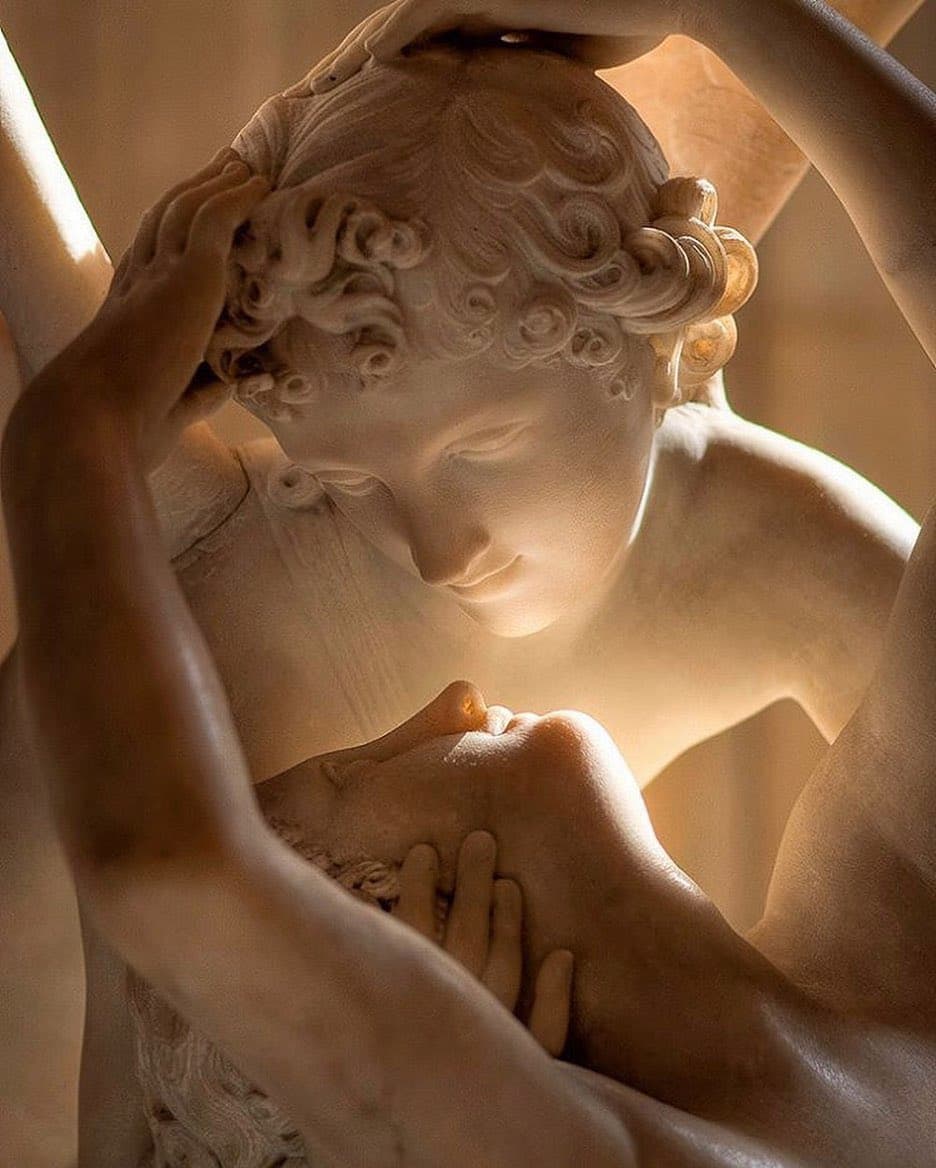
Tenerani's statue shows the moment the sleep strikes. A later moment of the same tale, Cupid waking Psyche with a kiss, is the subject of Antonio Canova's celebrated Psyche Revived by Cupid's Kiss, also known as Cupid and Psyche.
Tenerani and the Purist ideal
Pietro Tenerani (1789–1869) was born near Carrara, the great marble quarry town of Tuscany, and trained in Rome under the Danish sculptor Bertel Thorvaldsen, then the leading Neoclassical artist in the city. His first great success was Psyche Abandoned (plaster 1817, marble versions from about 1819), which shows Psyche seated in grief after Cupid's departure and made Tenerani famous. According to biographical accounts, in 1822 he followed it with a variant subject, Psyche fainting, and the theme stayed with him: marble versions were carved over several decades for different patrons, and one was shown in London at the International Exhibition of 1862. Sources differ on the date of each surviving marble, and the version in Rome's Galleria Nazionale d'Arte Moderna is generally considered among the earliest.
Tenerani became the leading sculptor of Purismo, an Italian movement that wanted to purge Neoclassicism of cold display and return to the sincerity and grace of early Renaissance art. You can feel that in Psyche. Compared with Canova's glossy, theatrical marbles, Tenerani's figure is quieter and more inward, and its emotion is carried by the tilt of the head and the softness of the half-closed eyes rather than by dramatic gesture.
Meaning
Apuleius' tale was read from antiquity onward as an allegory of the human soul (psyche) purified by suffering and united at last with divine love. In that reading Psyche's faint is a kind of death of the self, the price of curiosity, from which love alone can wake her. Nineteenth-century viewers also enjoyed the subject for simpler reasons: it allowed sculptors to show the young female body in a state of abandon that remained respectable because it came from a classical text. Tenerani's version balances both, keeping the sensuality soft and the pathos clear.
Where to see it
A marble Psyche in a Faint is in the Galleria Nazionale d'Arte Moderna e Contemporanea in Rome; other marbles of the subject exist in private and public collections. Tenerani's Psyche Abandoned can be seen in Florence. For other Neoclassical marbles in our collection, see Pradier's Three Graces, famous sculptures and Greek mythology in art.
Questions & answers
What happens in Psyche in a Faint?
It shows Psyche from Apuleius' Golden Ass just after she opens the box of beauty she has fetched from Proserpina in the underworld. Instead of beauty it holds a deathlike sleep, and she sinks to the ground still holding the lid, until Cupid comes to wake her.
Where is Tenerani's Psyche in a Faint?
A marble version is in the Galleria Nazionale d'Arte Moderna e Contemporanea in Rome, generally considered one of the earliest. Tenerani and his studio carved the subject several times, so other marbles are in private and public collections.
Why does Psyche have butterfly wings?
In Greek, psyche means both 'soul' and 'butterfly.' Artists gave Psyche butterfly wings to show that she personifies the human soul, which in ancient thought could take flight from the body like a butterfly.
Who was Pietro Tenerani?
Pietro Tenerani (1789–1869) was an Italian sculptor born near Carrara who trained in Rome under Bertel Thorvaldsen. He became the leading sculptor of Italian Purismo, and his Psyche Abandoned of 1817 made his reputation.
Kindred works
You may also study
Psyche Revived by Cupid's Kiss
Antonio Canova · 1787–1793
Psyche in the Temple of Love
Edward John Poynter · 1882
The Three Graces
James Pradier · 1831
Sleeping Beauty (Dornröschen)
Louis Sussmann-Hellborn · 1878

Venus de Milo
Alexandros of Antioch · c. 150–125 BC

Nymphs Dancing to Pan's Flute
Joseph Tomanek

The Thinker
Auguste Rodin · Modeled 1880–82; enlarged 1902–03; this cast 1904

Saturn Devouring His Son
Francisco Goya · c. 1819–1823