Modern sculpture
The Eternal Idol
Auguste Rodin, c. 1889 (first marble 1893)
The Eternal Idol (L'Éternelle Idole) is a sculpture by Auguste Rodin, conceived around 1889: a kneeling man kisses a woman's body, his arms held behind his back. The first marble (1893) is at the Harvard Art Museums; a plaster belongs to the Musée Rodin.
- Artist
- Auguste Rodin
- Date
- c. 1889 (first marble 1893)
- Medium
- Marble (plaster and bronze versions also exist)
- Movement
- Modern sculpture
What you are looking at
Two nude figures kneel on a rough block of white marble. A young man leans forward and presses his face just beneath the woman's breast. His arms are held behind his back, so the only point of contact he allows himself is the kiss. The woman kneels upright above him, her hair gathered in a low knot, one long arm hanging straight down to rest on the rock beside her heel.
She looks down at him with a calm, closed face. Her expression is hard to fix: tender to some viewers, pitying or remote to others. That uncertainty is the work.
The photograph on this page shows a marble version in a museum gallery, with plaster casts glimpsed behind it. In this carving the woman's hair is tied up, which distinguishes it from the 1893 marble at Harvard, where her hair falls loose to the shoulders.
The title many people search for, "Ebedi İdol," is simply the Turkish rendering of Rodin's French title, L'Éternelle Idole, the Eternal Idol. It is the same sculpture.
How it was made
Like much of Rodin's mature work, the group grew out of his enormous commission for The Gates of Hell, the bronze doors inspired by Dante's Inferno that occupied him from 1880 until his death. Rodin modeled figures in clay and plaster, then took them apart, recombined them and gave them new titles as independent works. The two bodies of The Eternal Idol belong to that family of pairs, alongside the lovers of The Kiss.
A patinated plaster, dated around 1889, belongs to the Musée Rodin in Paris; since 2017 it has been on long-term deposit at the Musée Camille Claudel in Nogent-sur-Seine, where it can be seen beside the work of Rodin's pupil and lover. Small plaster and bronze studies also survive, some only 17 to 18 cm high, which shows how long Rodin turned the idea over at hand-size before enlarging it.
The first marble, dated 1893, is now in the Harvard Art Museums in Cambridge, Massachusetts. Harvard records that it was carved by Jean Escoula, one of the skilled praticiens who translated Rodin's plasters into stone, and that it measures 72.4 × 63.5 × 40 cm. This is normal practice for the period: Rodin designed, corrected and signed; specialist carvers did most of the cutting.
Close looking
Walk around the marble and the composition changes. From the front, the man's bent back and the woman's tilted head form a closed loop, a ring of bodies with the kiss at its center. From the side, the open space between them becomes visible, and you notice how little they actually touch. His hands, clasped out of sight, are the detail most viewers miss in photographs. They turn an embrace into something closer to an act of homage.
Rodin contrasts the polished skin of the figures with the chisel-marked block they kneel on. Light slides over the woman's long torso in one unbroken curve from shoulder to knee, while the man's back is all ridges and hollows, his shoulder blades pushed up by the arms pinned behind him. The difference in surface is a difference in feeling: she is still, he is straining.
Look too at her hanging arm. It is almost unnaturally long and relaxed, the fingers just touching the stone, as if she were barely present in the encounter at all. In the rougher passages of the base, the non finito effect Rodin borrowed from Michelangelo makes the figures seem to be coming out of the stone rather than posed on it.
What does The Eternal Idol mean?
Rodin left no fixed program, and the title itself is puzzling. In nineteenth-century French poetry, a beloved woman was often called an idole, an object of worship. Read that way, the man is a devotee at a shrine, and the clasped hands signal restraint and reverence: he adores without seizing.
Other viewers read the same pose as submission. The hidden hands look bound; the woman's downward gaze reads as condescension or sorrow; the kneeling man becomes a captive of desire. Both readings sit comfortably inside Rodin's art, where love is rarely simple and often borders on suffering, as in the damned couples of The Gates of Hell.
The poet Rainer Maria Rilke, who worked as Rodin's secretary, wrote about the group with particular feeling, describing a mysterious greatness in it and placing it somewhere between heaven and hell. That is a useful key: the sculpture holds worship and abjection in the same pose and refuses to choose.
Reception and versions
The 1893 marble was made for the painter Eugène Carrière, a close friend of Rodin, who lent it to the artist's landmark retrospective at the Place de l'Alma in Paris in 1900. It was so admired there that Rodin produced a second marble. Carrière's marble later passed to the collector Sir Edmund Davis and then to Grenville L. Winthrop, who bequeathed it to the Fogg Art Museum at Harvard in 1943.
Posthumous bronzes, cast under the authority of the Musée Rodin, are held in several museums, including the Montreal Museum of Fine Arts, the Leopold Museum in Vienna and Christchurch Art Gallery in New Zealand. Size and finish vary between versions, so check which one a photograph shows before quoting dimensions.
Related works
If the clasped hands interest you, compare them with the open, almost architectural gesture of Rodin's The Thinker, another figure born from The Gates of Hell. For a Neoclassical version of the same theme of love as revival, see Canova's Psyche Revived by Cupid's Kiss, or Francesco Hayez's painted embrace in The Kiss. More sculpture of this kind is gathered in Famous Sculptures.
Where to see it
There is more than one marble. The first, of 1893 with the woman's hair loose, is in the Harvard Art Museums, Cambridge, Massachusetts; gallery displays change, so check before visiting. The version photographed here, with tied-up hair, is shown in a museum setting among plaster casts, which suggests the Musée Rodin in Paris, but its exact identity has not been confirmed. The plaster version can be seen at the Musée Camille Claudel in Nogent-sur-Seine, on deposit from the Musée Rodin. The Musée Rodin in Paris holds further plasters and bronzes of the group.
Questions & answers
What is the Ebedi Idol?
Ebedi İdol is the Turkish name for Auguste Rodin's sculpture L'Éternelle Idole, known in English as The Eternal Idol. Conceived around 1889, it shows a kneeling man kissing a woman's body with his hands held behind his back. The first marble dates from 1893.
Where is The Eternal Idol by Rodin today?
The first marble, carved in 1893 by Jean Escoula under Rodin's direction, is in the Harvard Art Museums in Cambridge, Massachusetts. A patinated plaster of about 1889 belongs to the Musée Rodin and has been on deposit at the Musée Camille Claudel in Nogent-sur-Seine since 2017. Bronze casts are in several other museums.
What does The Eternal Idol mean?
Rodin gave no single meaning. The title draws on the nineteenth-century habit of calling a beloved woman an idol, so the man can be read as a worshipper showing restraint. Others see the hidden hands as bondage and the pose as submission. Rilke placed the group between heaven and hell.
Why are the man's hands behind his back?
Clasping his hands out of sight limits the man's contact with the woman to a single kiss. It turns an embrace into an act of homage or self-denial. Some viewers read it instead as a sign that he is captive to her, which is why the sculpture is so often debated.
Is The Eternal Idol connected to The Gates of Hell?
Yes. Like The Kiss and The Thinker, the pair of figures grew out of Rodin's work on The Gates of Hell, his bronze doors based on Dante's Inferno. Rodin often took figures from that project, recombined them and exhibited them as independent sculptures with new titles.
More by the artist
Auguste Rodin

Kindred works
You may also study
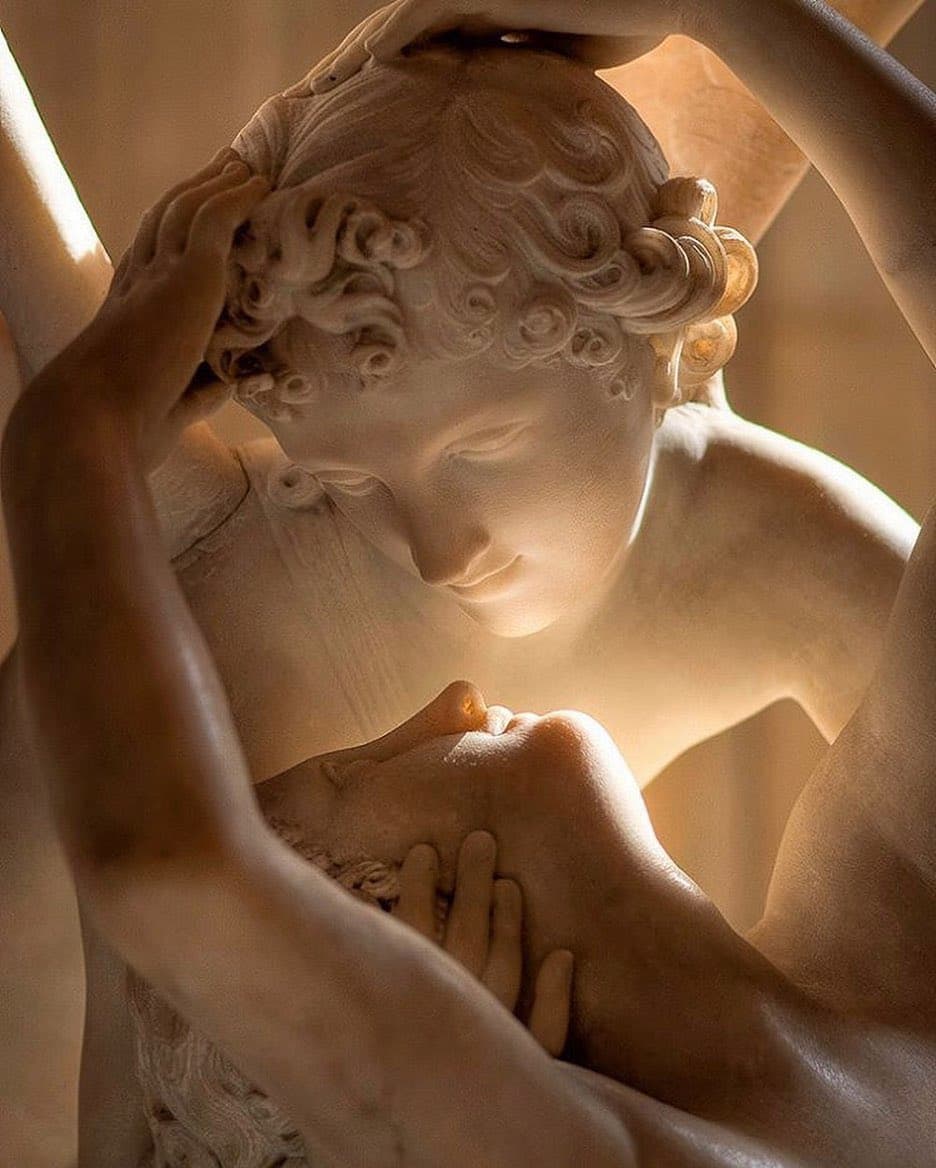
Psyche Revived by Cupid's Kiss
Antonio Canova · 1787–1793
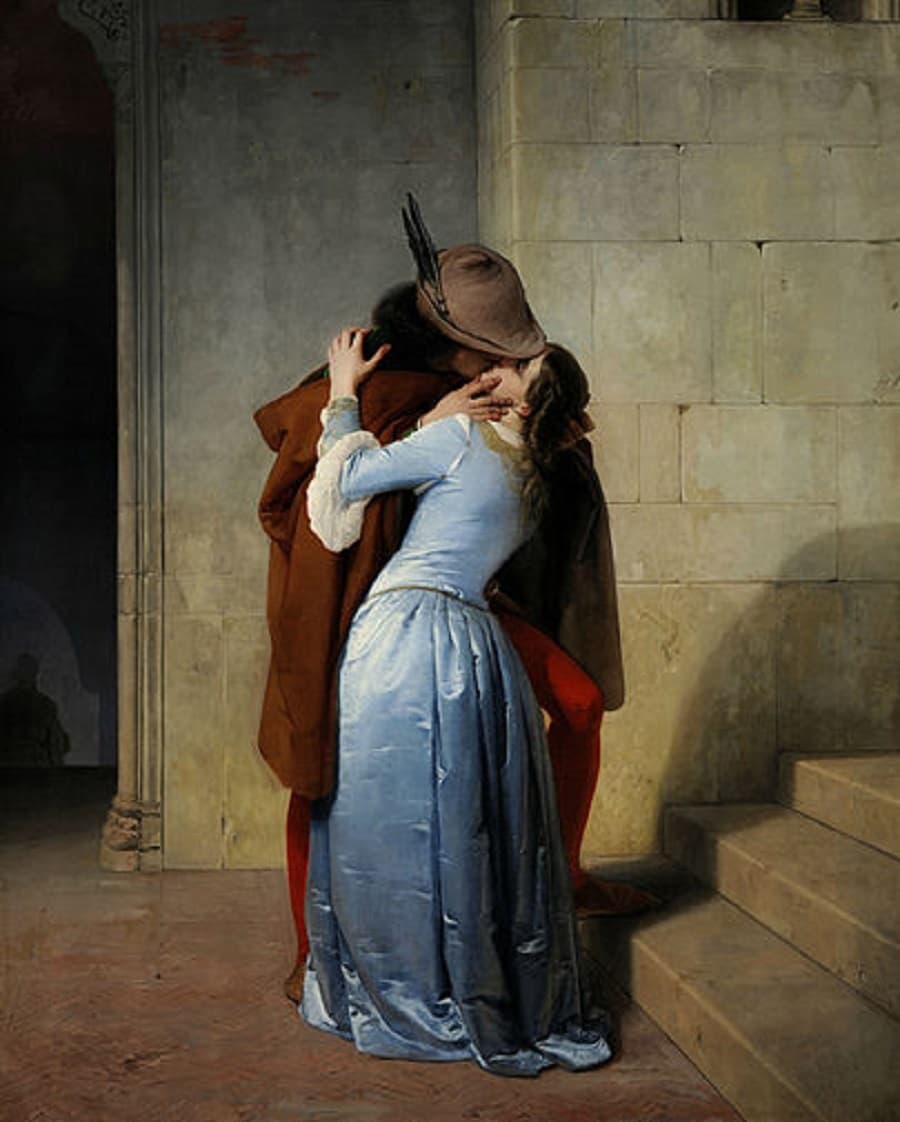
The Kiss
Francesco Hayez · 1859
The Three Graces
Antonio Canova · 1814–17

Venus de Milo
Alexandros of Antioch · c. 150–125 BC

Nymphs Dancing to Pan's Flute
Joseph Tomanek
The Creation of Adam
Michelangelo · c. 1511–12
Lucifer
Franz von Stuck · 1890
The Birth of Venus
Sandro Botticelli · c. 1484–1486