French · Romanticism
Théodore Géricault
b. 26 September 1791, Rouen — d. 26 January 1824, Paris
Théodore Géricault (1791–1824) was the French painter who launched Romanticism with The Raft of the Medusa, a vast shipwreck scene in the Louvre, before dying at 32.
1 work in the collection
Works by Théodore Géricault
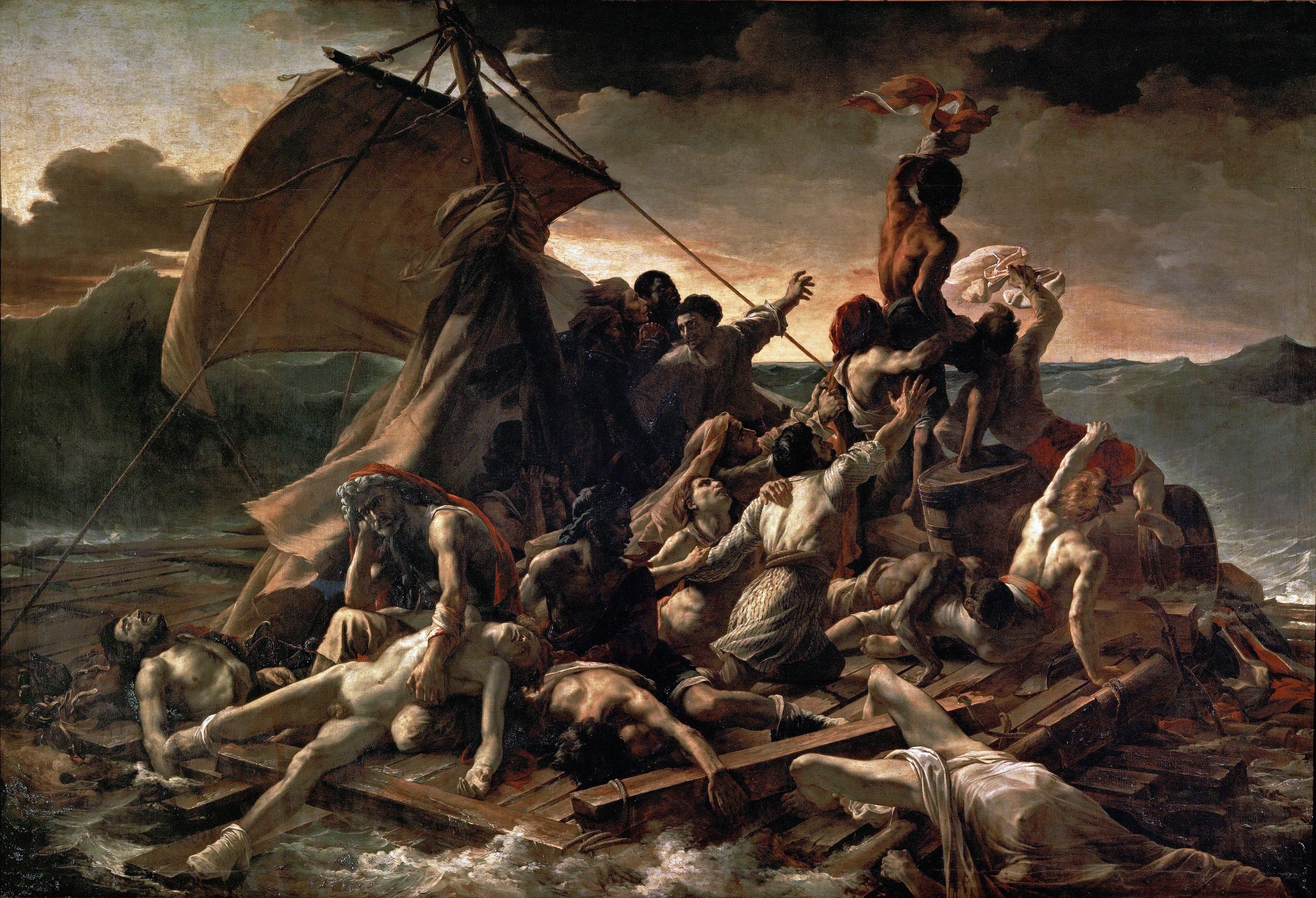
Théodore Géricault was a French painter and lithographer whose short career opened the Romantic movement in France. His masterpiece, The Raft of the Medusa (1818–19), a seven-meter canvas of shipwreck survivors, hangs in the Louvre in Paris.
Life in brief
Géricault was born in Rouen in 1791 into a wealthy family that moved to Paris when he was a child. Financially independent, he trained with the horse painter Carle Vernet and then with Pierre-Narcisse Guérin, but learned most by copying Rubens, Titian and Rembrandt in the Louvre. He was only 21 when his Charging Chasseur won a gold medal at the Salon of 1812. In 1816–17 he traveled to Italy, where Michelangelo's figures overwhelmed him.
After The Raft he spent 1820–21 in Britain, where the painting was exhibited to paying crowds in London; there he painted The Derby at Epsom (1821, Louvre) and made lithographs of London street life. Back in Paris his health failed after a series of riding accidents and illness, and he died in January 1824, aged 32.
Style
Géricault painted energy and suffering: rearing horses, wounded soldiers, bodies straining against fate. His figures have the muscular weight of Michelangelo, his color is dark and dramatic, and his subjects often come from modern life rather than antiquity. Between about 1819 and 1822 he painted a series of portraits of patients suffering from what doctors then called monomania; five survive, in Lyon, Paris, Ghent, Winterthur and Springfield, Massachusetts, and they are among the most compassionate images of mental illness in art.
The Raft of the Medusa
In July 1816 the French frigate Méduse ran aground off the coast of West Africa. About 150 people were set adrift on a makeshift raft; after thirteen days of starvation, murder and cannibalism, only 15 were rescued. The disaster became a political scandal. Géricault interviewed survivors, had a model of the raft built, and studied corpses and severed limbs from a Paris hospital. He chose the moment when the survivors sight a distant ship, the Argus, building the composition upward from the dead in the foreground to a man waving a cloth at the top. The young Eugène Delacroix posed for one of the figures; he later painted Liberty Leading the People in the same heroic spirit.
Where to see his work
The Louvre holds The Raft of the Medusa and many other major works; the Musée des Beaux-Arts in Rouen has a fine collection. Explore Romanticism and Death in Art.
Questions & answers
Where is The Raft of the Medusa?
The Raft of the Medusa (1818–19) is in the Musée du Louvre in Paris, in the large French paintings galleries of the Denon wing. It measures about 491 by 716 cm. The Louvre acquired it shortly after Géricault's death in 1824.
What happened to the real Raft of the Medusa?
In July 1816 the French frigate Méduse ran aground off present-day Mauritania. About 150 people were put on a raft that was soon cut loose. After thirteen days of starvation, violence and cannibalism, only 15 men were picked up by the ship Argus, and several died soon after.
How did Géricault die?
Géricault died in Paris on 26 January 1824, aged 32, after a long illness. He had suffered several falls from horses, and complications, including a spinal infection or tuberculosis of the spine, are usually blamed. He left only about ten years of mature work.