Image: National Gallery, London · Public domain · via Wikimedia Commons
Romanticism
The Hay Wain
John Constable, 1821
The Hay Wain is John Constable's 1821 painting of a horse-drawn hay cart crossing the River Stour beside a cottage at Flatford in Suffolk, under a summer sky of moving clouds. It hangs in the National Gallery, London, and is one of the best-known English landscapes.
- Artist
- John Constable
- Date
- 1821
- Medium
- Oil on canvas
- Dimensions
- 130.2 × 185.4 cm
- Collection
- National Gallery, London, United Kingdom
- Movement
- Romanticism
What you are looking at
An empty wooden farm cart, a wain, stands in the shallow water of a mill stream, pulled by three horses. Two men ride on it. They have stopped mid-ford, perhaps to let the horses drink or to cool the wheels, before going on toward the fields to collect a load of hay.
On the left bank stands a small brick and timber cottage with a big chimney, half buried in trees. At its edge a woman kneels at the water. A little dog on the near bank stops to watch the cart.
Beyond the stream, the land opens into a broad, flat meadow stretching to a line of trees, and in the far distance, if you look carefully, there are tiny figures of haymakers at work in the sunlight. Above everything is the sky: big white and gray cumulus clouds, a darker shower cloud at the top left, patches of blue. It fills more than half of the canvas.
The detail most people miss is in the reeds on the right bank: a man in a small boat, partly hidden among the plants, perhaps fishing or cutting rushes. Look also at the flecks of white paint scattered across the leaves and water. Critics in Constable's day mocked them as "Constable's snow"; they are his way of making light sparkle on wet surfaces.
The place
Constable painted the River Stour at Flatford, in Suffolk, near his birthplace of East Bergholt. His father owned Flatford Mill, just out of the picture to the right. The cottage belonged to a tenant farmer named Willy Lott, who was said to have been born in it and never to have left it for more than four days in his life. It still stands; the area, now known as "Constable Country", is preserved by the National Trust. Today the site looks remarkably like the painting, though the trees have changed.
How Constable made it
John Constable (1776–1837) painted The Hay Wain in his London studio, not outdoors. He worked from years of oil sketches and drawings made on the spot, and for his big "six-footer" exhibition canvases he made a full-size oil sketch first. The full-size sketch for The Hay Wain is now in the Victoria and Albert Museum. He wanted the finished picture to keep the freshness of the sketches while having the finish expected at the Royal Academy.
His skies were the product of serious study. In 1821 and 1822, while living in Hampstead, he made dozens of cloud studies, often noting the date, time and wind direction on the back. That attention to real weather is what separates his landscapes from the idealized views of earlier painters.
What does The Hay Wain mean?
At first glance there is no story at all: a cart, a cottage, a summer day. But the picture carries a set of ideas that mattered greatly to Constable. It is a portrait of a particular, familiar place rather than an imagined Arcadia, painted with the conviction that ordinary English countryside was worthy of serious art. It shows agricultural work as part of the landscape, the cart on its way to the harvest. And it is full of memory: Constable painted his childhood landscape from London, at a time when the rural world he knew was changing fast after the Napoleonic Wars.
Some historians read it as an idealized image that leaves out the hardship of rural labor in the 1820s. Others see it as simply honest observation. Either way, it is a picture about belonging to a place.
Reception and legacy
Constable exhibited it at the Royal Academy in 1821 under the title Landscape: Noon, and it did not sell. In 1824 the dealer John Arrowsmith bought it with other Constables, and it was shown at the Paris Salon, where it won a gold medal from Charles X and caused a stir among French painters. Eugène Delacroix is said to have repainted the background of one of his own pictures after seeing it. That influence ran on through the Barbizon painters to the Impressionists, including Claude Monet, whose river scenes such as The Seine at Argenteuil owe something to Constable's broken touch and open-air light.
In Britain the painting has become almost a national emblem. In July 2022 climate protesters glued themselves to its frame and covered the canvas with an altered, apocalyptic version of the image; the gallery reported only minor damage to the varnish and frame. The gold medal from the 1824 Salon is set into the frame. It sits within Romanticism as the calm counterpart to Turner's storms and Friedrich's Wanderer above the Sea of Fog.
Where is The Hay Wain today?
The Hay Wain hangs in the National Gallery in London, which received it in 1886 as a gift from Henry Vaughan. Admission to the permanent collection is free. The painting is in the public domain.
Questions & answers
Where is The Hay Wain painting?
The Hay Wain is in the National Gallery in London, which received it in 1886 as a gift from the collector Henry Vaughan. It is normally on display, and entry to the gallery's permanent collection is free. A full-size oil sketch for it is in the Victoria and Albert Museum.
Where was The Hay Wain painted?
It shows the River Stour at Flatford, Suffolk, beside Willy Lott's cottage and near Flatford Mill, which belonged to Constable's father. Constable painted the final canvas in his London studio from sketches made on the spot. The cottage still stands and is cared for by the National Trust.
What is a hay wain?
A wain is an old English word for a large open farm wagon. In the painting the cart is empty: it is crossing the stream on its way to the meadows, where haymakers are working in the distance, to collect a load of hay.
Why is The Hay Wain famous?
It made English landscape painting famous in Europe. After a quiet reception in London in 1821, it won a gold medal at the Paris Salon in 1824 and influenced French painters from Delacroix to the Barbizon school and, later, the Impressionists. In Britain it became a national icon.
Kindred works
You may also study
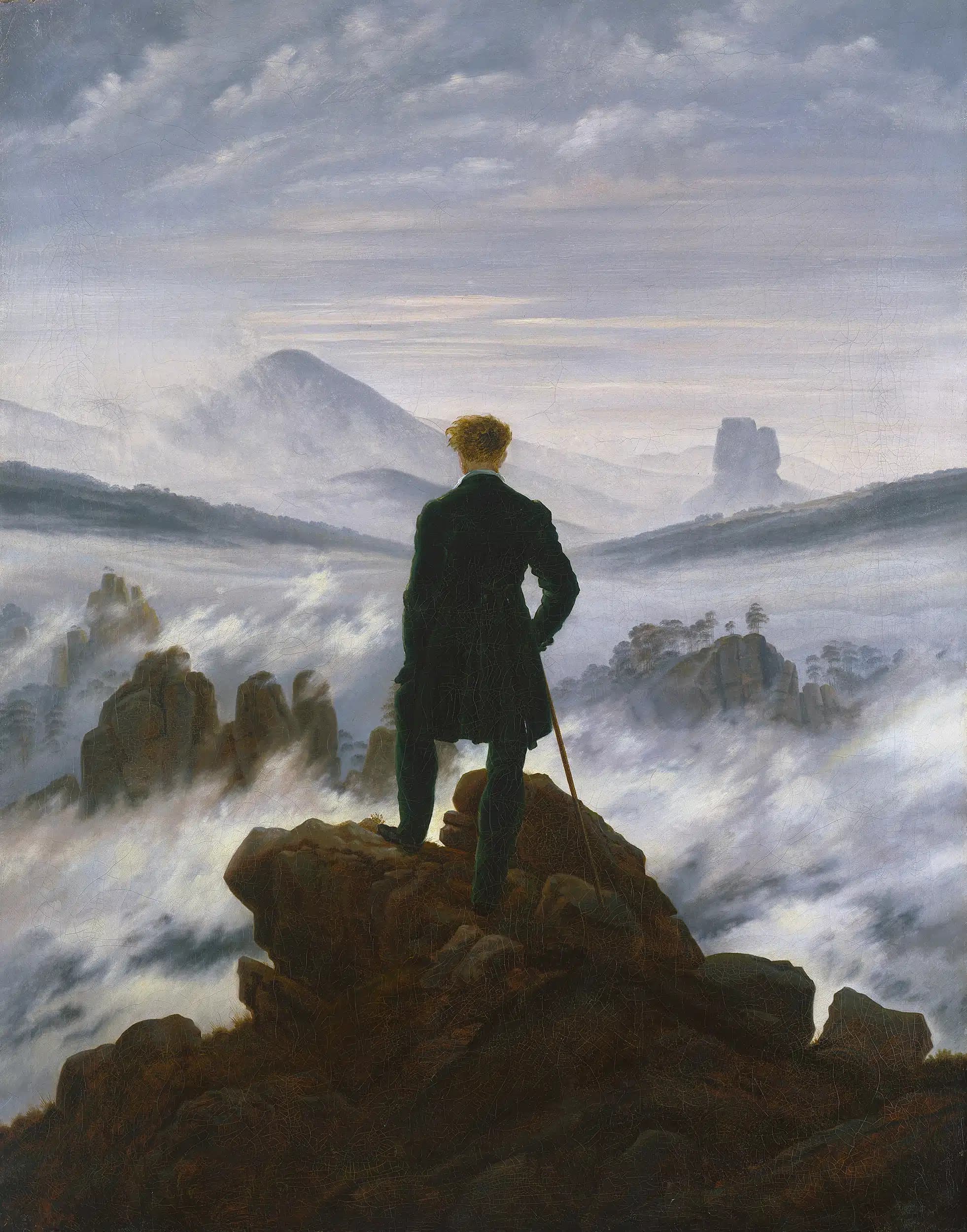
Wanderer above the Sea of Fog
Caspar David Friedrich · c. 1817
Impression, Sunrise
Claude Monet · 1872
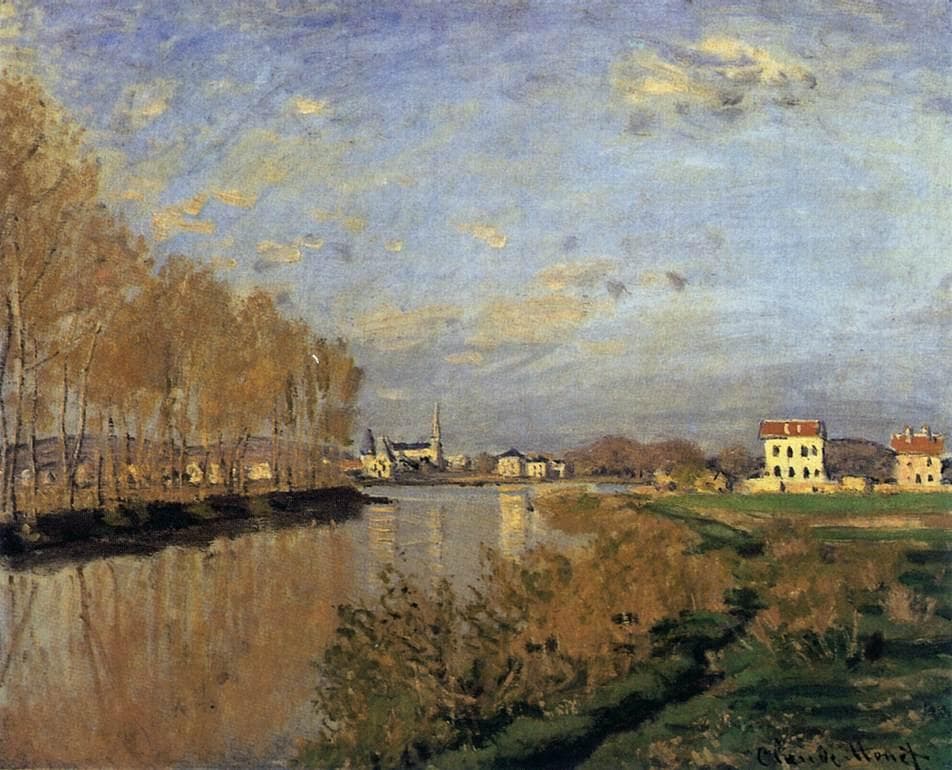
The Seine at Argenteuil
Claude Monet · 1873
A Yorkshire Lane in November
John Atkinson Grimshaw
The Course of Empire: Destruction
Thomas Cole · 1836

Bridge over a Pond of Water Lilies
Claude Monet · 1899

Venus de Milo
Alexandros of Antioch · c. 150–125 BC

The Scream
Edvard Munch · 1893