Image: New-York Historical Society (scan via Explore Thomas Cole) · Public domain · via Wikimedia Commons
Hudson River School / Romanticism
The Course of Empire: Destruction
Thomas Cole, 1836
The Course of Empire is Thomas Cole's five-painting cycle of 1833–36 tracing an imaginary city from wilderness to ruin; Destruction, the fourth canvas, shows the marble capital sacked and burning under a storm. The series is in the New-York Historical Society.
- Artist
- Thomas Cole
- Date
- 1836
- Medium
- Oil on canvas
- Dimensions
- 100.3 × 161.3 cm
- Collection
- New-York Historical Society, New York, United States
- Movement
- Hudson River School / Romanticism
What you are looking at
A great classical city is falling. Its harbor, lined with colonnades, temples and palaces, is choked with burning ships and fighting men. A storm sweeps across the sky from the left, the light breaking through in cold white shafts, while on the right black smoke and orange fire pour out of the palace arcades.
The drama is concentrated on a bridge in the middle distance. It has given way under the weight of invading soldiers, and men pour off its broken edge into the water. In the foreground, on a stone landing, a woman in white runs to the very edge of a parapet, chased by a soldier, about to leap. Around her lie the dead and dying, scattered shields and spears, a mother clutching a child.
At the right towers a colossal marble statue of a striding warrior, a shield raised in his left hand. His head has been knocked off. The pose is borrowed from the famous ancient statue known as the Borghese Gladiator, and the headless hero, still frozen in his gesture of attack, is the painting's sharpest image of power reduced to an empty shell.
The detail people miss: high up at the left, behind the city, rises a rocky crag with a boulder balanced on top. The same crag appears in every one of the five paintings in the series, the one fixed point in a landscape that changes completely around it.
The Course of Empire series
Thomas Cole (1801–1848), the English-born painter who founded the American landscape tradition known as the Hudson River School, conceived The Course of Empire as a cycle of five large canvases showing the same valley over centuries.
- The Savage State: wilderness at dawn, with hunters among the rocks.
- The Arcadian or Pastoral State: farmers and shepherds, the first temple, a calm morning.
- The Consummation of Empire: noon, the valley built over with a gleaming marble capital and a triumphal procession.
- Destruction: the city sacked in a storm, the painting shown here.
- Desolation: evening, the ruins overgrown, nature returning, not a human figure left.
The series was commissioned by the New York merchant and collector Luman Reed, who died in 1836 before it was finished. It was completed that year and exhibited in New York to great acclaim. After Reed's death the paintings passed, with the rest of his collection, to the New-York Gallery of the Fine Arts and later to the New-York Historical Society.
In the final canvas, Desolation, the storm has passed. Evening light falls on broken arches and a lone column, now overgrown, and the city has become a ruin returning to nature. Cole painted his famous view of the Connecticut River, The Oxbow, in the same year, a reminder that his visionary allegories and his observed American landscapes grew side by side.
How Cole made it
Cole drew on everything he had seen in Europe from 1829 to 1832: the ruins of Rome, the paintings of Claude Lorrain and J. M. W.
Turner, and the vast apocalyptic scenes of the English painter John Martin. The architecture is invented, a composite of Roman and Greek forms rather than any real city. The painting is carefully built: a dark diagonal of smoke and fire on the right, a pale diagonal of storm light on the left, and the broken bridge as the hinge between them.
What does The Course of Empire mean?
Cole took his theme from an old idea, the cyclical theory of history, in which civilizations rise, flourish, grow corrupt and fall. He attached to the series lines from Byron's Childe Harold's Pilgrimage: first freedom, then glory, and when that fails, wealth, vice, corruption, and barbarism at last.
The warning was aimed at his own country. In the 1830s many Americans, Cole among them, worried that the young republic's rapid expansion, its pursuit of wealth and the populist politics of Andrew Jackson's era would lead it down the same path as Rome. Cole also loved the wilderness and regretted its destruction; the series ends with nature reclaiming the land. Destruction is the moment where the warning becomes violence: luxury and power give way to war, rape and fire.
Reception and legacy
The cycle made Cole famous and remains the most ambitious allegorical series in American painting. Destruction in particular has become a widely shared image, used again and again to illustrate the fall of empires, from history textbooks to political commentary online. It sits naturally beside Karl Bryullov's The Last Day of Pompeii, Bruegel's The Triumph of Death and the stormy side of Romanticism, and it speaks directly to the ruin-haunted mood of dark academia.
Where is The Course of Empire today?
All five paintings, including Destruction, belong to the New-York Historical Society on Central Park West in New York City, which displays the series together when it is on view. The images are in the public domain.
Questions & answers
Where is The Course of Empire by Thomas Cole?
All five paintings of The Course of Empire, including Destruction, belong to the New-York Historical Society in New York City. They came to the Society with the collection of the series' patron, Luman Reed, via the New-York Gallery of the Fine Arts.
What does The Course of Empire mean?
The series shows a civilization rising from wilderness, reaching a peak of wealth and power, then collapsing into violence and ruin. Cole meant it as a warning to the young United States that greed, luxury and lust for power could bring it down like ancient Rome.
What are the five paintings in The Course of Empire?
The Savage State, The Arcadian or Pastoral State, The Consummation of Empire, Destruction, and Desolation. All show the same valley, marked by a distinctive boulder-topped crag, at different stages of history and times of day.
What is the headless statue in Destruction?
It is a colossal warrior statue based on the ancient Borghese Gladiator, with its head knocked off. Still striding forward with its shield raised, it symbolizes the empty pride of an empire that has lost its power.
Kindred works
You may also study
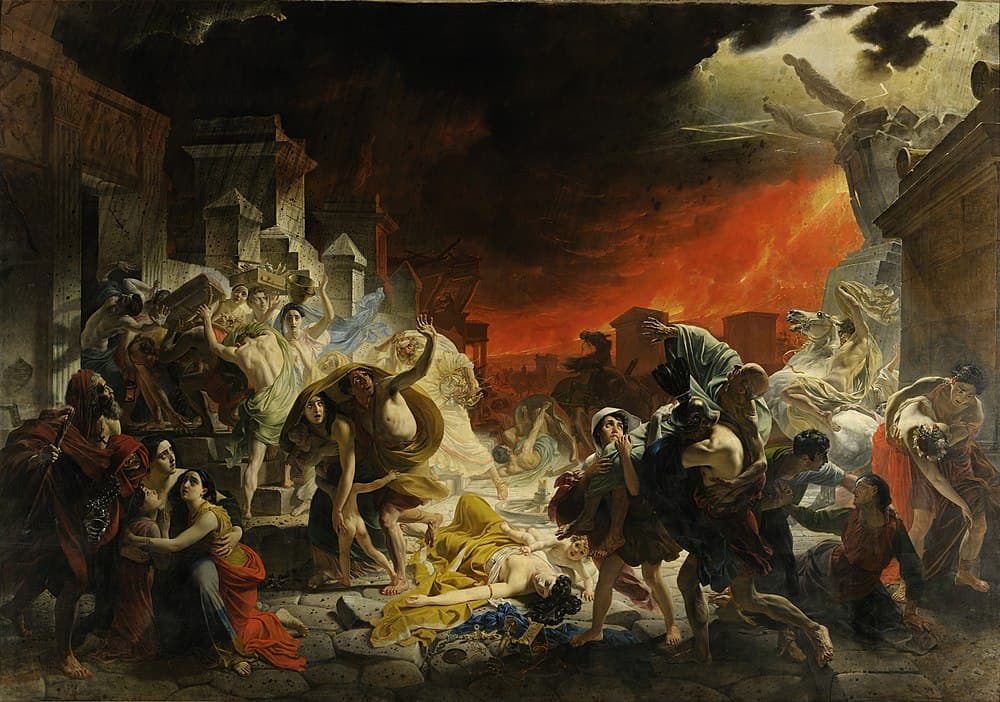
The Last Day of Pompeii
Karl Bryullov · 1830–33
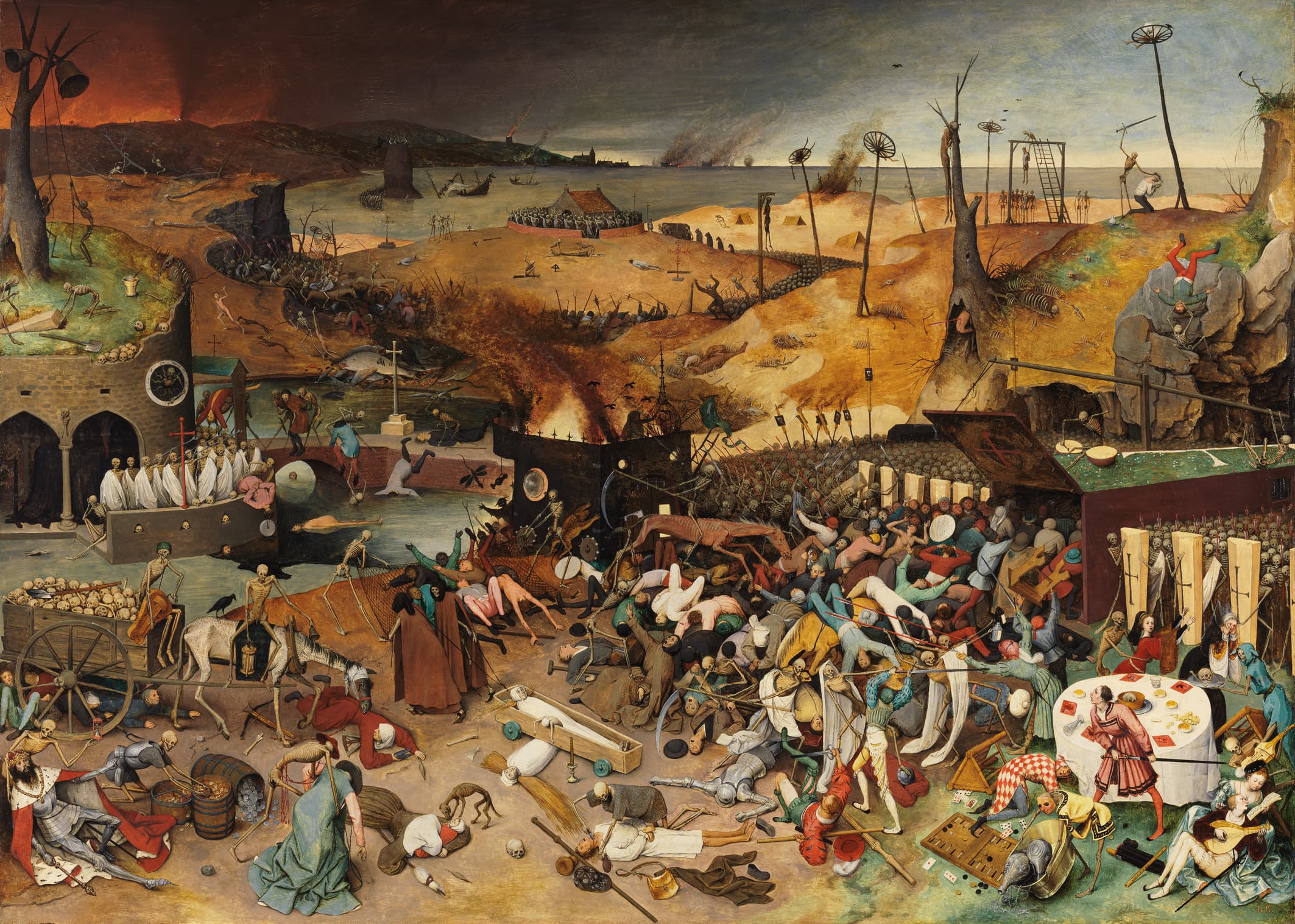
The Triumph of Death
Pieter Bruegel the Elder · c. 1562
Isle of the Dead
Arnold Böcklin · 1880 (first version); five versions 1880–86
The Raft of the Medusa
Théodore Géricault · 1818–1819
Wanderer above the Sea of Fog
Caspar David Friedrich · c. 1817

The Scream
Edvard Munch · 1893
The Thinker
Auguste Rodin · Modeled 1880–82; enlarged 1902–03; this cast 1904

Saturn Devouring His Son
Francisco Goya · c. 1819–1823