British · Romanticism · Landscape painting
John Constable
b. 11 June 1776, East Bergholt, Suffolk — d. 31 March 1837, London
John Constable (1776–1837) was the English Romantic landscape painter of The Hay Wain, who made the fields, rivers and skies of Suffolk's Stour Valley into a subject as serious as history painting.
1 work in the collection
Works by John Constable
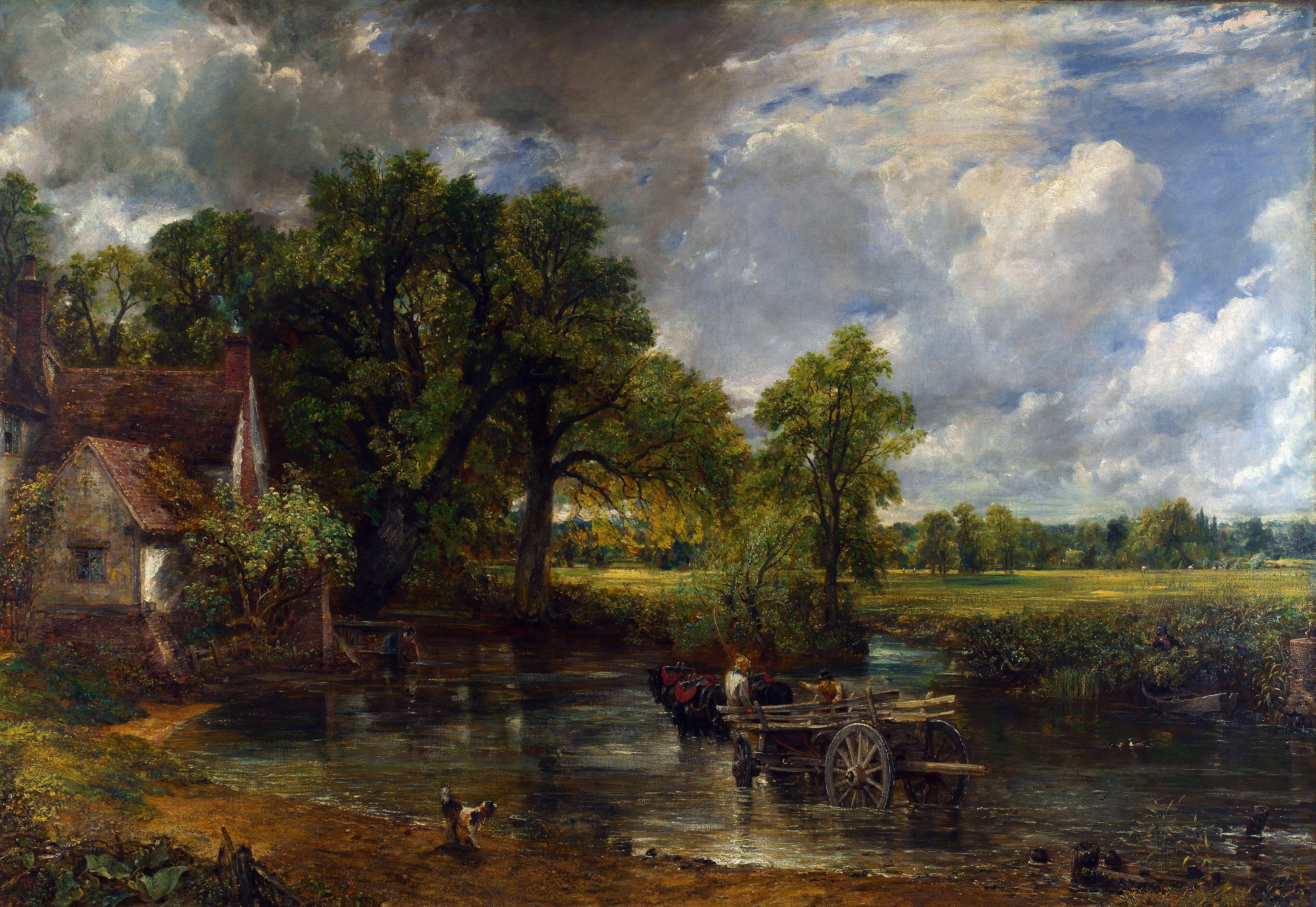
John Constable was an English landscape painter who spent his career painting a few square miles of country he had known as a boy, the Stour Valley on the border of Suffolk and Essex, now often called Constable Country. His best-known painting, The Hay Wain (1821), is in the National Gallery, London.
Life in brief
Constable was born in 1776 at East Bergholt, the son of a prosperous corn merchant who owned Flatford and Dedham mills. He entered the Royal Academy Schools in 1799 and spent years studying old masters such as Claude, Ruisdael and Gainsborough while slowly finding his own path. Success was late. He married Maria Bicknell in 1816 after a long courtship opposed by her family; her death from tuberculosis in 1828 left him grieving for the rest of his life. He became a full Royal Academician only in 1829 and died in London in 1837.
Style and technique
Constable insisted on painting what he saw. He made oil sketches outdoors, and in 1821–22 at Hampstead he painted dozens of studies of clouds, noting the date, time and wind direction on the back. For his large exhibition canvases, the “six-footers,” he made full-size oil sketches first, worked with a palette knife, and flecked the surfaces with dabs of white to catch the sparkle of light on water and leaves. Critics mocked it as “Constable's snow.”
Key works
The Hay Wain, first shown at the Royal Academy in 1821 as Landscape: Noon, shows a horse-drawn wagon crossing the millstream below Willy Lott's cottage near Flatford Mill. Other major works include Flatford Mill (1816–17, Tate Britain), Salisbury Cathedral from the Bishop's Grounds (1823, Victoria and Albert Museum), The Leaping Horse (1825, Royal Academy) and the stormy Hadleigh Castle (1829, Yale Center for British Art).
Influence
When The Hay Wain was shown at the Paris Salon of 1824 it won a gold medal from Charles X and impressed French painters, including the young Eugène Delacroix. Constable's fresh color and outdoor sketching anticipated the Barbizon painters and, later, Claude Monet and the Impressionists.
Where to see his work
The Victoria and Albert Museum holds the largest collection, including many oil sketches; the National Gallery and Tate Britain show his finished masterpieces. Flatford Mill and Willy Lott's cottage still stand. See also Romanticism.
Questions & answers
What is John Constable's most famous painting?
Constable's most famous painting is The Hay Wain (1821), showing a hay wagon crossing a shallow millstream by Willy Lott's cottage near Flatford Mill, Suffolk. It is in the National Gallery, London, and won a gold medal at the Paris Salon of 1824.
Where is Constable Country?
Constable Country is the Dedham Vale on the Suffolk–Essex border in eastern England, around the River Stour, East Bergholt, Flatford and Dedham. Flatford Mill and Willy Lott's cottage, both painted by Constable, survive and are cared for by the National Trust.
Where can I see John Constable's paintings?
The largest group is at the Victoria and Albert Museum, London, which owns many of his oil sketches. The National Gallery has The Hay Wain, Tate Britain has Flatford Mill, and the Royal Academy owns The Leaping Horse.