Victorian
A Yorkshire Lane in November
John Atkinson Grimshaw
A Yorkshire Lane in November is a moonlit painting by the Victorian artist John Atkinson Grimshaw of a wet country road between bare trees, with a lone figure walking toward a distant light.
- Artist
- John Atkinson Grimshaw
- Medium
- Oil on canvas
- Dimensions
- 54.6 × 43.2 cm
- Movement
- Victorian
A Yorkshire Lane in November is one of the moonlit lane pictures for which the Leeds painter John Atkinson Grimshaw (1836–1893) became famous. It shows a rain-soaked country road under bare autumn trees, lit by a full moon breaking through cloud. The canvas is recorded at about 54.6 by 43.2 centimeters; its exact date and present owner have not been confirmed.
What you are looking at
A road curves away from us between two rows of tall, leafless trees. Their black trunks and spidery branches rise on both sides and almost meet overhead, forming a dark tunnel. High in the sky at right, a small bright moon shines through a green-grey haze of cloud, and its light picks out the twigs against the sky like lace.
Below, the road is wet and muddy, its ruts filled with water that catches the moonlight in silvery streaks and puddles. Fallen leaves, painted in tiny touches of gold and rust, lie thickly along its edges. At the right a stone wall and an iron railing or gate line the lane. Far down the road, a single small figure walks away from us, dark against the pale surface, the only human presence in the scene.
How it was painted
Grimshaw built his night scenes with extraordinary control. He painted thinly and smoothly, and he is thought to have used photographs, and possibly projected images, to fix the intricate patterns of the branches. The palette is restricted to green-greys, browns and the silver of the moon, so the few warm notes, the leaves and any lit window, glow.
Grimshaw's moonlight
Grimshaw was largely self-taught. A railway clerk who gave up his job to paint, he began in the meticulous manner of the Pre-Raphaelites and then found his subject in the suburbs and lanes of Leeds and the docks of Liverpool, Glasgow and London after dark. James McNeill Whistler, himself a painter of nocturnes, reportedly said he had thought he invented the nocturne until he saw Grimshaw's moonlights. Grimshaw painted many variations on the lane theme, which is why titles and dates are easily confused.
The mood, solitary, damp and quietly uncanny, has made these pictures favorites of dark academia and of the Gothic imagination. For an earlier Dutch master of moonlight, compare Aert van der Neer's Moonlit Landscape. More on the painter at John Atkinson Grimshaw.
Questions & answers
Who painted A Yorkshire Lane in November?
It was painted by John Atkinson Grimshaw (1836–1893), a Victorian artist from Leeds in Yorkshire. Grimshaw specialized in moonlit scenes of lanes, suburban streets and harbors, painted with precise detail and a cool, silvery light that made him one of the most distinctive British painters of night.
What is the meaning of A Yorkshire Lane in November?
It is not a story painting but a study of mood. The bare trees, wet road, cold moon and solitary walker evoke loneliness, the end of the year and the quiet strangeness of the countryside at night, themes Grimshaw returned to again and again in his moonlit lanes.
Why are Grimshaw's paintings associated with dark academia?
Grimshaw's moonlit lanes, misty streets and gaslit docks have a melancholy, slightly Gothic atmosphere that fits the dark academia aesthetic of autumn, solitude, old architecture and night. His work is widely shared online for that reason, often alongside Romantic and Victorian literature.
Kindred works
You may also study
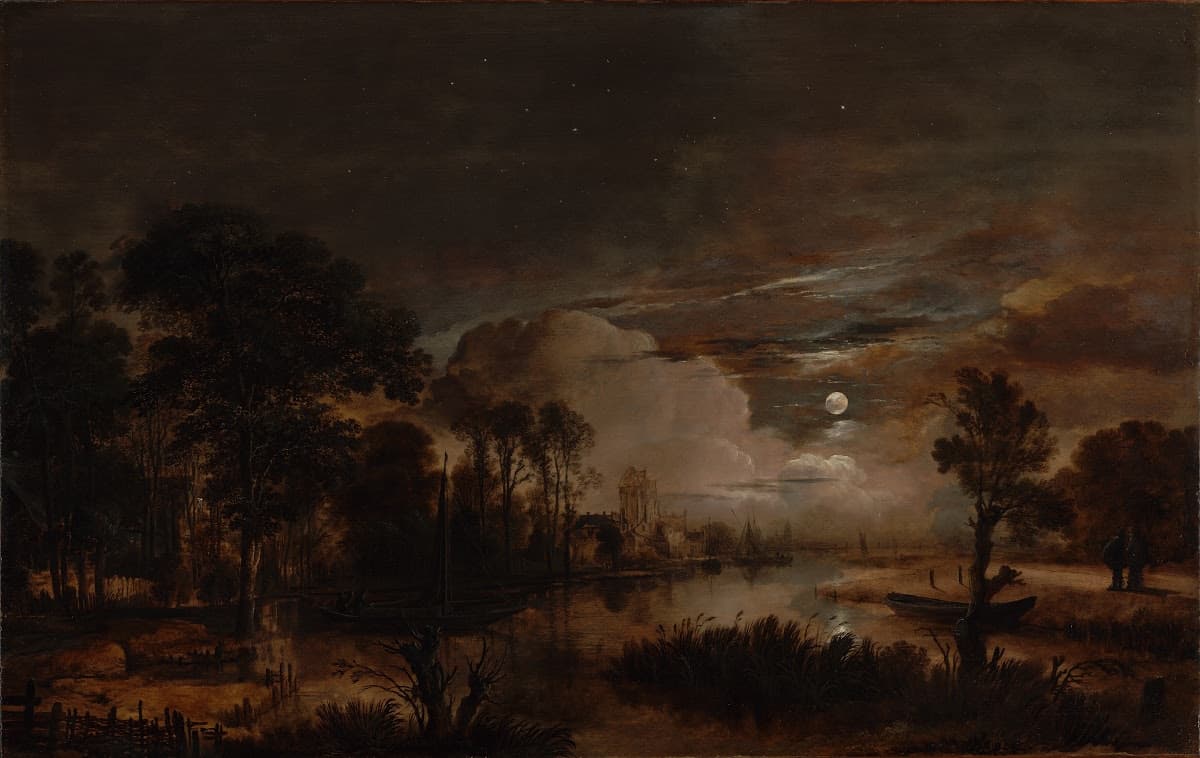
Moonlit Landscape with a View of the New Amstel River and Castle Kostverloren
Aert van der Neer · c. 1647
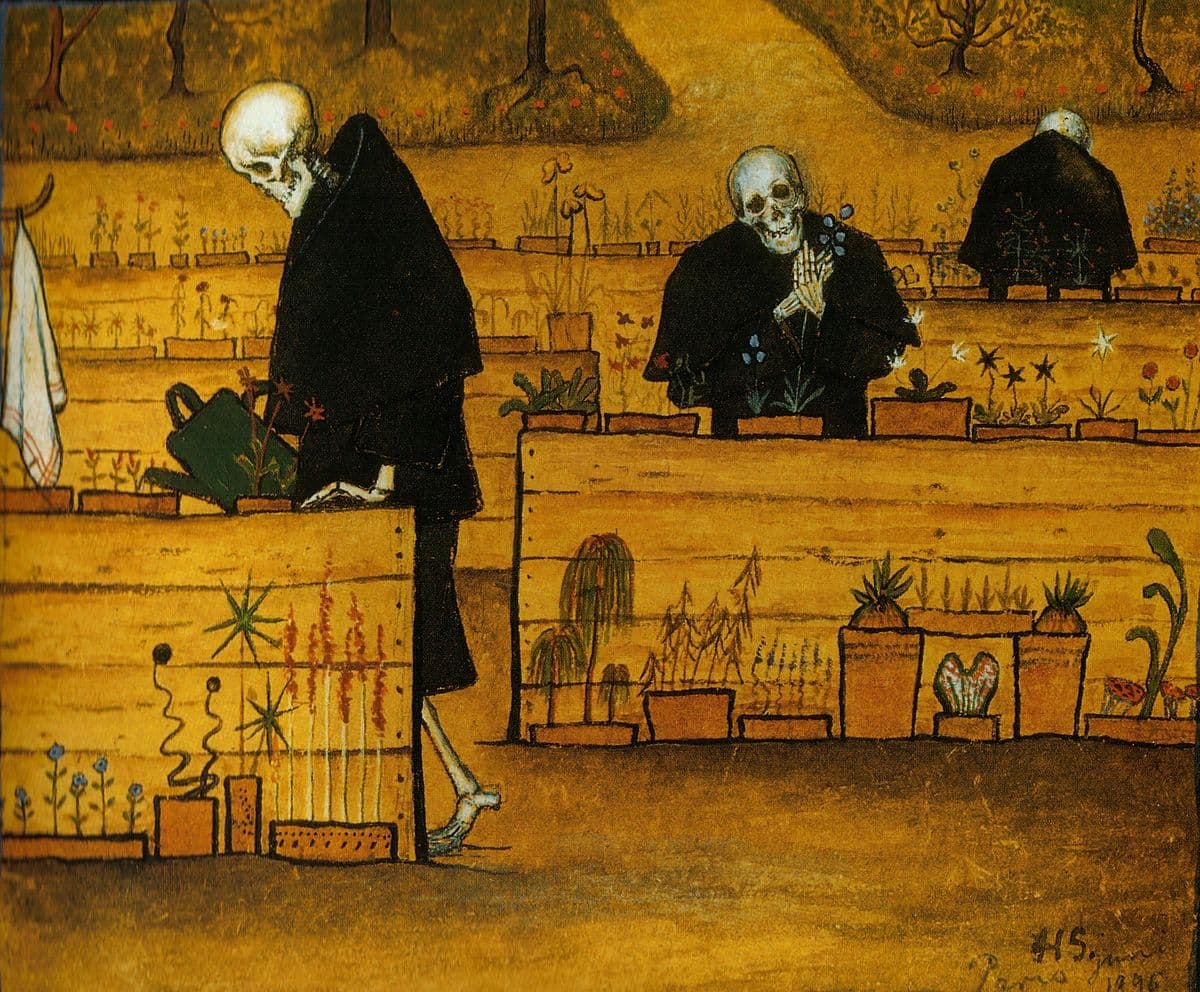
The Garden of Death
Hugo Simberg · 1896
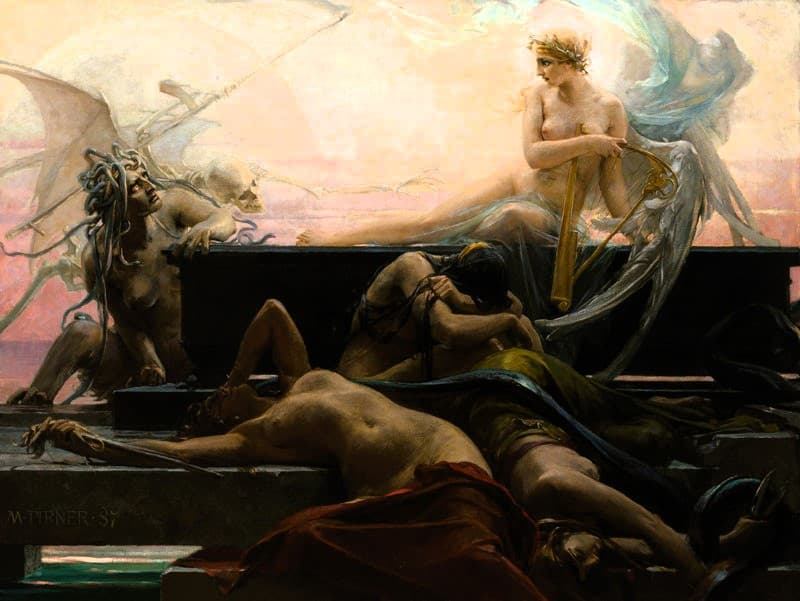
Finis (The End of All Things)
Maximilian Pirner · 1887

Bridge over a Pond of Water Lilies
Claude Monet · 1899

Nymphs Dancing to Pan's Flute
Joseph Tomanek

The Scream
Edvard Munch · 1893

The Thinker
Auguste Rodin · Modeled 1880–82; enlarged 1902–03; this cast 1904

Saturn Devouring His Son
Francisco Goya · c. 1819–1823