German · Symbolism · Art Nouveau (Jugendstil) · Munich Secession
Franz von Stuck
b. 23 February 1863, Tettenweis, Bavaria — d. 30 August 1928, Munich
Franz von Stuck (1863–1928) was a German Symbolist painter, sculptor and architect, co-founder of the Munich Secession, known for dark, sensual images such as The Sin and Lucifer and for teaching Kandinsky and Klee.
1 work in the collection
Works by Franz von Stuck
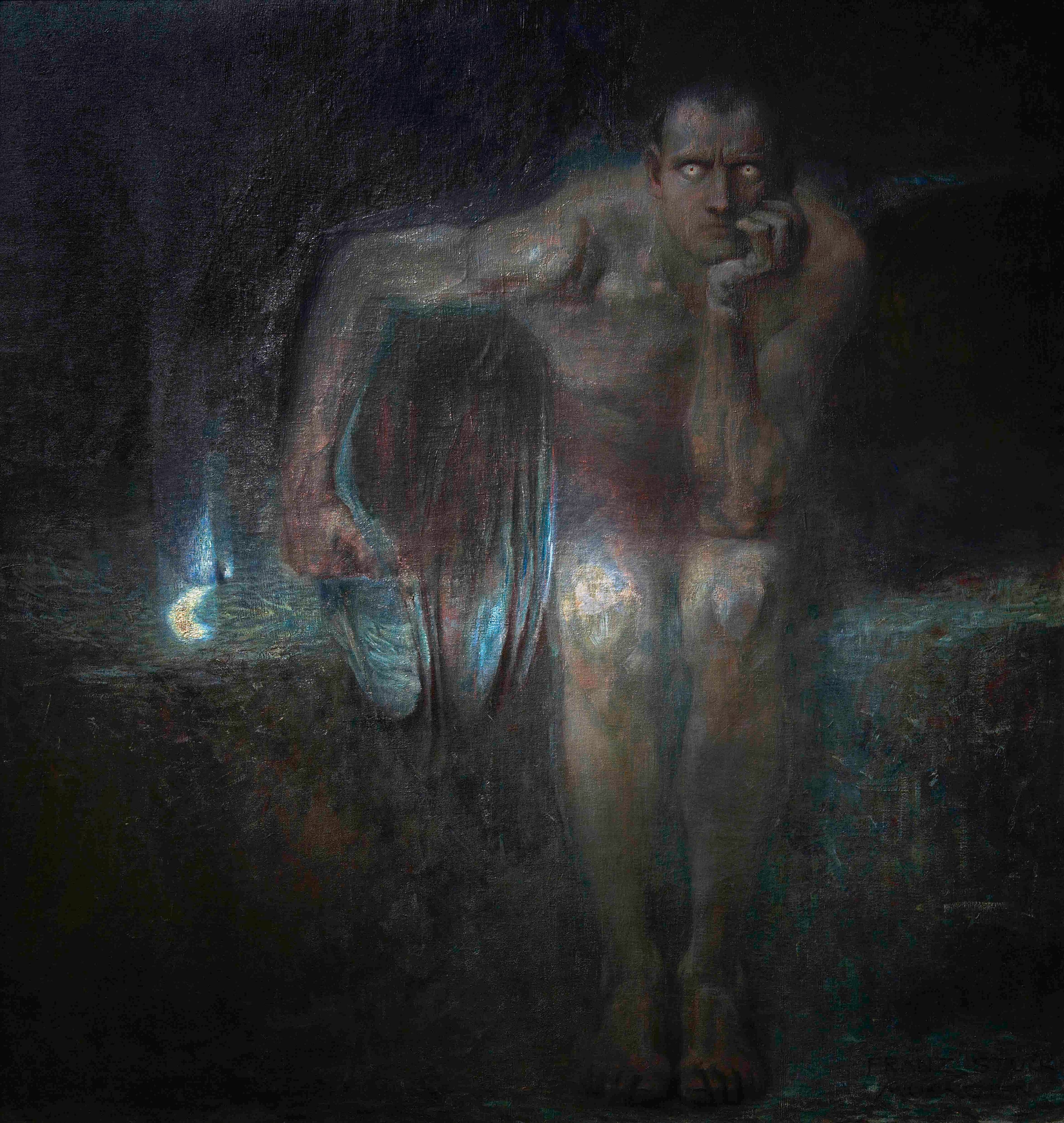
Franz von Stuck was the leading painter of Munich around 1900, a Symbolist whose images of temptation, guilt and demonic beauty were famous across Europe. His Lucifer (1890), a crouching fallen angel staring out of the dark with luminous eyes, is in the National Gallery in Sofia, Bulgaria.
Life in brief
The son of a miller, Stuck was born in 1863 in Tettenweis in Lower Bavaria. He studied at the Munich School of Applied Arts and then the Academy, and first made his name drawing caricatures and vignettes for the magazine Fliegende Blätter. His painting The Guardian of Paradise won a gold medal in 1889. In 1892 he was among the founders of the Munich Secession, the breakaway exhibiting society that challenged the official art establishment, and in 1895 he became a professor at the Munich Academy. He was ennobled in 1906, becoming Ritter von Stuck, and died in Munich in 1928.
Style
Stuck's pictures combine classical myth and biblical subject with a heavy, theatrical darkness. Bodies glow against black or deep green grounds; snakes, sphinxes, fauns and centaurs recur. He designed his own frames, often gilded and architectural, with titles cut into them, so that each painting reads as a shrine. His most notorious image, The Sin (1893, Neue Pinakothek, Munich), shows a nude woman emerging from shadow with a great python coiled around her body; he painted many versions.
Lucifer belongs to the same imagination. The fallen angel sits hunched on a rock, chin on fist, wings dark, eyes burning. Stories that its stare frightened those who saw it belong to legend rather than record. It was acquired by Ferdinand of Saxe-Coburg and Gotha, ruler of Bulgaria, which is why it is in Sofia.
Villa Stuck and teaching
In 1897–98 Stuck built and decorated the Villa Stuck in Munich, a total work of art in which architecture, furniture and painting were designed as one. As a teacher at the Academy he had extraordinary pupils, among them Wassily Kandinsky, Paul Klee and Josef Albers, who later moved in directions he did not share.
Where to see his work
The Villa Stuck is now a museum. Major paintings are in the Neue Pinakothek, Munich, and the National Gallery, Sofia. Compare his Viennese contemporary Gustav Klimt, and explore Fallen Angels in Art and Symbolism.
Questions & answers
What is Franz von Stuck known for?
Franz von Stuck is known for dark, sensual Symbolist paintings such as The Sin (1893) and Lucifer (1890), for co-founding the Munich Secession in 1892, for designing the Villa Stuck in Munich, and for teaching Kandinsky, Klee and Albers at the Munich Academy.
Where is Franz von Stuck's Lucifer?
Lucifer (1890) is in the National Gallery in Sofia, Bulgaria. It was acquired by Ferdinand of Saxe-Coburg and Gotha, who ruled Bulgaria as prince and later tsar, and it passed into the Bulgarian national collections.
Can you visit the Villa Stuck?
Yes. The Villa Stuck in Munich, built in 1897–98 as Stuck's home and studio, is now a museum. Its restored historic rooms show his paintings, furniture and decoration together, and it also hosts changing exhibitions of art and design.