Contemporary figurative sculpture
Pietà (Jago)
Jago (Jacopo Cardillo), 2020–21
Pietà is a marble sculpture by the Italian artist Jago (Jacopo Cardillo), carved in Naples and completed in 2021. Instead of the Virgin and Christ, it shows a kneeling father holding the body of his dead son. It is now in the Jago Museum in Naples.
- Artist
- Jago (Jacopo Cardillo)
- Date
- 2020–21
- Medium
- Marble
- Collection
- Jago Museum, Sant'Aspreno ai Crociferi, Naples, Italy
- Movement
- Contemporary figurative sculpture
Jago's Pietà is a life-size marble group carved by the Italian sculptor Jacopo Cardillo, known as Jago, in his Naples studio in the deconsecrated church of Sant'Aspreno ai Crociferi, over about sixteen months spanning 2020 and 2021. It was first shown in Rome, in the Cappella del Crocifisso of the basilica of Santa Maria in Montesanto, the "Church of the Artists" on Piazza del Popolo, from October 2021 to February 2022. It has since returned to Naples and is displayed in the Jago Museum at Sant'Aspreno, in the Rione Sanità.
What you're looking at
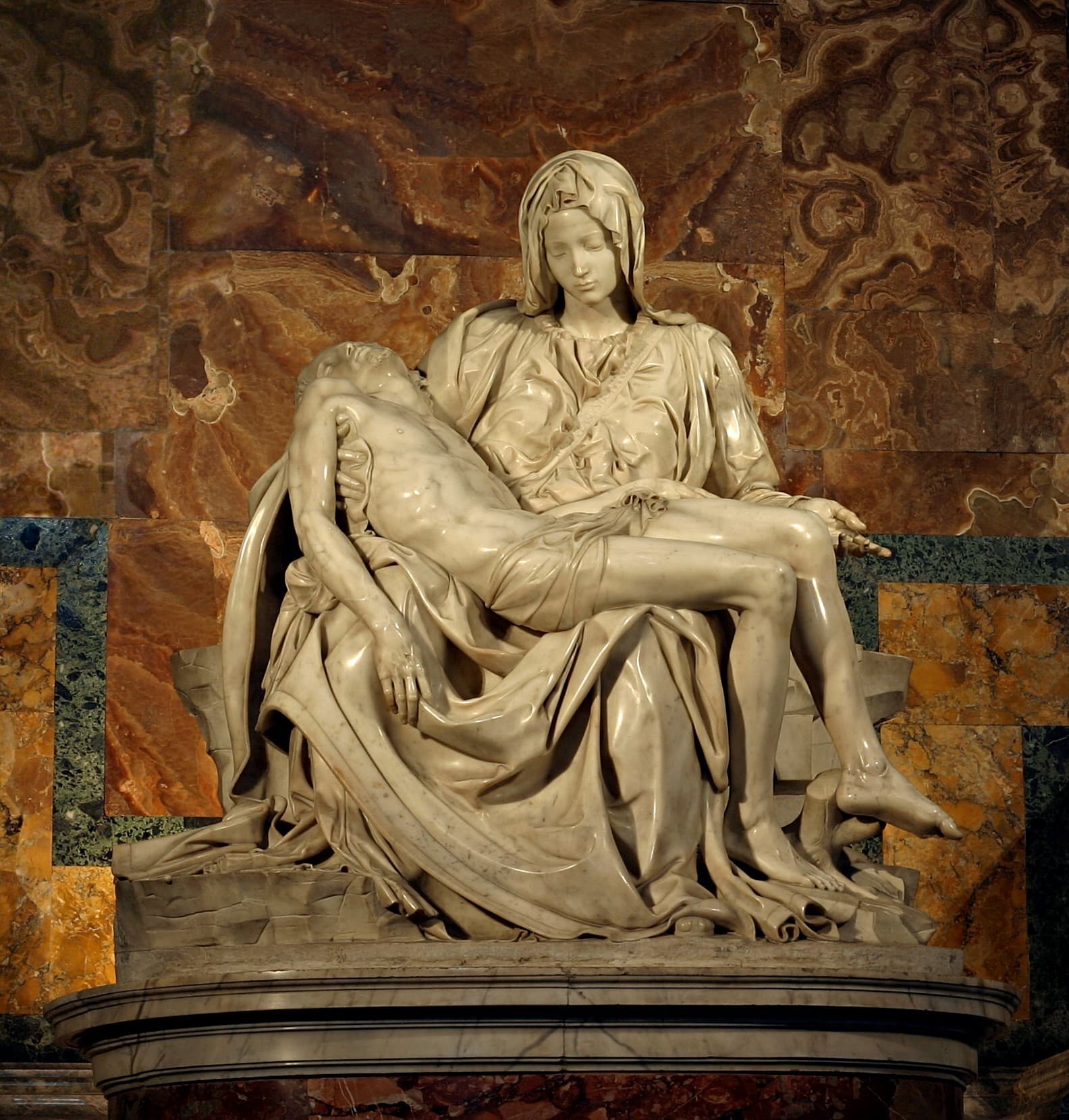
The sculpture rewrites the most famous image in Christian sculpture. In place of the Virgin Mary holding the dead Christ, as in Michelangelo's Pietà, Jago shows a man, a father, down on one knee and lifting the body of his grown son from the ground. Both are nude. The father is bald and heavily built, his chest and shoulders modeled with dense realism, and his face is not serene: it is distorted by grief, the features pulled into a grimace of pain that some viewers at first read almost as a smile. Jago has said he wanted the father's suffering to show in the face rather than to idealize it.
The son lies limp across his father's raised thigh, his head thrown back and hanging, his long hair falling toward the ground, one arm dangling. The weight of the body is palpable: the father's hand presses into the son's side, the son's legs slide off at the right. The marble is polished to a soft sheen on the skin and left slightly rougher on the base.
In the photograph shown here the sculpture is still in the studio-church, surrounded by scaffolding, a ladder and a mallet resting on the base, while a shaft of daylight cuts through the dust from a high window. It is an unusually direct view of a contemporary marble being made in a Baroque setting, the way sculptors worked for centuries.
Meaning
Jago's change of protagonist is the point. By removing the Virgin and the haloes, he turns the Pietà from a doctrinal image into a universal one: any parent mourning any child. Coming in the years of the COVID-19 pandemic, and shown first in a church dedicated to artists, the work was widely read as a meditation on collective loss. The Vatican newspaper L'Osservatore Romano described it simply as a father raising his son's lifeless body from the ground, a gesture anyone who has lost a child can recognize.
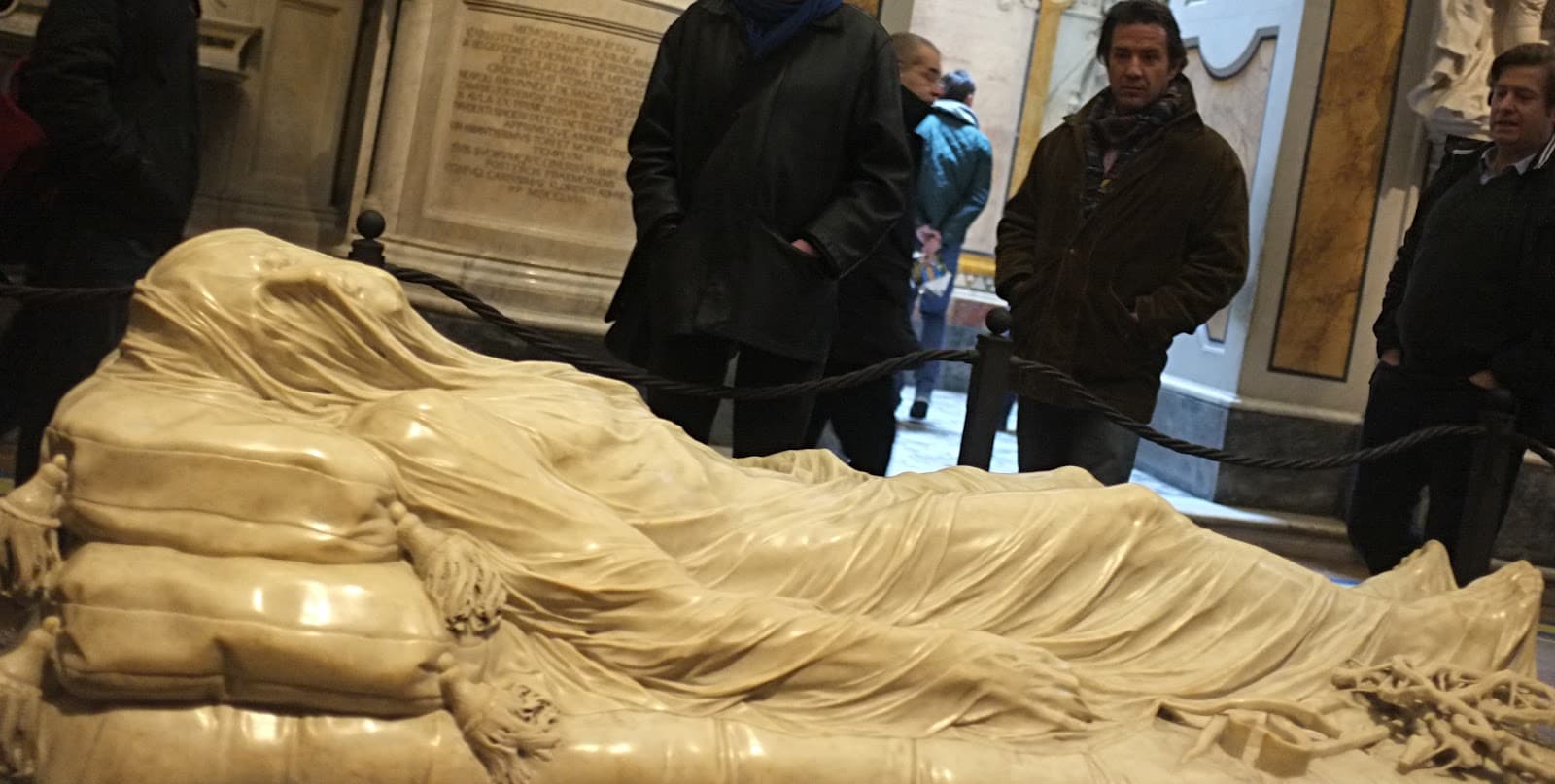
The choice of a father also reflects Jago's broader interest in updating classical models. His earlier Figlio Velato (Veiled Son, 2019), now in the chapel of San Severo fuori le Mura in Naples, answered Giuseppe Sanmartino's eighteenth-century Veiled Christ with a child under a marble shroud.
The artist
Jago, born in 1987, is one of the best-known Italian sculptors of his generation, partly because he documents his carving process on social media. His works include Habemus Hominem, a bust of Pope Benedict XVI that he later re-carved bare-chested after the pope's resignation, and The First Baby, a small marble sent to the International Space Station in 2019. He works almost entirely in marble, using traditional techniques alongside modern power tools, and has been compared, often by the press, to the Renaissance masters whose subjects he reworks.
Related works
For the traditions behind this sculpture, see Michelangelo's Pietà, Veiled Christ and the modern War Pieta by Max Ginsburg. More marble in Famous Sculptures.
Where to see it
The Jago Museum, in the former church of Sant'Aspreno ai Crociferi in Naples's Rione Sanità, where the sculpture was carved. Check the museum's website for opening hours and current displays, since works sometimes travel to exhibitions.
Questions & answers
Where is Jago's Pietà?
Jago's Pietà is in the Jago Museum in Naples, in the former church of Sant'Aspreno ai Crociferi in the Rione Sanità, where it was carved. It was first exhibited in Rome at Santa Maria in Montesanto, the Church of the Artists on Piazza del Popolo, from October 2021 to February 2022.
What does Jago's Pietà represent?
Instead of the Virgin Mary holding the dead Christ, it shows a kneeling father lifting the body of his dead son. Jago wanted to show the father's grief openly in his face. Made during the pandemic years, it is widely read as a universal image of a parent's loss.
When did Jago make the Pietà?
He carved it in marble over about sixteen months in 2020 and 2021, in his studio in the church of Sant'Aspreno ai Crociferi in Naples. It was unveiled in Rome in October 2021 and returned to Naples after the exhibition closed.
Who is Jago?
Jago is the professional name of Jacopo Cardillo, an Italian sculptor born in 1987. He works mainly in marble and is known for Habemus Hominem, a bust of Pope Benedict XVI; Figlio Velato (Veiled Son); The First Baby, sent to the International Space Station; and this Pietà.
Kindred works
You may also study
Pietà
Michelangelo · 1498–1499
Veiled Christ
Giuseppe Sanmartino · 1753

War Pietà
Max Ginsburg · 2007
Body of Christ
Lizz Lopez
The Thinker
Auguste Rodin · Modeled 1880–82; enlarged 1902–03; this cast 1904

Venus de Milo
Alexandros of Antioch · c. 150–125 BC

Nymphs Dancing to Pan's Flute
Joseph Tomanek

The Scream
Edvard Munch · 1893