Italian · Contemporary painting
Nicola Samorì
b. 13 May 1977, Forlì, Italy
Nicola Samorì (born 1977) is an Italian painter and sculptor who paints in the manner of seventeenth-century masters and then wounds the image, peeling, scraping and cracking the paint so that faces tear and dissolve.
1 work in the collection
Works by Nicola Samorì
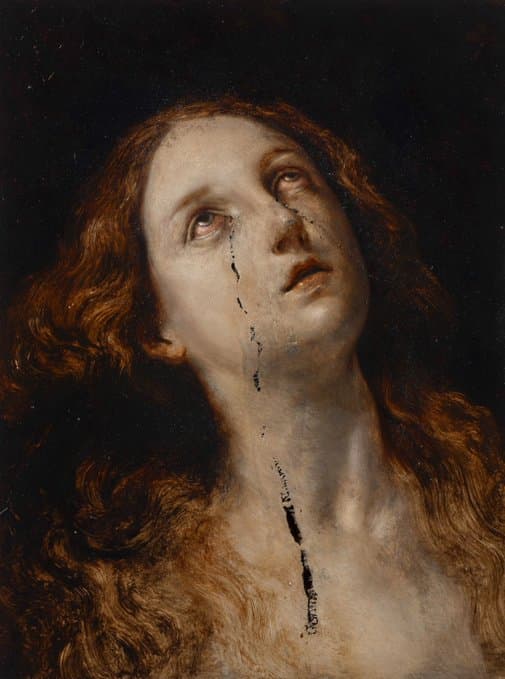
Nicola Samorì is an Italian painter and sculptor, born in Forlì in 1977, who lives and works in Bagnacavallo, near Ravenna. His paintings look at first like Baroque altarpieces or portraits in the manner of Guido Reni, Jusepe de Ribera or the followers of Caravaggio. Look again, and the surface has been attacked: skin peeled back like a sheet, faces dragged sideways, eyes scraped out, paint split open in cracks.
Life in brief
Samorì studied at the art high school in Ravenna and then at the Accademia di Belle Arti in Bologna, where he graduated in 2004. He took part in the Venice Biennale in 2011 and again in 2015, in the Italian Pavilion's Codice Italia exhibition curated by Vincenzo Trione. He has shown widely in Europe, with the gallery Eigen + Art in Germany among his long-standing supporters, and has held exhibitions in historic settings such as the Museo di Capodimonte in Naples, where his damaged figures hang in conversation with the old masters who inspired them.
Style and technique
Samorì first paints with the patience of a seventeenth-century workshop, building up a convincing figure in oil. Then he intervenes, with palette knives, solvents or his hands, lifting the still-soft skin of paint, scraping through it, or letting it slide. He also paints on stone, such as onyx and marble, where natural veins and fissures interrupt the image, and carves marble sculptures that are partly finished and partly broken. The process turns painting into something physical and vulnerable, and makes the viewer conscious of how fragile the old masterpieces themselves are.
Lacrimosa
In Lacrimosa a red-haired young woman in the type of a Baroque Magdalene turns her eyes upward, and her tears are real ruptures in the paint, dark cracks running down her cheeks and throat. The title is Latin for tearful, the opening word of a verse of the Dies irae sung in the Requiem Mass, and familiar from Mozart's Requiem. The painting weeps with its own material.
Where to see his work
Samorì's work is shown by European galleries and in museum exhibitions in Italy and abroad, and is held in public and private collections. For the tradition he answers, see Baroque Art and Caravaggio Paintings.
Questions & answers
Who is Nicola Samorì?
Nicola Samorì is an Italian painter and sculptor born in Forlì in 1977. He paints figures in the style of seventeenth-century masters and then damages the surface, peeling, scraping or cracking the paint, and he has shown twice at the Venice Biennale.
Why does Nicola Samorì destroy his paintings?
Samorì's interventions are part of the work, not destruction for its own sake. By wounding a carefully painted surface he makes the paint itself suffer like a body, and draws attention to the fragility of images and of the old-master tradition he borrows from.
What does Lacrimosa mean?
Lacrimosa is Latin for tearful. It begins a verse of the Dies irae in the Requiem Mass. In Samorì's painting the weeping woman's tears are actual cracks in the paint.