Contemporary realism
War Pietà
Max Ginsburg, 2007
War Pietà is a 2007 oil painting by the American realist Max Ginsburg: a mother wails as she cradles her maimed, bloodied soldier son on a flag before burning oil derricks, a Pietà recast as a protest against the Iraq War.
- Artist
- Max Ginsburg
- Date
- 2007
- Medium
- Oil on canvas
- Dimensions
- 127 × 152.4 cm (50 × 60 in)
- Movement
- Contemporary realism
What you are looking at
A young American soldier lies across his mother's lap on a scorched, oil-slicked plain. He is stripped to the waist, his chest and belly soaked with blood, and both of his arms end in thick, blood-red bandaged stumps. His legs, still in camouflage trousers and desert boots, are wrapped in more bandages at the knee. His dog tags lie on his bare chest. He may be dying or already dead; Ginsburg leaves that moment open.
The mother sits upright behind him, a brown shawl drawn over her head like a veil, her white blouse falling from one shoulder. She cradles his head against her breast with both hands and throws her own head back, eyes shut, mouth wide in a howl. It is the loudest face Ginsburg ever painted.
Around them lies the debris of a firefight, laid out almost like a still life. An American flag is crumpled beneath the soldier's body, its stripes running into his blood. His helmet sits upturned on the ground, filling with blood. There is a canteen, an assault rifle lying across the flag, and a scatter of brass shell casings glinting in the lower right. Behind, under a sky turned black and ochre by smoke, a line of oil derricks stands in a burning field, with flames breaking out along the horizon and pools of oil reflecting the fire in the foreground.
Why is it called War Pietà?
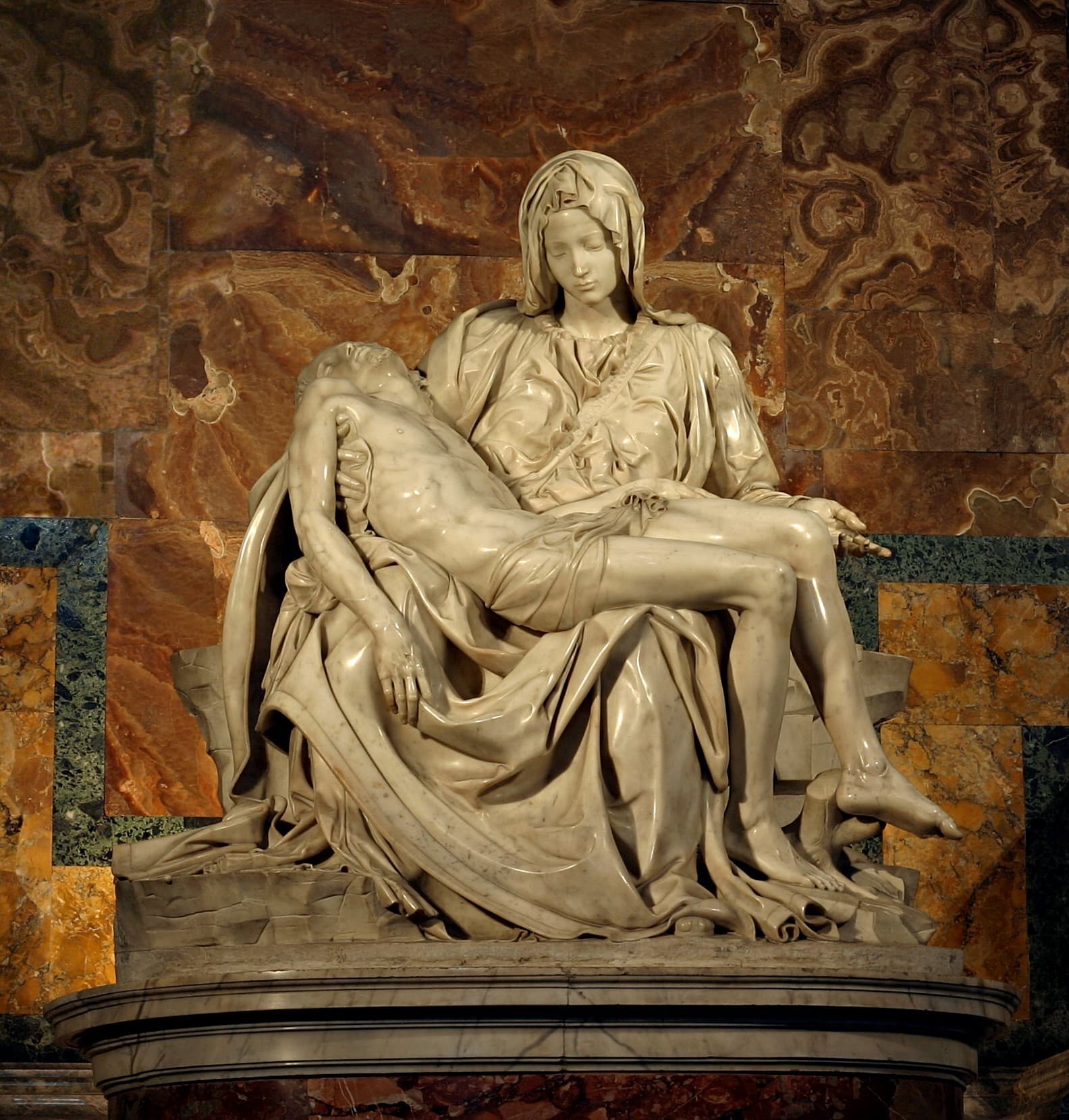
A pietà (Italian for pity or compassion) is the Christian image of the Virgin Mary holding the dead body of Christ after the Crucifixion. Its most famous form is Michelangelo's Pietà in St. Peter's Basilica, where a serene young Mary holds her son across her knees. Ginsburg borrows that exact arrangement, the son's body laid diagonally across the mother's lap, and keeps telling marks of the type: the veil over the mother's head, her pale garment, the son's bared torso.
What he changes is the emotion. Michelangelo's Mary is composed and inward. Ginsburg's mother is a contemporary woman in open, physical grief, closer to the shrieking mourners of medieval lamentations than to Renaissance calm. The son is not a god whose death has meaning in a larger story but an ordinary young man, maimed by the war he was sent to fight.
What does War Pietà mean?
Ginsburg painted the picture in 2007, at the height of the Iraq War, and it is an openly political work. In an interview with the Portland street newspaper Street Roots, he described being so angry about the war that he felt he had to express that emotion without holding anything back. The setting makes his argument. The burning oil derricks recall the oil-well fires of the Gulf War and the slogan of many antiwar protests of the 2000s, no blood for oil. The flag under the body ties the soldier's sacrifice to the nation that sent him, and the blood-filled helmet turns a piece of equipment into a cup of sacrifice.
The painting is a lament as much as a protest. Ginsburg does not show the enemy, the battle or the politicians. He shows the cost, measured in one body and one mother. That focus on the individual is consistent with the rest of his work, which records homelessness, foreclosure, protest and labor on the streets of New York.
Who is Max Ginsburg?
Max Ginsburg (born 1931) is an American realist painter based in New York. He first learned to paint from his father, the portrait painter Abraham Ginsburg, attended the High School of Music & Art, earned a BFA at Syracuse University and an MA at City College of New York. He taught for more than two decades at the High School of Art and Design and later at the School of Visual Arts and the Art Students League of New York, and worked as a commercial illustrator, painting book covers, from 1980 to 2004.
His style belongs to the American realist tradition of careful drawing from life, with models posed in the studio. War Pietà shows that method under pressure: every fold of the shawl and every shell casing is observed, yet the picture is built like a history painting, with a dramatic sky and a carefully staged pyramid of figures.
How it is painted
The palette is held in a narrow range of earth browns, smoky grays and black, so that three colors stand out: the white of the mother's blouse, the red of blood and bandages, and the red, white and blue of the flag. The flag's stripes and the blood-soaked dressings are painted in the same red, a deliberate rhyme. The light falls from the left onto the mother's face and the soldier's chest, as if from a stage spotlight, while the fires on the horizon give the dark sky a dull orange underglow.
Where is War Pietà now?
War Pietà is oil on canvas, 50 × 60 inches (about 127 × 152 cm), dated 2007. No public museum is recorded as owning it, and it appears to remain with the artist. It has been shown in several of Ginsburg's exhibitions, including Max Ginsburg: The Realities of Our Times at the ArtRage Gallery in Syracuse in 2014, and was among works by Ginsburg in a group show that toured museums in China in 2012–13. His 2011 retrospective at the Butler Institute of American Art in Youngstown, Ohio, brought wider attention to his social subjects.
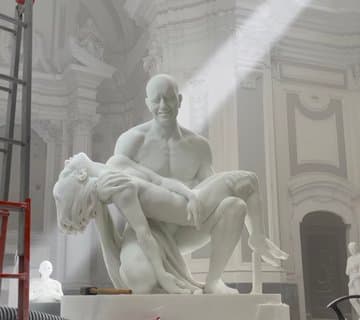
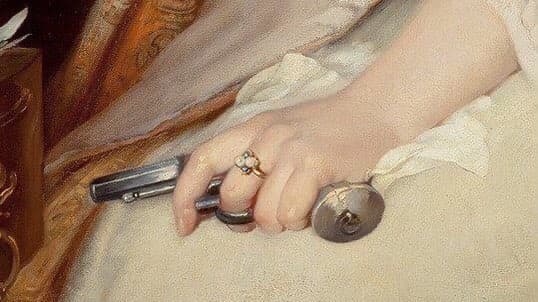
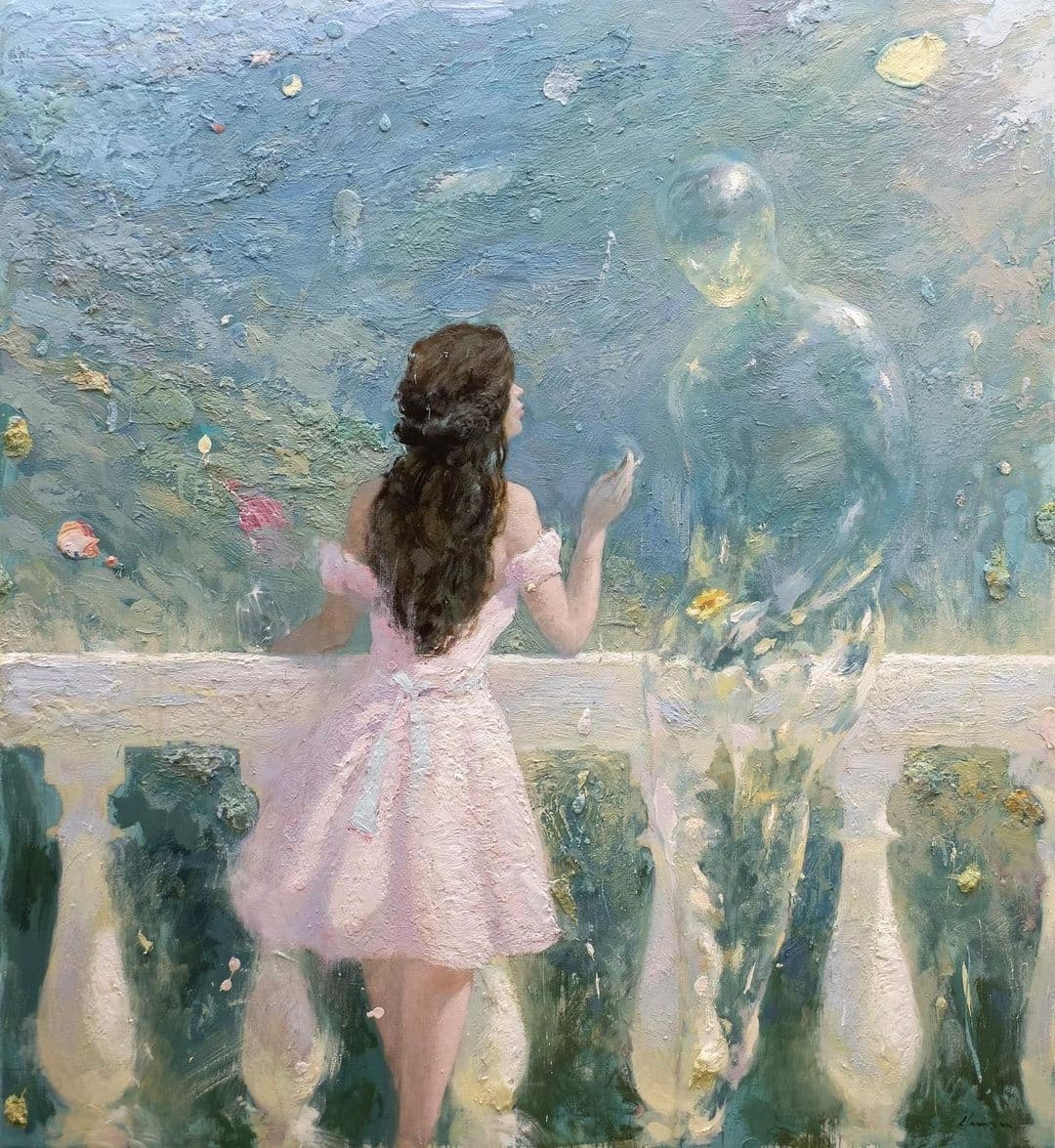
For related images of mourning, see the contemporary marble Pietà by Jago, The Telegram by Luise Max Ehrler, and the wider survey in Death in Art.
Questions & answers
Who painted War Pietà?
War Pietà was painted in 2007 by Max Ginsburg (born 1931), a New York realist painter and longtime teacher at the School of Visual Arts and the Art Students League. It is one of his best-known social paintings, alongside works on homelessness, foreclosure and the Abu Ghraib torture scandal.
What does War Pietà mean?
It recasts the Pietà, the Virgin Mary mourning the dead Christ, as an American mother holding her maimed soldier son. Painted during the Iraq War, with burning oil derricks behind and a flag beneath the body, it protests the human cost of the war. Ginsburg has said he painted it out of outrage.
Is War Pietà based on Michelangelo's Pietà?
It borrows the Pietà type that Michelangelo made famous: a mother holding her dead son across her lap. Ginsburg keeps the veil and the diagonal body but swaps Mary's calm for an open scream, and the divine Christ for an ordinary, wounded young soldier.
Where is War Pietà by Max Ginsburg?
No museum is recorded as owning War Pietà; it appears to remain in the artist's collection. The 50 × 60 inch oil has been shown in Ginsburg's exhibitions, including at ArtRage Gallery in Syracuse in 2014, and in a touring group show in China in 2012–13.
Kindred works