Swiss · Symbolism
Arnold Böcklin
b. 16 October 1827, Basel — d. 16 January 1901, San Domenico di Fiesole, near Florence
Arnold Böcklin (1827–1901) was a Swiss Symbolist painter best known for Isle of the Dead, five versions of a silent cypress island that became one of the most reproduced images of death in modern art.
1 work in the collection
Works by Arnold Böcklin
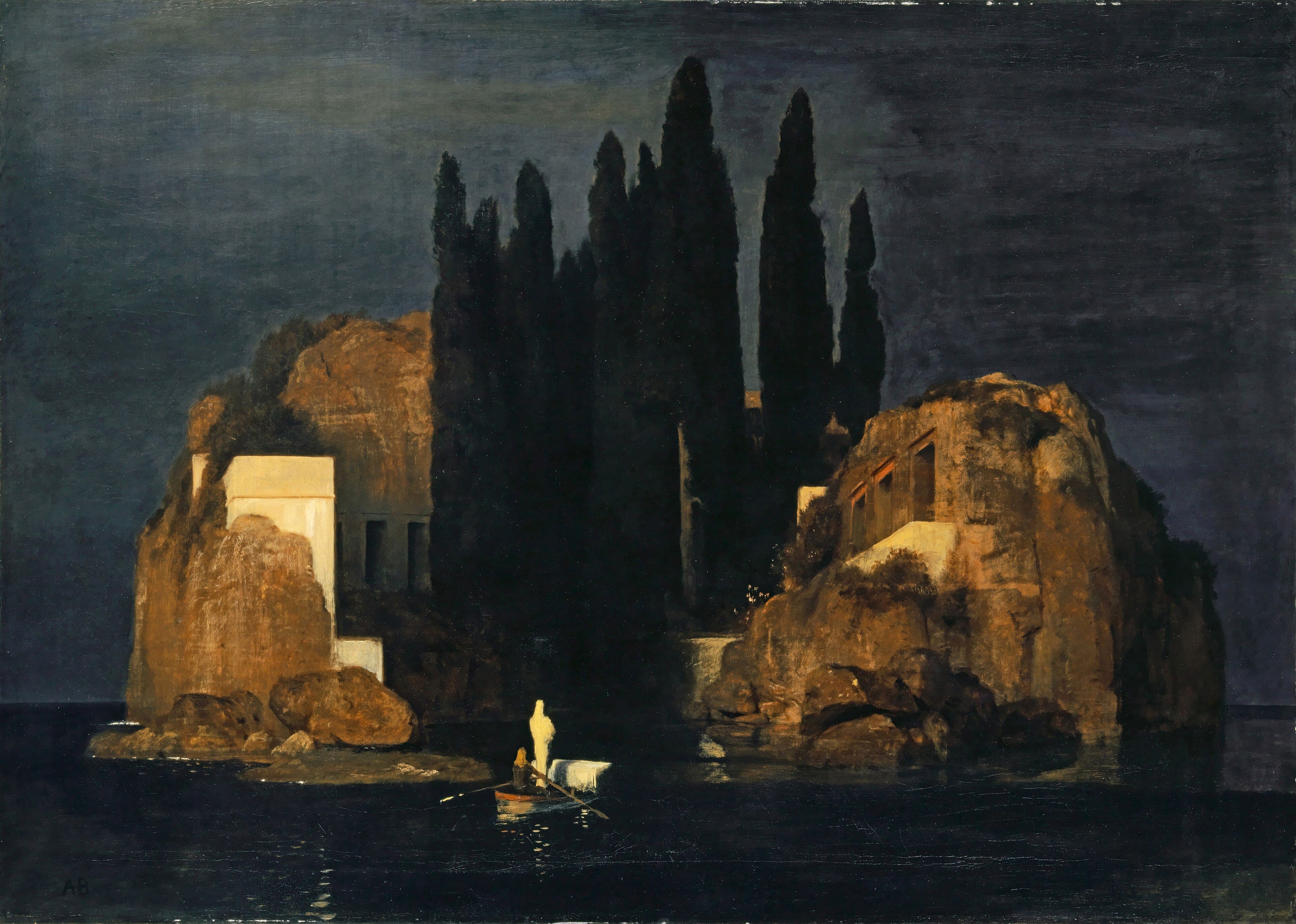
Arnold Böcklin was a Swiss painter who spent much of his life in Italy and became, by the 1890s, one of the most admired artists in the German-speaking world. He is remembered above all for Isle of the Dead, which he painted in five versions between 1880 and 1886; the first is in the Kunstmuseum Basel.
Life in brief
Born in Basel in 1827, Böcklin trained at the Düsseldorf Academy under the landscape painter Johann Wilhelm Schirmer, then traveled to Brussels, Paris and, in 1850, Rome. Italy became his true subject. He taught briefly at the new art school in Weimar (1860–62), and moved between Basel, Munich, Florence and Zurich before settling near Florence. Recognition came late and then overwhelmingly: by his seventieth birthday in 1897 he was celebrated with exhibitions in Basel, Berlin and Hamburg. He died at his villa at San Domenico, near Fiesole, in 1901.
Style
Böcklin painted landscapes peopled by myth: centaurs, nymphs, tritons and fauns, rendered with solid, almost sculptural bodies in strong, sometimes harsh color. His art sits between late Romanticism and Symbolism. The mood is the point: a sea that seems to watch, a wood that holds its breath. In his Self-Portrait with Death Playing the Fiddle (1872, Alte Nationalgalerie, Berlin) a skeleton leans over his shoulder and plays a single string while the painter listens, brush in hand.
Isle of the Dead
The first version was painted in 1880 in Florence. Before he had finished it, a widow, Marie Berna, visited his studio and asked for a picture to dream by; he painted her a second version (now in the Metropolitan Museum of Art) and added the small white-draped figure and coffin in the boat. Three more versions followed. The third (1883) is in the Alte Nationalgalerie, Berlin, and was once owned by Adolf Hitler; the fourth (1884) was destroyed in the Second World War; the fifth (1886) is in Leipzig. Böcklin himself never explained the image, and the title was supplied by his dealer.
Influence
Prints of Isle of the Dead hung in countless middle-class homes around 1900. Sergei Rachmaninoff based a tone poem on it (1909), Giorgio de Chirico and the Surrealists admired it, and Salvador Dalí painted his own variations. Its funereal calm connects him with Symbolists such as Hugo Simberg.
Where to see his work
The Kunstmuseum Basel holds the largest group, with major works in Berlin, Leipzig, Munich and New York. Continue with Symbolism and Death in Art.
Questions & answers
What is Arnold Böcklin famous for?
Böcklin is famous for Isle of the Dead, a painting of a rowing boat carrying a white-draped figure toward a rocky island of cypresses, which he painted in five versions between 1880 and 1886. He is a leading figure of Swiss and German Symbolism.
Where is Isle of the Dead?
Four of the five versions survive. The first (1880) is in the Kunstmuseum Basel, the second (1880) in the Metropolitan Museum of Art, New York, the third (1883) in the Alte Nationalgalerie, Berlin, and the fifth (1886) in the Museum der bildenden Künste, Leipzig. The fourth was destroyed in the Second World War.
What does Isle of the Dead mean?
Böcklin never explained it; he called it a picture for dreaming. Most viewers read the boat as a funeral crossing to a burial island, echoing Charon ferrying souls over the Styx. The title was given by his dealer, Fritz Gurlitt, in 1883.