Neoclassicism
Undine Rising from the Waters
Chauncey Bradley Ives, 1880
Undine Rising from the Waters is a marble statue by the American sculptor Chauncey Bradley Ives, carved in Rome and dated 1880 by its owner, the Yale University Art Gallery. It shows the water spirit Undine lifting a wet veil as she rises from a well, famous for its illusion of transparent drapery.
- Artist
- Chauncey Bradley Ives
- Date
- 1880
- Medium
- Marble
- Dimensions
- 153.7 × 48.3 × 39.4 cm
- Collection
- Yale University Art Gallery, New Haven, United States
- Movement
- Neoclassicism
What you are looking at
A young woman rises upward, her arms lifted above her head, holding a veil that falls around her like water pouring off her body. Her head is tilted back and her face turned up, eyes half closed, as if she were surfacing into air. The thin fabric clings to her: you can see the shape of her breasts, her navel and the curve of her hips through it, while at the sides it hangs in long, heavy folds and pools behind her. The whole figure is carved from a single block of white marble, about one and a half meters high.
This is Undine, often called Undine Rising from the Waters, by the American sculptor Chauncey Bradley Ives. The Yale University Art Gallery in New Haven, Connecticut, which owns this marble, dates it to 1880 and records that it was made in Rome. It is one of the most admired American sculptures of the nineteenth century for one reason above all: the illusion of wet, transparent cloth over flesh.
Who was Undine?
Undine is a water spirit, or elemental, of European folklore. The name comes from the Latin unda, a wave. The Renaissance physician Paracelsus described undines as water beings without souls who could gain one by marrying a human. The story was made famous by the German Romantic writer Friedrich de la Motte Fouqué, whose novella Undine (1811) was read across Europe and America throughout the nineteenth century.
In Fouqué's tale, Undine is raised by a fisherman's family and marries the knight Huldbrand, gaining a human soul through their love. But Huldbrand grows cold and turns to another woman, Bertalda. By the laws of the water spirits, an unfaithful husband must die. On the night of Huldbrand's second wedding, the stone that seals the castle well is removed, and Undine rises from it, veiled, to come to him and take his life with a kiss.
Ives's statue shows that moment of rising. The Yale gallery describes her as rising "like a fountain" to claim his life. She is both lover and avenger, beautiful and fatal, and the veil she lifts is the sign of what she is about to reveal.
Looking closely
The technical feat is the drapery. Marble is opaque and hard, yet Ives makes it read as thin, soaking wet fabric. Where the cloth lies against the body, he carves the forms beneath with very low relief, keeping the folds shallow and sharp so they look like wrinkles in wet silk. Where it lifts away, over the raised arms and down the back, he cuts deeper, heavier folds that suggest weight and water streaming off.
Walk around the statue, if you can. The upward thrust of the pose, arms raised, head back, gives the figure a vertical surge, a fountain-like motion that matches the story. Look at the face: the parted lips and closed eyes hold an expression somewhere between ecstasy and sorrow, appropriate for a creature who loves the man she must kill.
The "veiled" effect was a specialty of Italian sculptors from the eighteenth century onward. Antonio Corradini's La Pudicizia in Naples and Giuseppe Sanmartino's Veiled Christ are the famous precedents, and the technique enjoyed a revival in Rome and Florence in the nineteenth century, where Ives worked.
Chauncey Bradley Ives
Ives was born in 1810 in Hamden, Connecticut, near New Haven, and began as a woodcarver. Like many American sculptors of his generation, he went to Italy for its marble, skilled carvers and classical models, settling first in Florence in 1844 and then in Rome in 1851, where he spent the rest of his life. He died there in 1894.
His studio produced portrait busts and ideal figures drawn from the Bible, literature and myth, many of them carved in multiple copies for American collectors. Undine was among his most successful subjects. Ives first modeled it in the 1850s, and a smaller first version was carved in several examples; in 1880 he reworked the composition. Yale's large marble carries that later date. Other examples are held by American museums, including the High Museum of Art in Atlanta.
Ives belongs to the circle of American sculptors in Italy that included Hiram Powers and Thomas Ridgeway Gould, whose West Wind shares the same polished ideal style. Compare too the Italian Pietro Tenerani's Psyche in a Faint.
Meaning and reception
For Victorian audiences, Undine was a perfect subject: literary, romantic, morally serious and an excuse to show a beautiful female body in a respectable context. The statue explores love, betrayal and the price of a soul, while the wet drapery allows the viewer to admire the nude under the cover of the story. Modern viewers often see in it a figure close to the femme fatale of later Symbolist art: the woman as an elemental force, irresistible and dangerous.
The piece has found a new audience online, where images of the "wet veil" statue circulate widely as a marvel of carving. It belongs with the works in our guide to famous sculptures.
Where to see it
The marble is in the Yale University Art Gallery in New Haven, Connecticut (accession 1926.116), the gift of Mrs. Alice A. Allen in memory of her father, Simon Sterne. Admission to the gallery is free. Ives's birthplace, Hamden, is only a few miles away.
Questions & answers
Where is Undine Rising from the Waters?
The large marble Undine by Chauncey Bradley Ives is in the Yale University Art Gallery in New Haven, Connecticut. Yale dates it 1880 and records that it was made in Rome. It was given in 1926 by Mrs. Alice A. Allen in memory of her father, Simon Sterne.
Who is Undine?
Undine is a water spirit from European folklore who gains a human soul by marrying a mortal. In Friedrich de la Motte Fouqué's novella Undine (1811), she must kill her unfaithful husband, the knight Huldbrand, rising from a well on his wedding night to do so.
How did Ives make marble look like wet fabric?
Ives carved the cloth in very shallow, sharp folds where it clings to the body, so the forms beneath show through, and deeper folds where it hangs free. The contrast creates the illusion of thin, wet, almost transparent drapery.
Who was Chauncey Bradley Ives?
Chauncey Bradley Ives (1810–1894) was an American sculptor born in Hamden, Connecticut. He moved to Italy in 1844 and worked in Rome from 1851 until his death, producing portrait busts and ideal marble figures from literature, myth and the Bible.
Kindred works
You may also study
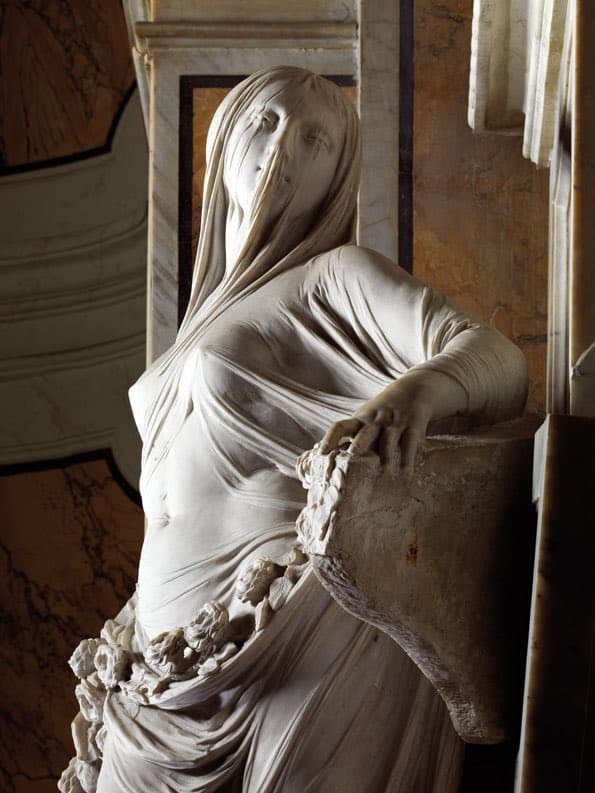
Modesty (La Pudicizia)
Antonio Corradini · 1752
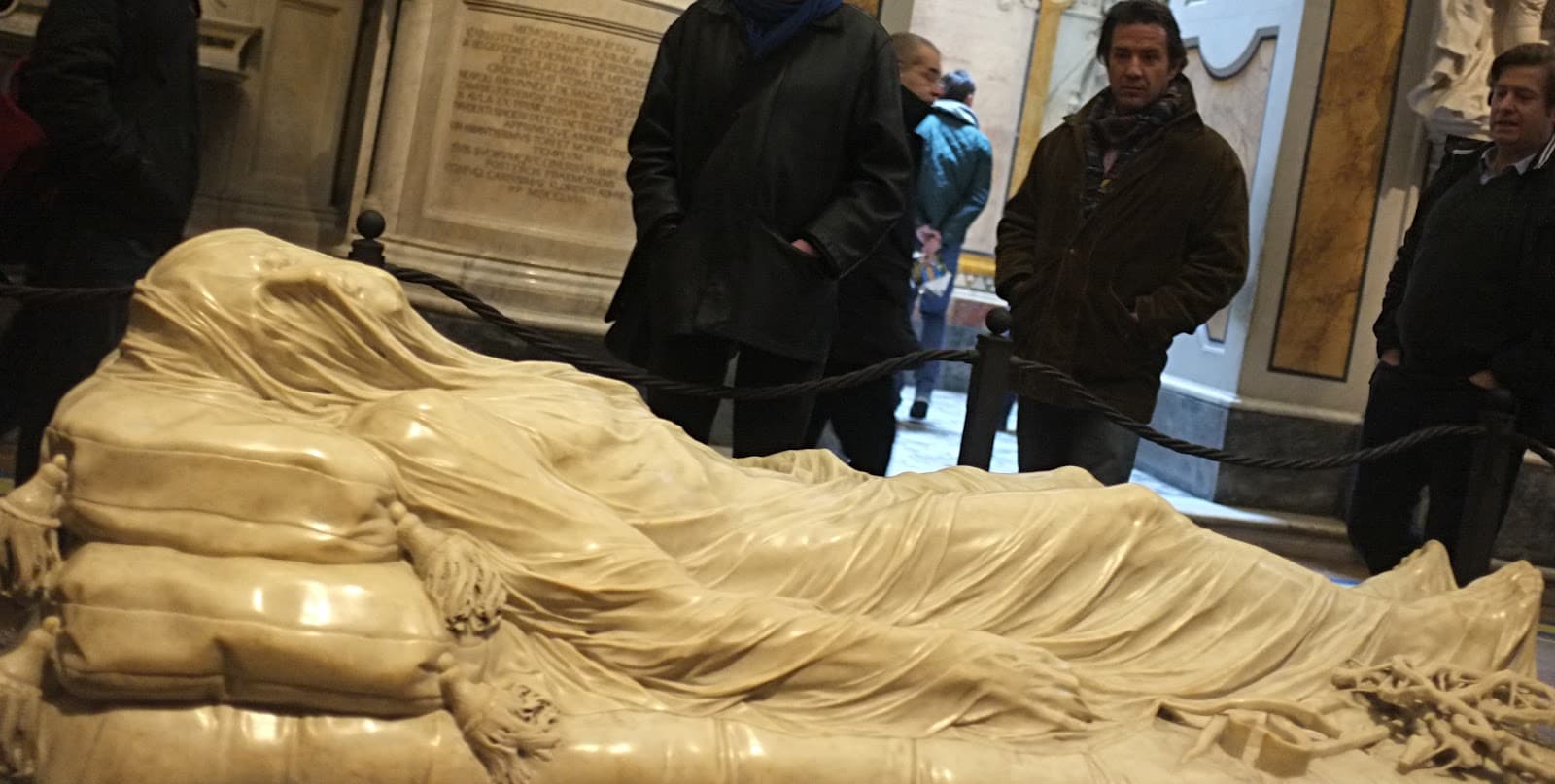
Veiled Christ
Giuseppe Sanmartino · 1753
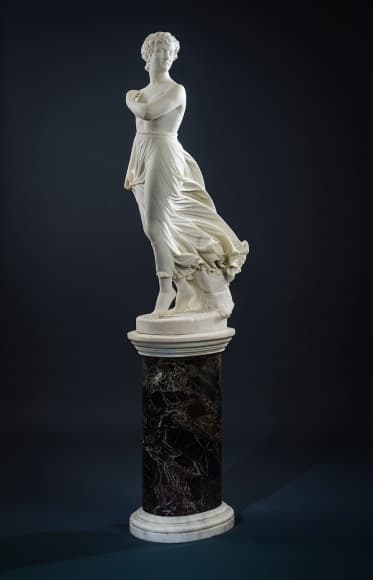
The West Wind
Thomas Ridgeway Gould · Modeled 1870
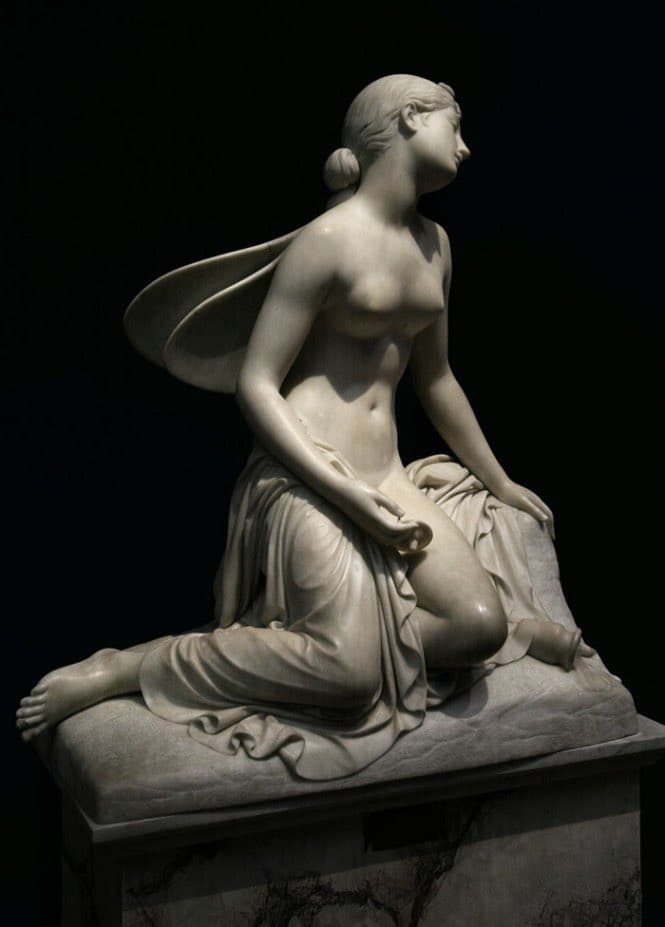
Psyche in a Faint
Pietro Tenerani · composition c. 1822

Bridge over a Pond of Water Lilies
Claude Monet · 1899

Venus de Milo
Alexandros of Antioch · c. 150–125 BC

Nymphs Dancing to Pan's Flute
Joseph Tomanek
The Thinker
Auguste Rodin · Modeled 1880–82; enlarged 1902–03; this cast 1904