Abstract Expressionism
The Deep
Jackson Pollock, 1953
The Deep is a 1953 painting by Jackson Pollock: a field of white paint parting around a jagged black void. One of his last major works, it is in the Centre Pompidou, Paris.
- Artist
- Jackson Pollock
- Date
- 1953
- Medium
- Oil and enamel on canvas
- Dimensions
- 220.4 × 150.2 cm
- Collection
- Centre Pompidou, Musée national d'art moderne, Paris, France
- Movement
- Abstract Expressionism
What you are looking at
A tall canvas is covered almost entirely in creamy, broken white, laid on thickly in some places and thinly in others, with flecks of yellow and touches of grey. Down the middle, from near the top to the bottom edge, runs a jagged opening of black. Its edges are irregular and torn, and the white seems to curl over them, as if a crust of ice or cloud has split to reveal a chasm underneath. Faint white veins cross the black in places.
The Deep was painted by Jackson Pollock (1912–1956) in 1953, three years before his death. It is in oil and enamel on canvas, about 220 by 150 centimeters, and belongs to the Centre Pompidou, Musée national d'art moderne, Paris.
A late turn
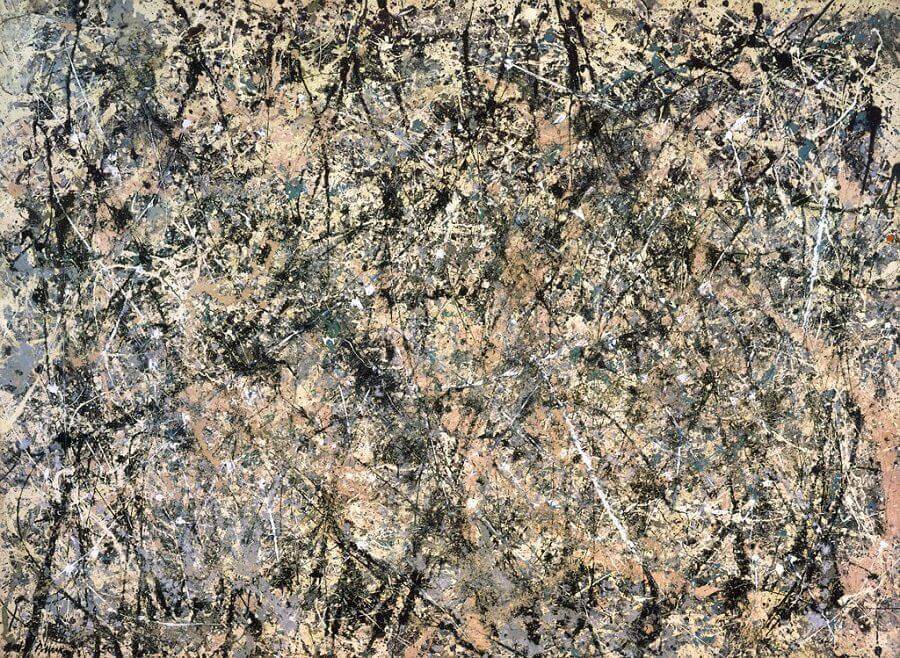
Pollock is famous for the drip paintings of 1947–50, where skeins of paint poured and flung onto canvas laid on the floor cover the surface edge to edge, as in Number 1 (Lavender Mist). After 1951 he moved away from that method: first to black paintings that brought back figurative fragments, then to works like this, where the all-over web gives way to a single dramatic image.
His output in these years fell sharply. He was drinking heavily, his marriage to the painter Lee Krasner was strained, and he struggled to find a way forward after the success of the drip works. The Deep is one of a handful of major canvases from 1953.
Looking closely
The white is not one color. Look closely and it is built up in layers, with paint dragged, dabbed and in places allowed to drip, so the surface has the texture of plaster or snow. Yellow appears at the margins of the black like light at the edge of a hole. The black itself is flat and dense, and it reads as space, not as a shape painted on top. Pollock reverses the usual relation of figure and ground: the "image" is an absence.
What does it mean?
Pollock gave few explanations, and the title is the main clue. Critics have read the painting as an abyss, a wound, a cave, a glimpse into the unconscious, or a premonition of the artist's death in a car crash in 1956. All of these are later interpretations. What the painting undeniably does is invert the energy of the drip works into something still and vertiginous.
Where to see it
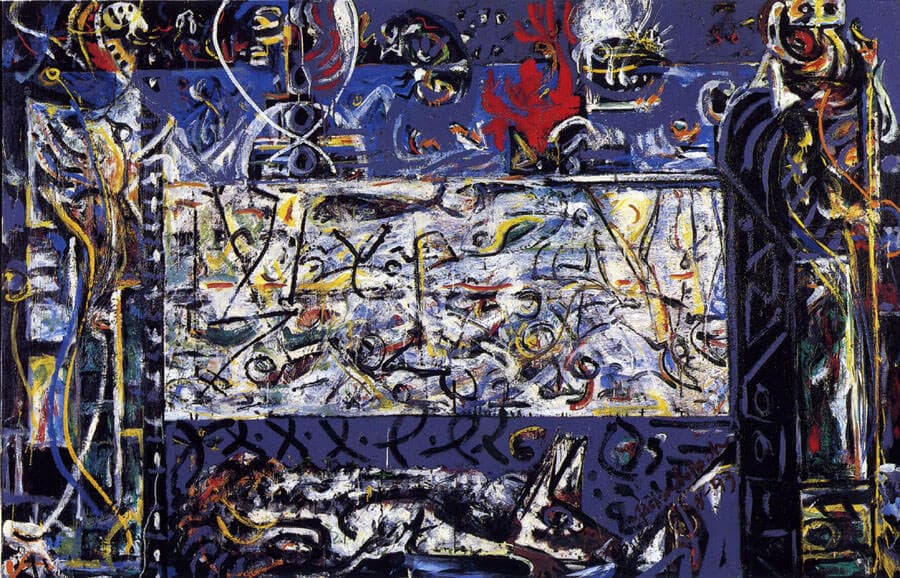
The painting is in the collection of the Centre Pompidou, Paris. See also Pollock's Guardians of the Secret and his artist page.
Questions & answers
Where is Jackson Pollock's The Deep?
The Deep (1953) is in the Centre Pompidou, Musée national d'art moderne, in Paris. It is one of the most important works by Pollock in a European public collection and is periodically shown in the museum's modern art galleries or lent to exhibitions.
What does Pollock's The Deep mean?
Pollock left no explanation beyond the title. Critics have read the black opening in the white field as an abyss, a wound, a cave or the unconscious, and some see it as foreshadowing his death in 1956. These are interpretations, not the artist's stated intentions.
Is The Deep a drip painting?
Not in the classic sense. Painted in 1953, after Pollock moved away from the all-over poured paintings of 1947–50, it is built mainly from layered white paint around a single black void, though some passages are dripped and poured.
More by the artist
Jackson Pollock
Kindred works
You may also study
Weeping Willow
Claude Monet · 1920–22

Nymphs Dancing to Pan's Flute
Joseph Tomanek

The Scream
Edvard Munch · 1893

Saturn Devouring His Son
Francisco Goya · c. 1819–1823

Ophelia
John Everett Millais · 1851–52
Lucifer
Franz von Stuck · 1890
Head of a Skeleton with a Burning Cigarette
Vincent van Gogh · 1886
The Garden of Earthly Delights
Hieronymus Bosch · c. 1490–1510