Abstract Expressionism
Number 1, 1950 (Lavender Mist)
Jackson Pollock, 1950
Number 1, 1950 (Lavender Mist) is one of Jackson Pollock's great poured paintings, made in summer 1950 in his barn studio on Long Island. Nearly three meters wide, it is in the National Gallery of Art, Washington.
- Artist
- Jackson Pollock
- Date
- 1950
- Medium
- Oil, enamel and aluminum paint on canvas
- Dimensions
- 221 × 299.7 cm
- Collection
- National Gallery of Art, Washington, D.C., United States
- Movement
- Abstract Expressionism
Number 1, 1950 (Lavender Mist) is one of the masterpieces of Jackson Pollock's drip period. He made it in the summer of 1950 in the barn he used as a studio at Springs, near East Hampton on Long Island, where he had lived since 1945. The canvas, about 221 by 299.7 centimeters, is in the National Gallery of Art in Washington, D.C., which bought it in 1976.
What you are looking at
The entire canvas is covered, edge to edge, in a dense web of poured and flung paint. There is no center, no focal point and no figure: Pollock's so-called "all-over" composition gives every part of the surface roughly equal weight.
The web is built in layers. Long, looping lines of black run through everything, some thick and puddled, some thin as hair. Over and under them lie skeins of white, pale gray, salmon pink, tan and blue-gray, with flecks of silver from aluminum paint. In places the paint has pooled into small blots; elsewhere it has been flicked into spatters and dots.
The famous lavender is an illusion. There is almost no lavender paint in the picture. The soft violet haze comes from the eye mixing the pinks, blues, grays and whites at a distance, which is why the critic Clement Greenberg suggested the title. Along the top edge, look for the prints of Pollock's own hands, pressed into the wet paint.
How it was made
Pollock unrolled unprimed canvas on the floor and worked from all four sides, walking around and over it. He poured and dripped commercial enamel house paint, oil and aluminum paint from cans, sticks and hardened brushes, controlling the flow with his arm and body. He described being "in" the painting while he worked. That same summer, the photographer Hans Namuth photographed and filmed him at work, images that made his method famous.
The process looks random but is not. Pollock built the web over days, adding layers, judging the density and rhythm, and stopping when he felt the painting was complete.
Context
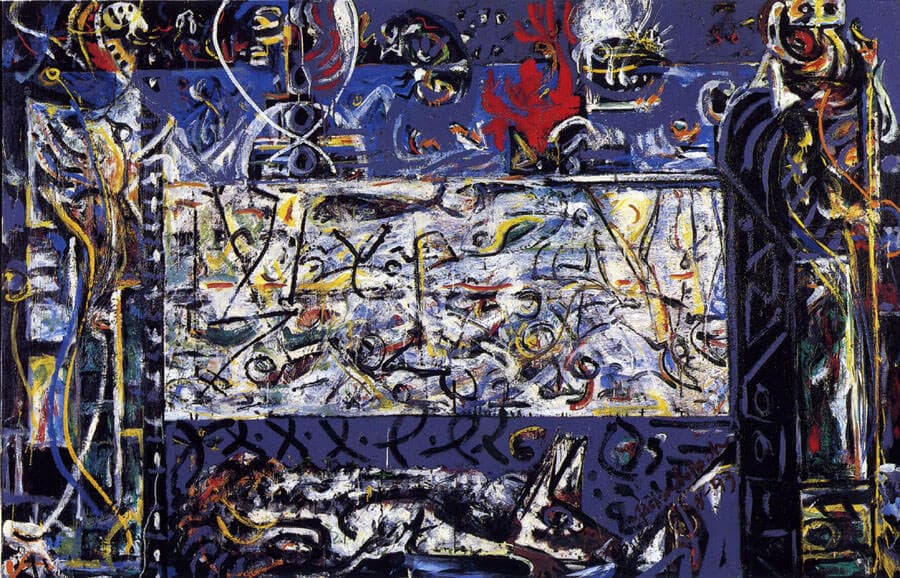
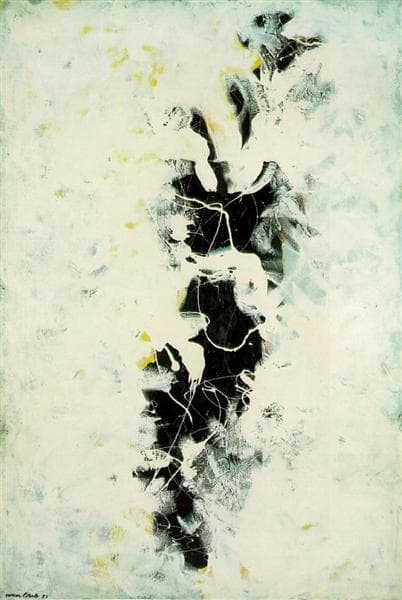
Lavender Mist was shown at the Betty Parsons Gallery in New York in late 1950, in an exhibition that also included Autumn Rhythm and One: Number 31, the three great canvases of that summer. It marks the high point of the drip paintings, a style he would largely abandon after 1951. Compare it with his earlier, symbol-filled Guardians of the Secret and The Deep.
Where to see it
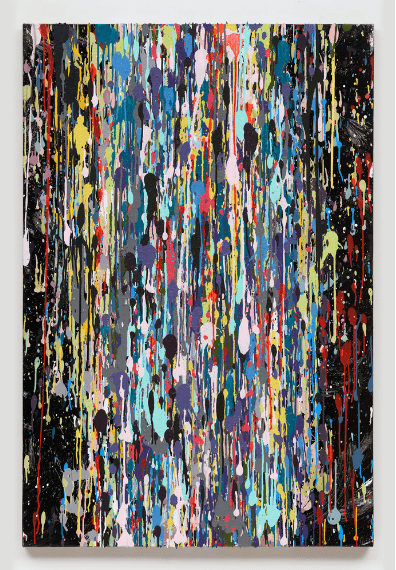
The painting hangs in the East Building of the National Gallery of Art in Washington. See also the Jackson Pollock page and, for a later take on poured paint, Left-Over Paint Abstraction.
Questions & answers
Where is Pollock's Lavender Mist?
Number 1, 1950 (Lavender Mist) is in the National Gallery of Art in Washington, D.C., which bought it in 1976. It is usually displayed in the museum's East Building, among its collection of postwar American painting, alongside works by other Abstract Expressionists.
Why is it called Lavender Mist?
There is very little lavender paint in it. The soft violet haze comes from the viewer's eye mixing pinks, blues, grays, whites and black at a distance. The critic Clement Greenberg suggested the title, which Pollock added to the painting's number.
How did Jackson Pollock make Lavender Mist?
He laid the unprimed canvas on the floor of his barn studio at Springs, Long Island, and poured, dripped and flung oil, enamel and aluminum paint from cans, sticks and brushes, working from all sides. His handprints are visible along the top edge.
More by the artist
Jackson Pollock
Kindred works