American (English-born) · Hudson River School · Romanticism
Thomas Cole
b. 1 February 1801, Bolton-le-Moors, Lancashire, England — d. 11 February 1848, Catskill, New York
Thomas Cole (1801–1848) was the English-born American painter who founded the Hudson River School, known for wild Catskill landscapes and for allegorical cycles such as The Course of Empire.
1 work in the collection
Works by Thomas Cole
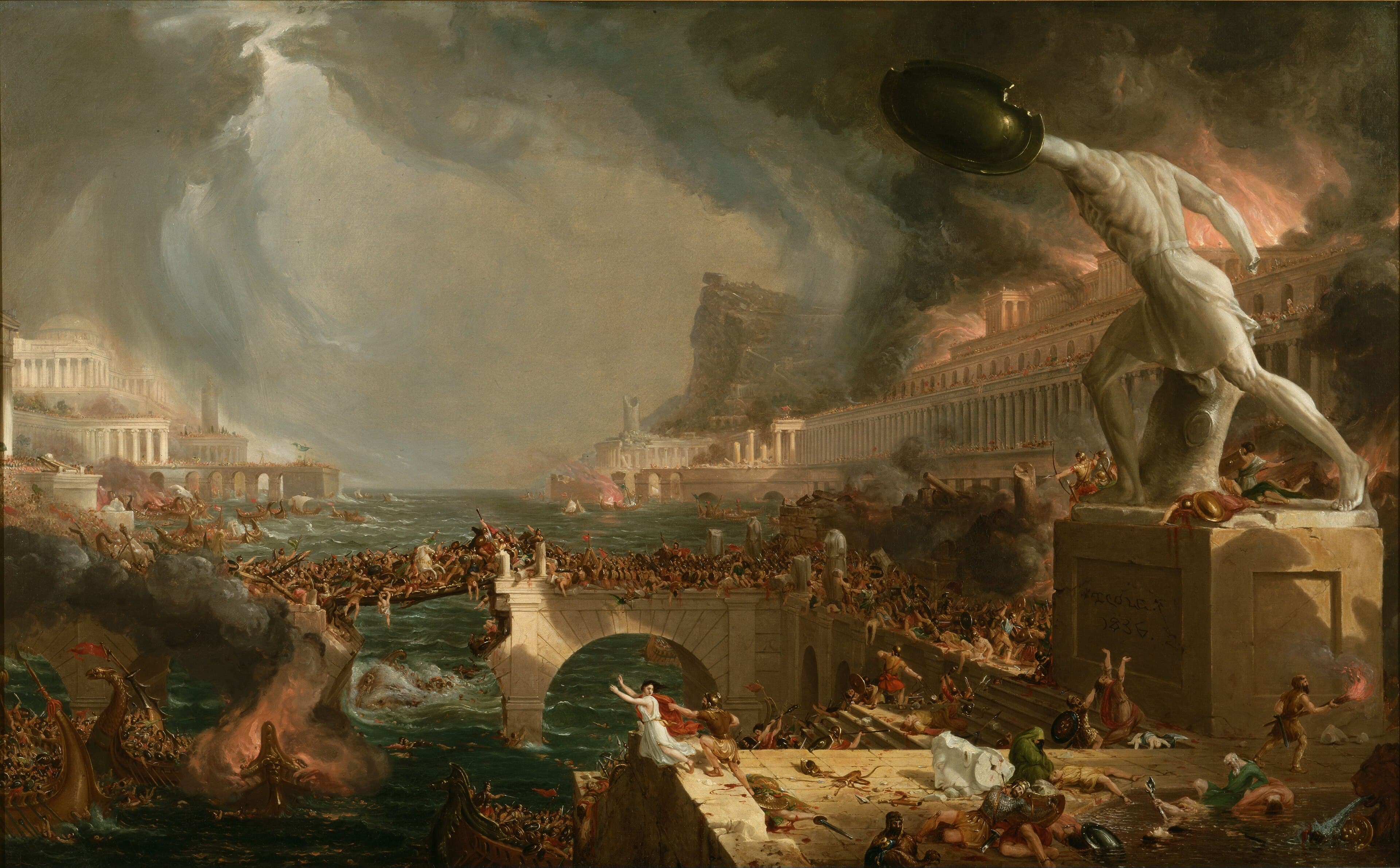
Thomas Cole is usually called the founder of American landscape painting. Born in England and raised partly in the United States, he made the Hudson Valley and the Catskill Mountains into national subjects, and his five-part allegory The Course of Empire (1833–36), including The Course of Empire: Destruction, belongs to the New-York Historical Society.
Life in brief
Cole was born in 1801 in Bolton-le-Moors, Lancashire, and worked as a young engraver's apprentice before his family emigrated to the United States in 1818. Largely self-taught as a painter, he worked in Ohio and Philadelphia before moving to New York in 1825. That autumn he sailed up the Hudson to sketch, and the paintings he brought back were bought by the painters John Trumbull and Asher B. Durand. His career was made. He traveled in England and Italy in 1829–32 and again in 1841–42, settled at Cedar Grove in the village of Catskill, and died there suddenly in 1848, aged 47.
Style
Cole painted the American wilderness as sublime: storm-split trees, gorges, waterfalls and vast skies, with human figures tiny or absent. In his Essay on American Scenery (1836) he argued that the country's untamed nature was its equivalent of Europe's ruins and history. He also feared what progress would do to it. The Oxbow (1836, Metropolitan Museum of Art) divides the view between dark, stormy forest on the left and cleared, cultivated land on the right.
The Course of Empire
Commissioned by the New York merchant Luman Reed, the cycle traces one imaginary city from The Savage State through The Arcadian or Pastoral State and The Consummation of Empire to Destruction and Desolation. In Destruction, invaders sack the marble city, a bridge collapses and a headless statue strides forward through the smoke. A distinctive crag appears in every scene, fixing the place while centuries pass. Contemporary viewers read it as a warning to the young American republic. A later cycle, The Voyage of Life (1840; second version 1842, National Gallery of Art), follows a single human life down a river.
Influence
His pupil Frederic Edwin Church and followers such as Durand and Albert Bierstadt carried the Hudson River School through the century.
Where to see his work
The New-York Historical Society, the Metropolitan Museum of Art, the Wadsworth Atheneum and the National Gallery of Art hold major works; his home at Catskill is the Thomas Cole National Historic Site. See also Romanticism and Dark Academia.
Questions & answers
What is Thomas Cole known for?
Thomas Cole is known as the founder of the Hudson River School of American landscape painting and for allegorical series such as The Course of Empire (1833–36) and The Voyage of Life (1840). His dramatic views of the Catskills and the Hudson Valley defined the American Romantic landscape.
Where is The Course of Empire?
All five paintings of The Course of Empire belong to the New-York Historical Society in New York City. They were commissioned by Luman Reed, whose collection passed to the Society in the 1850s, and are usually displayed together.
What does The Course of Empire mean?
The series shows the rise and fall of a single imaginary civilization in five stages, from wilderness to empire to ruin. Cole intended it as a moral warning that luxury, pride and conquest lead to collapse, and Americans of the 1830s read it as a caution to their own young nation.