Realism
The Apparition
James Tissot, 1885
The Apparition is James Tissot's 1885 painting of two glowing spirit figures he believed he saw at a séance in London, one of them his late companion Kathleen Newton. He also made a mezzotint of the image.
- Artist
- James Tissot
- Date
- 1885
- Medium
- Oil on canvas
- Movement
- Realism
The Apparition records an experience James Tissot believed he had at a spiritualist séance in London in May 1885. The French painter, celebrated for his elegant pictures of fashionable women, had lost his companion and muse Kathleen Newton in November 1882, and he turned to spiritualism in his grief. He made the image both as a painting and as a mezzotint print titled Apparition médiumnique. We have not been able to confirm the current location of the painting shown here.
What you are looking at
Two figures emerge from total darkness. On the left stands a bearded man with a heavy, solemn face, wrapped in white drapery that covers his head. On the right, slightly lower and closer, is a young woman, also veiled in white, her face pale and lifted, her eyes wide.
Both hold out their hands, and each palm holds a small glowing light. The light is the only source of illumination in the picture: it shines up into their faces, through their fingers and across the folds of their garments, which seem to dissolve into luminous mist at the edges. Beyond the reach of the light, the background is a deep brown-black. The surface of the canvas is covered with fine craquelure, visible across the dark areas.
The séance
Kathleen Newton, a young Irish divorcée, lived with Tissot in his house in St John's Wood from the late 1870s until her death from tuberculosis in 1882, aged 28. Tissot left London for Paris soon after. On 20 May 1885, back in London, he attended a séance with the well-known medium William Eglinton. According to accounts of the sitting, two figures appeared in the dark room, carrying lights: Kathleen and a spirit guide whom Eglinton called Ernest. Tissot said Kathleen kissed him.
Tissot painted the scene soon afterward, and the mezzotint followed later the same year. Contemporary skeptics regarded Eglinton as a fraud, and his "materializations" were widely suspected to be staged, but Tissot seems to have accepted the experience as real.
Meaning
The painting is a record of grief and belief rather than an allegory. Its style is unlike Tissot's bright society pictures: it uses a single hidden light source, a device familiar from the candlelit scenes of Georges de La Tour, to make the figures appear out of the void. Within a year Tissot had a religious conversion experience in Paris and devoted the rest of his life to illustrating the Bible.
Where to see it
Impressions of the mezzotint are held in several museum print rooms. For other images of love and loss in our catalogue, see Finis (The End of All Things), Premier Deuil and our Death in Art collection, and the James Tissot page.
Questions & answers
What is The Apparition by James Tissot about?
It records a séance Tissot attended in London on 20 May 1885 with the medium William Eglinton. Tissot believed that his late companion, Kathleen Newton, appeared there with a spirit guide, both carrying lights. He painted the two glowing figures and also made a mezzotint of the scene.
Who was Kathleen Newton?
Kathleen Newton was a young Irish divorcée who lived with Tissot in St John's Wood, London, from the late 1870s and appears in many of his paintings. She died of tuberculosis in November 1882, aged 28, and her death led Tissot to leave London for Paris.
Where is Tissot's painting The Apparition?
We have not been able to confirm the current owner of the painting shown here. The related mezzotint, Apparition médiumnique of 1885, exists in a number of impressions, and examples are held in museum print collections, where the composition of the two glowing figures can be compared with the painting.
Kindred works
You may also study
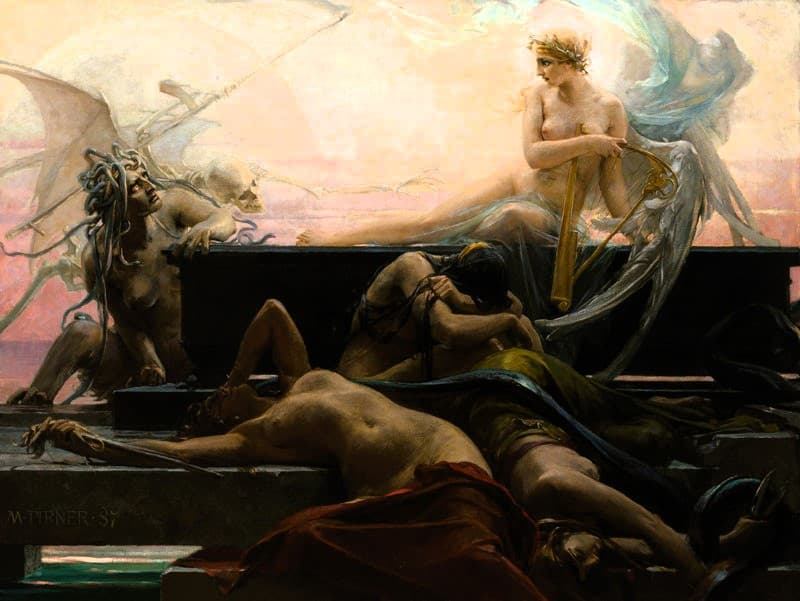
Finis (The End of All Things)
Maximilian Pirner · 1887
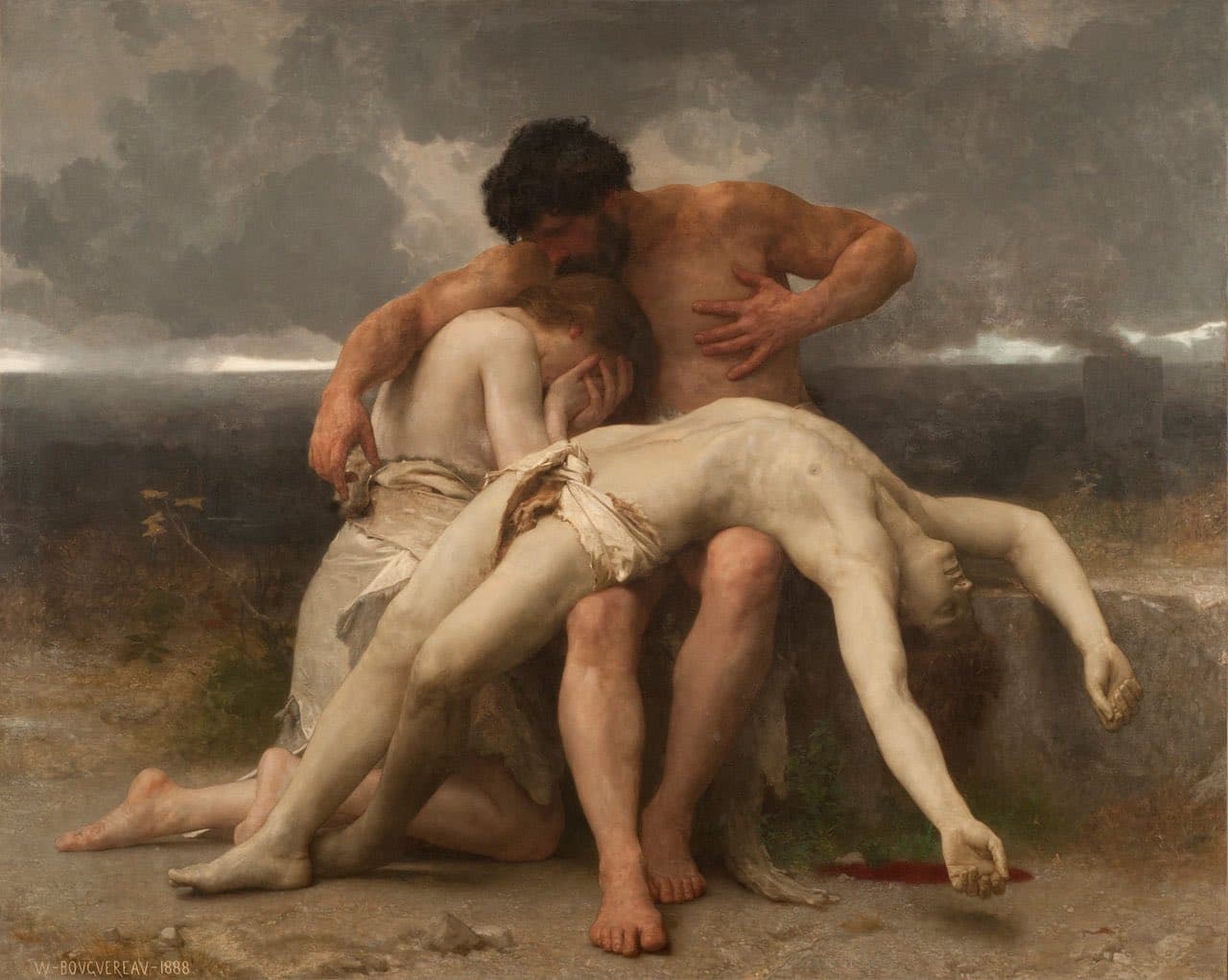
Premier Deuil
William-Adolphe Bouguereau · 1888
Ghost in the Mirror
Michael Locascio · c. 2019
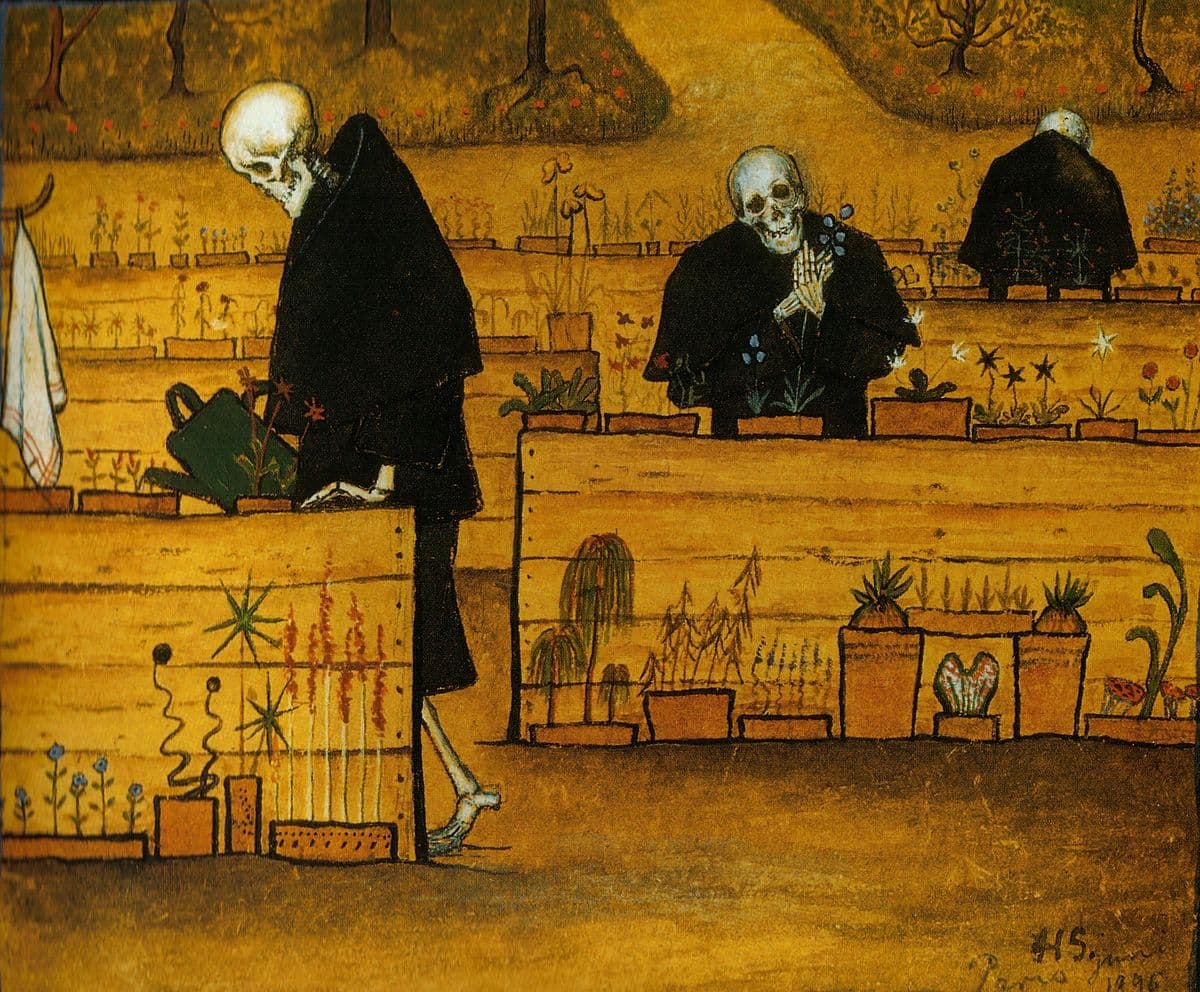
The Garden of Death
Hugo Simberg · 1896

Venus de Milo
Alexandros of Antioch · c. 150–125 BC

Nymphs Dancing to Pan's Flute
Joseph Tomanek

The Scream
Edvard Munch · 1893

Saturn Devouring His Son
Francisco Goya · c. 1819–1823