French · Academic art · Realism
James Tissot
b. 15 October 1836, Nantes, France — d. 8 August 1902, Chenecey-Buillon, France
James Tissot (1836–1902) was a French painter of fashionable modern life in Paris and Victorian London, famed for his exact rendering of dresses and interiors. After the death of his companion Kathleen Newton he turned to spiritualism and religious painting.
1 work in the collection
Works by James Tissot
James Tissot was a French painter and printmaker who made his reputation picturing elegant women, ships, gardens and drawing rooms in Paris and London in the 1860s to 1880s, then spent his last years illustrating the Bible. Born Jacques-Joseph Tissot in Nantes in 1836, the son of a draper and a milliner, he grew up surrounded by fabric, and it shows: few painters have described a ribbon, a pleat or a striped muslin skirt with such precision.
Life in brief
Tissot trained in Paris under Hippolyte Flandrin and Louis Lamothe and first showed at the Salon in 1859, adopting the anglicized name James. After fighting in the Franco-Prussian War and the turmoil of the Paris Commune in 1871, he moved to London, where pictures such as The Ball on Shipboard (Tate) and Too Early (Guildhall Art Gallery) sold well. Around 1876 he met Kathleen Newton, a young divorcée who became his companion and model and lived with him in St John's Wood. She died of tuberculosis in November 1882, aged 28. Tissot left London within days and returned to Paris.
The apparition
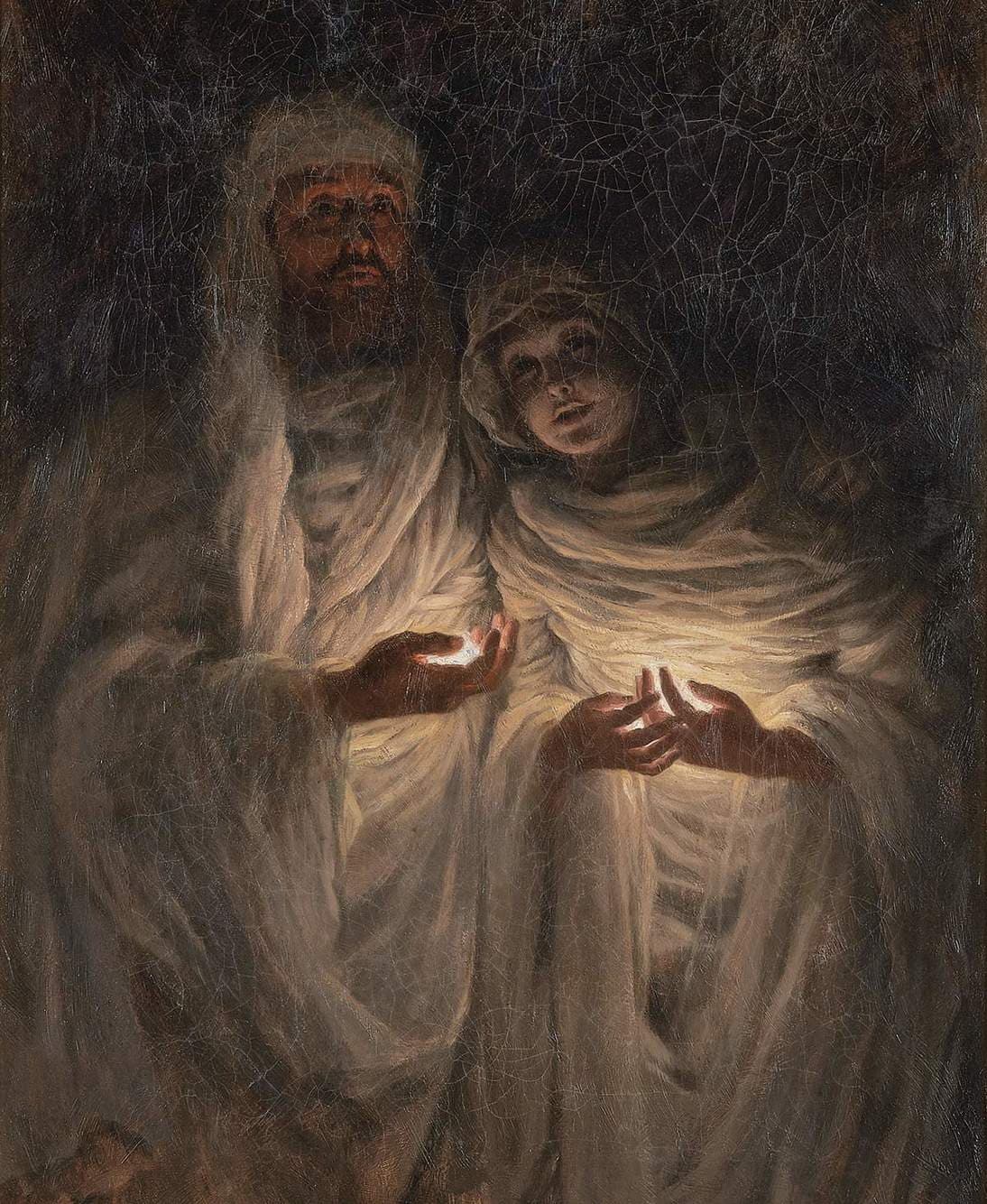
Grief drew Tissot to spiritualism. On 20 May 1885 he attended a séance with the medium William Eglinton, at which he believed Kathleen appeared to him with a spirit guide. He recorded the vision in a painting, now generally described as lost, and in a mezzotint, Apparition médiumnique (1885). The catalogue's The Apparition belongs to this group: two figures in white robes emerge from darkness, the light held in their cupped hands falling upward on their faces.
Religious work and style
The same years brought a return to Catholic faith. Tissot traveled to Palestine several times and produced some 350 gouache illustrations of The Life of Our Saviour Jesus Christ, bought by the Brooklyn Museum in 1900, followed by an Old Testament series. His style throughout is sharply focused and evenly lit, closer to academic finish than to his friends Degas and Manet, though he shared their interest in modern, everyday subjects. He died at the Château de Buillon, his family home in eastern France, in 1902.
Where to see his work
Major paintings are in Tate and the Guildhall Art Gallery in London, the Musée d'Orsay in Paris, the Montreal Museum of Fine Arts and the Brooklyn Museum. For other painters of ghosts and the afterlife, see Death in Art.
Questions & answers
What is James Tissot known for?
James Tissot is known for meticulous paintings of fashionable women and modern social life in Paris and Victorian London, such as The Ball on Shipboard, and later for hundreds of gouache illustrations of the life of Christ, now in the Brooklyn Museum.
What is Tissot's The Apparition about?
It records a séance of 20 May 1885 at which Tissot believed the spirit of his late companion Kathleen Newton appeared to him with a spirit guide. He depicted the vision in a painting, generally described as lost, and a mezzotint titled Apparition médiumnique.
Who was Kathleen Newton?
Kathleen Newton was a young divorcée of Irish family who lived with Tissot in St John's Wood, London, from the later 1870s and appears in many of his paintings. She died of tuberculosis in 1882, aged 28, and Tissot left London soon afterward.