Contemporary figurative sculpture
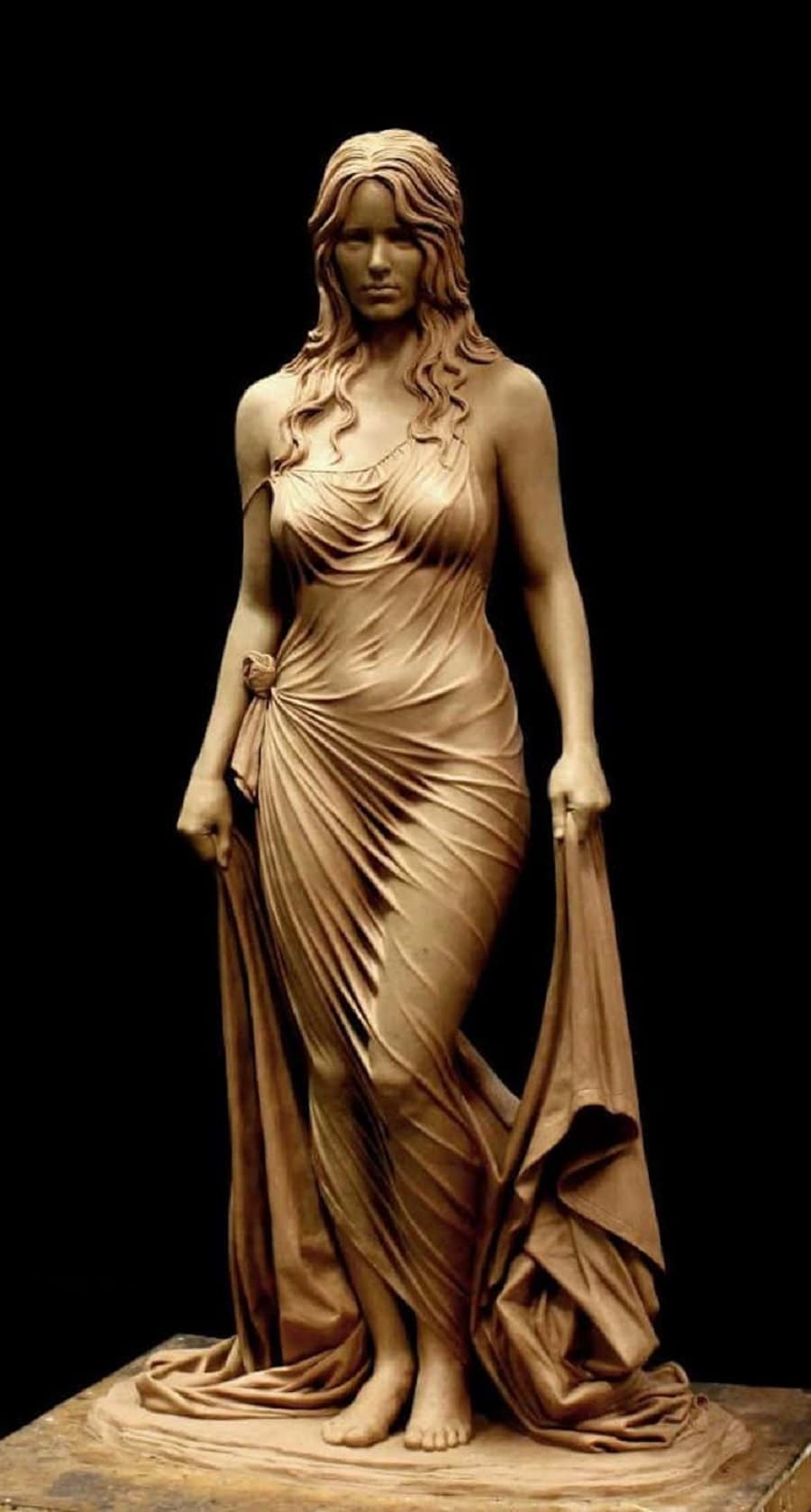
Zuleikha
Benjamin Victor, c. 2022
Zuleikha is a life-size clay figure by the American sculptor Benjamin Victor, made as the model for a bronze. It portrays the wife of Potiphar from Genesis 39, known in later tradition as Zuleikha, who tried to seduce Joseph.
- Artist
- Benjamin Victor
- Date
- c. 2022
- Medium
- Clay (life-size model for a bronze)
- Collection
- United States
- Movement
- Contemporary figurative sculpture
What you are looking at
A young woman leans against a tall pedestal draped with heavy cloth, both hands resting on its top edge, her weight thrown onto one hip. Her body twists: the shoulders turn one way while her head turns sharply the other, as if she has just heard someone enter. A thin band crosses her forehead, and long hair falls down her back. She wears a single garment of fine, clinging fabric that slips off one shoulder and is caught at the waist, and the cloth is modeled in dozens of tight, rippling folds that cling to her body like wet drapery, opening at the side to reveal one leg. Her bare feet rest on the base, one slightly forward.
The figure is modeled in clay, the material sculptors use to build a full-size model before it is molded and cast in bronze. The surface still shows the sculptor's working: crisp, sharp folds in the drapery against the smoother planes of the skin. The contrast between the rigid, vertical pedestal with its heavy cloth and the S-curve of the body gives the pose its tension.
The story of Zuleikha
The subject comes from Genesis 39. Joseph, sold into slavery in Egypt by his brothers, rises to become steward of the household of Potiphar, an officer of Pharaoh. Potiphar's wife repeatedly tries to seduce him. When Joseph refuses and flees, leaving his garment in her hands, she accuses him of attempting to assault her, and he is thrown into prison.
In the Bible the woman is unnamed. Later Jewish writings and Islamic tradition call her Zuleikha (also spelled Zulaikha or Zuleika), and in Persian literature she became a heroine in her own right: the fifteenth-century poet Jami's Yusuf and Zulaikha retells the story as an allegory of earthly love transformed into divine love. In European art, from the Renaissance onward, the episode was a favorite subject for its mix of temptation and virtue. Benjamin Victor's figure focuses on her alone: watchful, poised, caught between invitation and alarm.
The artist
Benjamin Victor (born 1979) is an American figurative sculptor based in Idaho. He is best known for public monuments, and he has three statues in the National Statuary Hall Collection in the United States Capitol, including Sarah Winnemucca, made when he was in his twenties, and Norman Borlaug. Alongside commissions he makes studio figures drawn from biblical and literary subjects, such as Bathsheba, which share this figure's clinging drapery and turning pose. According to earlier information on this page, smaller versions of Zuleikha were planned to follow the full-size bronze.
Where to see it
The location of the finished bronze has not been confirmed for this page. For other sculptures of biblical and mythological women, see Bathsheba, Statue of Chastity and famous sculptures.
Questions & answers
Who was Zuleikha?
Zuleikha is the name later Jewish and Islamic tradition gives to Potiphar's wife in Genesis 39, who tried to seduce Joseph in Egypt and, when he refused, falsely accused him. In the Bible she is unnamed; in Persian poetry she became a romantic heroine.
Who made the Zuleikha sculpture?
It is by Benjamin Victor, an American figurative sculptor born in 1979, known for his three statues in the National Statuary Hall Collection at the US Capitol and for studio figures such as Bathsheba.
What is Benjamin Victor's Zuleikha made of?
The figure shown is a life-size clay model, the stage before a mold is taken and the work is cast in bronze. The artist made it as the model for a bronze statue of the same name.
More by the artist
Benjamin Victor
Kindred works
You may also study
Modesty (La Pudicizia)
Antonio Corradini · 1752
Child Bride
Philippe Faraut · 2014

Venus de Milo
Alexandros of Antioch · c. 150–125 BC
The Creation of Adam
Michelangelo · c. 1511–12

Ophelia
John Everett Millais · 1851–52

Woman with a Parasol – Madame Monet and Her Son
Claude Monet · 1875
Las Meninas
Diego Velázquez · 1656
Lucifer
Franz von Stuck · 1890