Contemporary realism
Child Bride
Philippe Faraut, 2014
Child Bride is a 2014 clay bust by the French-born American sculptor Philippe Faraut of a young girl under a bridal veil, made to draw attention to child marriage.
- Artist
- Philippe Faraut
- Date
- 2014
- Medium
- Earthenware clay
- Dimensions
- 48.3 × 33 × 27.9 cm (19 × 13 × 11 in)
- Collection
- United States
- Movement
- Contemporary realism
Child Bride is a portrait bust modeled in earthenware clay by the sculptor Philippe Faraut in 2014. It shows a young girl whose head and shoulders are covered by a thin bridal veil. The work measures about 19 by 13 by 11 inches (48 by 33 by 28 centimeters). Faraut made it to draw attention to child marriage, which campaigners at the time estimated affected some 15 million girls each year who were married before the age of eighteen.
What you are looking at
The girl faces us almost head-on, her chin level, her gaze steady and slightly downcast. Her face is that of a child: rounded cheeks, a small mouth, a short nose. Over her head falls a veil that reaches down past her shoulders, finished at the edge with a band of lace.
The veil is the tour de force. Faraut models it as though it were wet, clinging fabric, so that every feature beneath shows through: the eyebrows, the bridge of the nose, the lips, strands of hair pressed against the forehead. Folds gather and fall in long vertical pleats around the face and spread outward over the shoulders. The effect is of a face both hidden and fully exposed. The veil, a symbol of a bride's modesty, here conceals nothing.
That contrast carries the meaning. The girl is dressed for a ritual meant for adults, but the veil reveals how young she is.
The veiled-figure tradition
Faraut is working in a tradition best known from Italian marble sculpture of the eighteenth and nineteenth centuries, such as Antonio Corradini's Statue of Chastity and Giuseppe Sanmartino's Veiled Christ, in which a solid material is carved to look like transparent cloth. In those works the veil usually stands for modesty, virtue or mystery. Faraut borrows the technique but turns it to a social subject, so that the veil becomes a sign of something imposed on the child.
The artist
Philippe Faraut trained in France in woodcarving and the construction of fine furniture before settling in the United States, first in the Chesapeake Bay area of Virginia and later in upstate New York. He works mainly in water-based clay and has taught portrait and figure sculpture widely through workshops, books and videos since the 1990s. His work, which includes portrait busts, figures and veiled heads, has been shown in the international salons of the Art Renewal Center.
Meaning
The bust works as a single, quiet image rather than a narrative. There is no groom and no setting, only the child. By holding her expression in a neutral, inward state, Faraut leaves the viewer to supply the emotion.
Where to see it
The current owner and display location of Child Bride are not publicly documented. For other veiled sculptures, see La Pudicizia and our selection of famous sculptures.
Questions & answers
Who made the Child Bride sculpture?
Child Bride was made in 2014 by Philippe Faraut, a French-born sculptor who trained in woodcarving and fine furniture in France before settling in the United States. He is known for portrait busts in clay and for teaching portrait and figure sculpture through workshops and books.
What is Child Bride about?
The bust addresses child marriage. It shows a young girl under a bridal veil so finely modeled that her face shows through clearly, contrasting a ceremony meant for adults with the obvious youth of the bride. Faraut made it to raise awareness of girls married before eighteen.
What is Child Bride made of?
It is modeled in earthenware clay and measures about 19 by 13 by 11 inches, or 48 by 33 by 28 centimeters. The thin, clinging veil is sculpted in the same clay as the face beneath it, following the tradition of Italian veiled marble sculpture.
How do sculptors make a stone or clay veil look transparent?
They model the features underneath first, then build the veil as a thin layer that follows the forms of the face, adding folds and fine edges. Light catching the raised features through the folds creates the illusion of see-through fabric, as in Italian veiled marbles.
Kindred works
You may also study
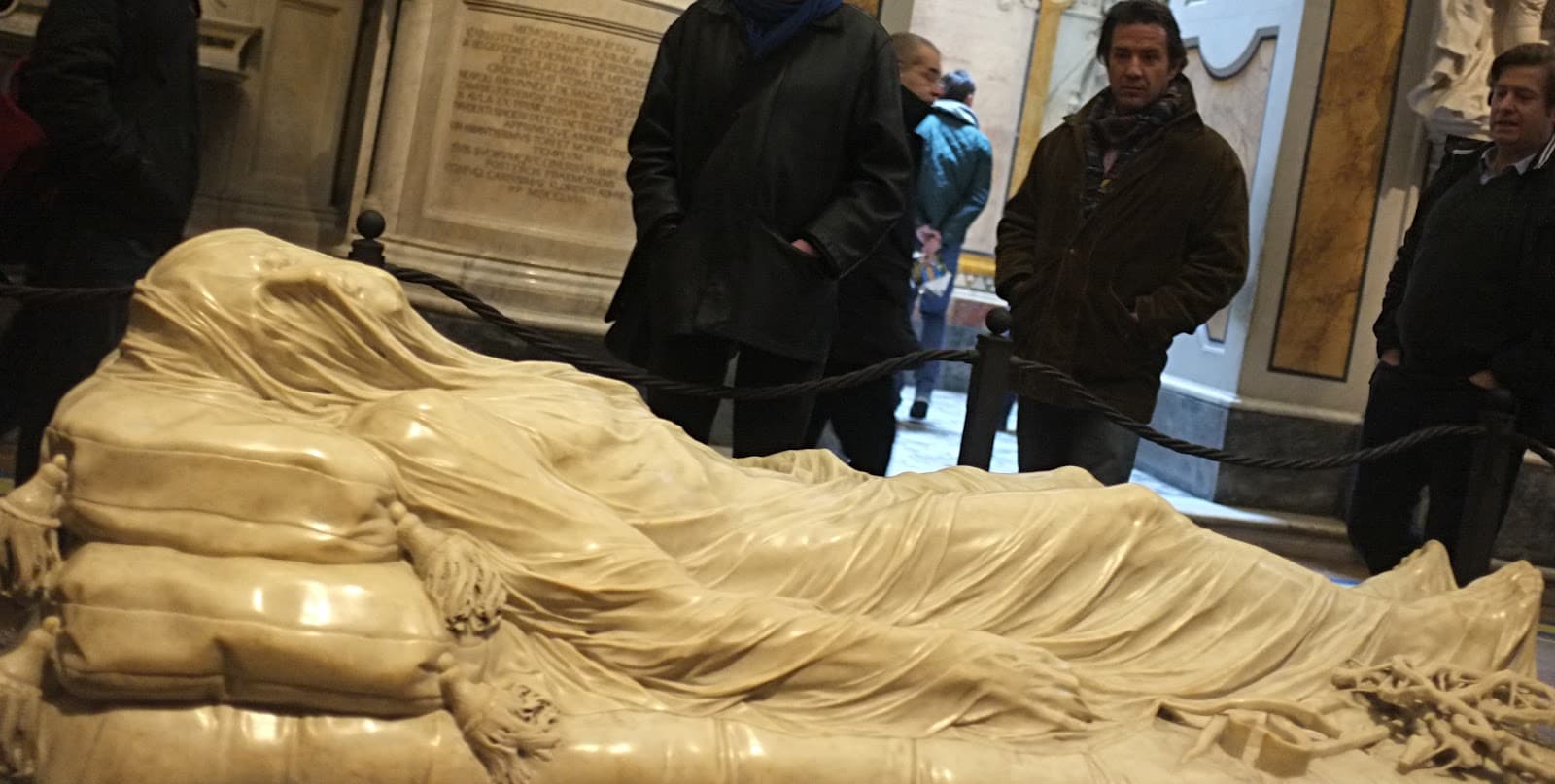
Veiled Christ
Giuseppe Sanmartino · 1753
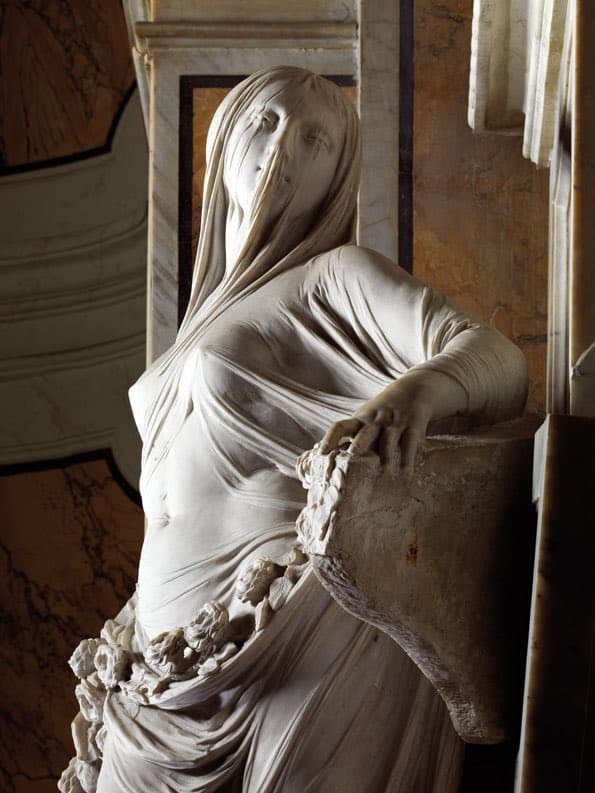
Modesty (La Pudicizia)
Antonio Corradini · 1752

Pietà (Jago)
Jago (Jacopo Cardillo) · 2020–21
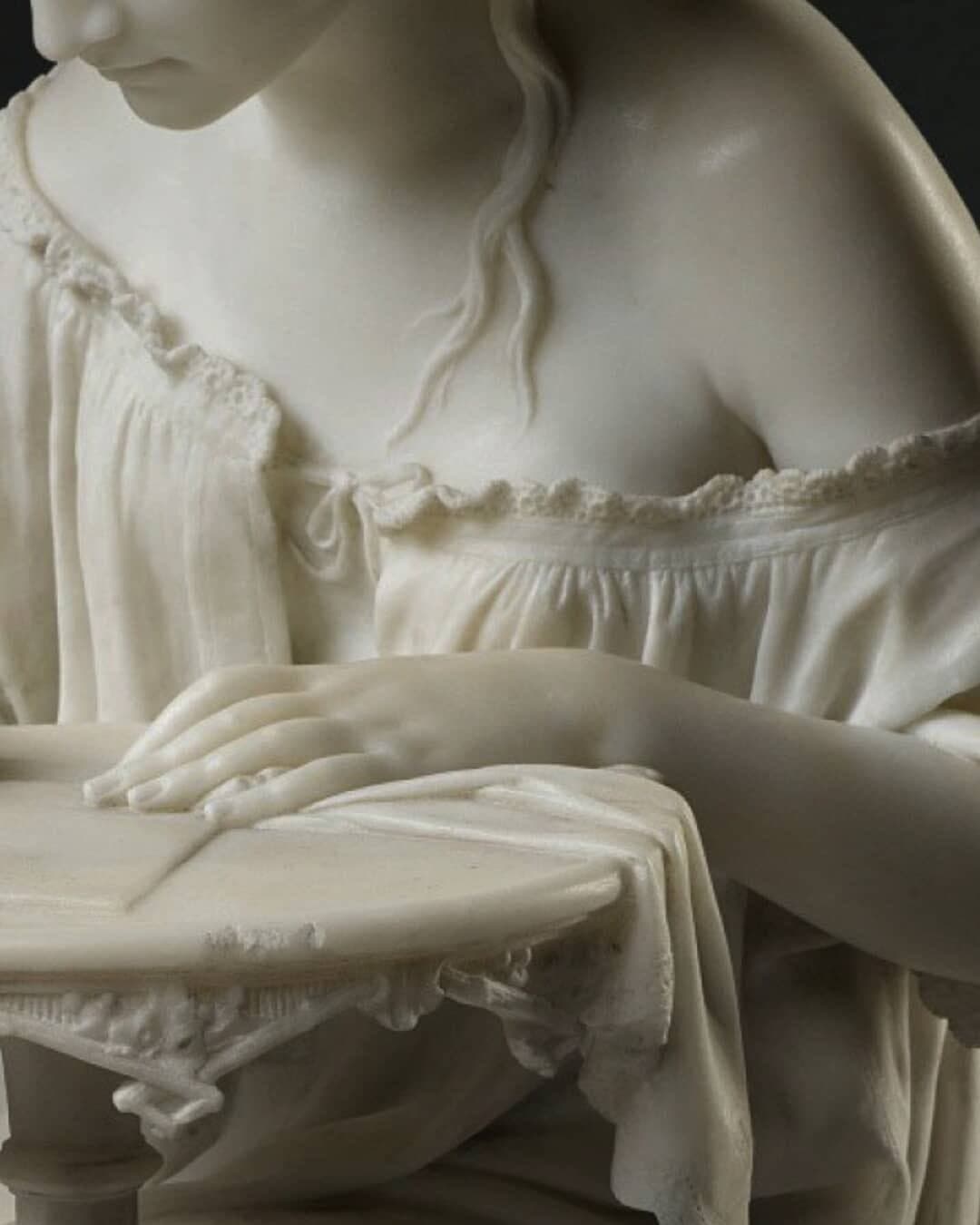
Girl Writing (La scrittrice)
Giovanni Spertini · 1866

Venus de Milo
Alexandros of Antioch · c. 150–125 BC

Ophelia
John Everett Millais · 1851–52

Woman with a Parasol – Madame Monet and Her Son
Claude Monet · 1875
Las Meninas
Diego Velázquez · 1656