Contemporary art
We Fight to Build a Free World: An Exhibition by Jonathan Horowitz
Jonathan Horowitz, 2020–21
We Fight to Build a Free World was an exhibition organized by the artist Jonathan Horowitz at the Jewish Museum in New York, 1 October 2020 to 14 February 2021, on how artists have answered authoritarianism, racism and antisemitism.
- Artist
- Jonathan Horowitz
- Date
- 2020–21
- Medium
- Exhibition: painting, sculpture, photography, video and commissioned posters
- Collection
- The Jewish Museum (exhibition, closed), New York, United States
- Movement
- Contemporary art
What you are looking at
The photograph shows the entrance to the exhibition at the Jewish Museum on Fifth Avenue. The museum occupies a Gothic-revival mansion, and its carved wood paneling, plaster ornament and brass chandelier frame the doorway. On the deep green wall to the right hangs a large white sign in heavy black capitals: WE FIGHT TO BUILD A FREE WORLD, and below it, AN EXHIBITION BY JONATHAN HOROWITZ. Through the doorway, in the next gallery, a red wall is hung in a grid with posters of different colors and designs. Blue floor markers, spaced along the parquet, are a reminder of the date: the show opened during the Covid-19 pandemic, with social distancing in place.
The exhibition
The exhibition was organized by Jonathan Horowitz, a New York artist known for work that mixes politics, pop culture and mass media. It ran from 1 October 2020 to 14 February 2021, after being postponed from its planned opening in March 2020 because of the pandemic. Horowitz began the project in 2017 in response to a rise in antisemitism, and broadened it to examine how artists have responded to authoritarianism, xenophobia, racism and other forms of bigotry, and to questions of immigration, assimilation and identity.
The title is adapted from a Ben Shahn painting of about 1942, We Fight for a Free World!, which was included. The museum described more than 80 works and over 70 voices. They ranged from 1930s and 1940s American social realism to works by Philip Evergood, Max Weber, Charles White, Robert Colescott, Adrian Piper, Kara Walker, Glenn Ligon, Huma Bhabha, Asco and Andy Warhol, alongside new works by Horowitz himself.
The poster wall
At the heart of the show were 36 protest posters commissioned from contemporary artists, among them Judith Bernstein, Marcel Dzama, Kim Gordon with Jason Smith, Cheyenne Julien, Christine Sun Kim, Guadalupe Maravilla and Marilyn Minter. These are the posters visible through the doorway, hung edge to edge like a street hoarding. The format deliberately echoes the wartime and political posters of the 1930s and 1940s that appear elsewhere in the show, setting the past and the present side by side.
Reception
Critics praised the range of the selection. The Guardian called the show comprehensive and powerful, and The New York Times noted its unexpected juxtapositions. For an artist curating rather than exhibiting his own work alone, the show was also a statement of method: Horowitz treats history as raw material to be rearranged.
Related works
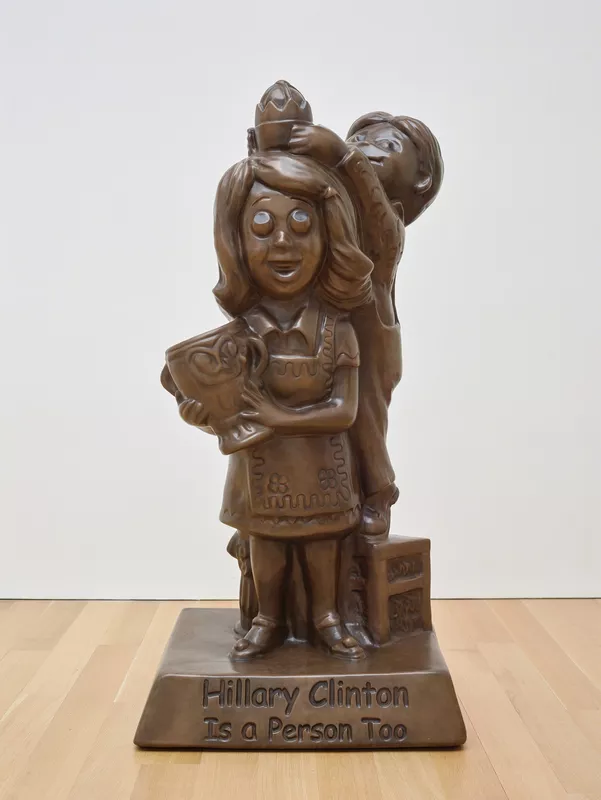
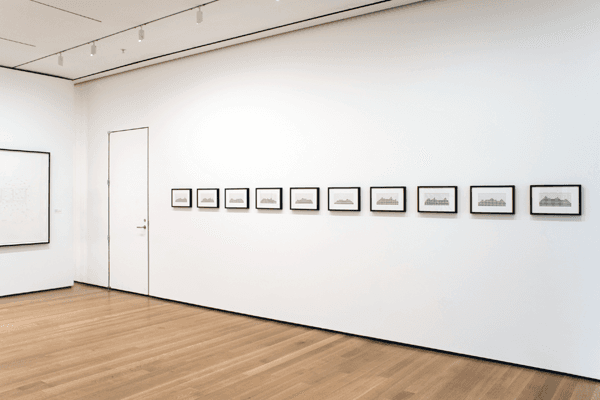
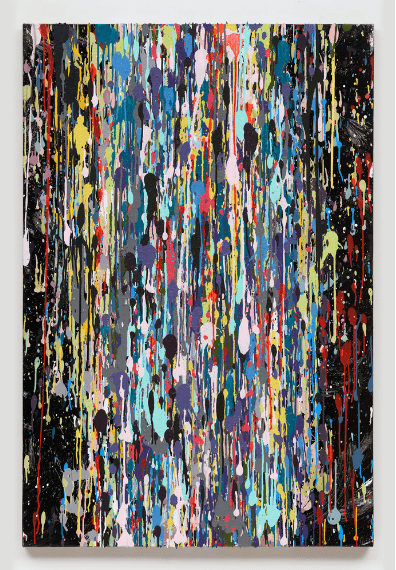
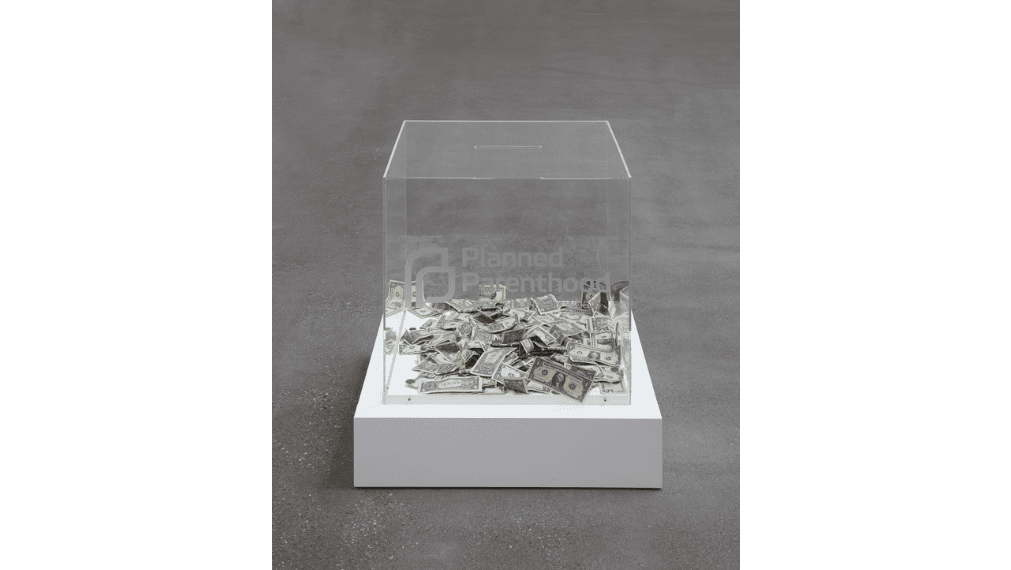
See other works by the artist, Hillary Clinton is a Person Too, Black Dot Project and Donation Cubes, and his page, Jonathan Horowitz.
Questions & answers
When was We Fight to Build a Free World at the Jewish Museum?
The exhibition ran at the Jewish Museum in New York from 1 October 2020 to 14 February 2021. It had been scheduled to open in March 2020 but was postponed because of the Covid-19 pandemic, and it opened with social distancing measures in place.
What was We Fight to Build a Free World about?
It explored how artists across history have responded to authoritarianism, xenophobia, racism, antisemitism and other forms of bigotry, as well as immigration and identity. It mixed historical works with new pieces, including 36 protest posters commissioned from contemporary artists.
Where does the title come from?
Jonathan Horowitz adapted it from a painting by Ben Shahn, We Fight for a Free World!, made around 1942 during the Second World War. The painting was included in the exhibition, linking wartime anti-fascist art to the political concerns of the present.
More by the artist
Jonathan Horowitz
Kindred works
You may also study

Saturn Devouring His Son
Francisco Goya · c. 1819–1823
Las Meninas
Diego Velázquez · 1656
The School of Athens
Raphael · 1509–1511
Liberty Leading the People
Eugène Delacroix · 1830
Wanderer above the Sea of Fog
Caspar David Friedrich · c. 1817
The Night Watch
Rembrandt · 1642
Winged Victory of Samothrace
Artist Unknown · c. 200–190 BC
The Raft of the Medusa
Théodore Géricault · 1818–1819