Realism
Girl Writing (La scrittrice)
Giovanni Spertini, 1866
Girl Writing (Fanciulla intenta a scrivere) is a marble by Giovanni Spertini, signed and dated 1866, of a barefoot girl in a nightgown writing at a small table. It belongs to the Pinacoteca di Brera and is on deposit at Milan's Galleria d'Arte Moderna.
- Artist
- Giovanni Spertini
- Date
- 1866
- Medium
- Marble
- Dimensions
- 122 × 60 × 80 cm
- Collection
- Galleria d'Arte Moderna (GAM), Villa Reale, Milan, Italy
- Movement
- Realism
What you're looking at
A girl of perhaps fifteen sits on a low upholstered stool, leaning over a little round table. Her head is bowed, her eyes on the page, and both forearms rest on the tabletop as she writes. She is dressed for bed: a long, loose nightgown, its neckline slipping off one shoulder, the sleeves pushed up to the elbow. Her hair is parted in the center and gathered in a long braid that falls over her shoulder. Her feet are bare, and one set of toes curls over the edge of the base.
Everything in the statue is white marble, and the realism lies in how different materials are told apart without color. The stool has a fringed skirt whose tassels hang in separate, drilled strands. The table, a slender tripod on carved feet, is covered with a cloth whose lace edge is cut so thin it seems to hang free of the wood. The nightgown is crumpled into soft folds at the lap and pulled taut across the knee, while the skin of the shoulder and arms is smoothed to a quiet polish. The pen and the sheets of paper are there too, small enough that many visitors only notice them on a second look.
It is worth walking around the piece. From the front you see concentration; from the side, the long curve of the spine bending toward the page, the posture of someone who has been writing for some time and has forgotten that anyone might be watching.
Who made it, and when
Giovanni Spertini (1821–1895) was born in Pavia and studied at the Brera Academy in Milan from 1836, later working with the sculptors Giovanni Maria Benzoni and Pietro Magni. He spent his career in Milan, making intimate genre figures and portrait busts of Risorgimento figures, and later taught modeling at the city's school of art applied to industry.
The marble is signed on the right side of the base: SPERTINI FECE / 1866, "Spertini made it, 1866." (Some older sources give 1863, which may refer to the first model rather than the finished stone.) It is counted as Spertini's first major work, and he gave it to the Brera Academy, which is why it still belongs to the Pinacoteca di Brera today. It was shown again at the Milan fine arts exhibition of 1872.
A reply to Magni's Reading Girl
The sculpture makes most sense next to its famous model. In 1856 Spertini's teacher Pietro Magni exhibited La leggitrice (The Reading Girl), a marble of a young woman in a slipping chemise absorbed in a book, which became one of the most admired and most copied Italian sculptures of the century. Spertini's girl reads as its counterpart, whether or not he intended a pendant: where Magni's figure receives words, his produces them.
Both works belong to a Lombard taste for verismo in sculpture: ordinary modern subjects, contemporary dress and furniture, and a technical bravura that turns lace, fringe and wrinkled cotton into marble. They are cousins of the realist painting of the period, and quite different from the idealized nudes and mythologies that still dominated official commissions.
What does it mean?
Spertini left no statement about the subject, and the old story that the model was his own daughter is not supported by the museum's records. What the sculpture does make clear is its theme: privacy and inner life. The nightgown and bare feet place the scene late at night or early in the morning, the hours of diaries and private letters. The slipping shoulder strap, a motif borrowed from Magni, adds a note of vulnerability, but the girl's attention is wholly on her page, and the sculpture never asks her to look up.
For viewers in 1860s Italy, a girl writing also carried a quiet modernity. Female literacy was rising, and the image of a young woman composing her own words, rather than reading a man's, is part of the work's lasting appeal, and part of why it has found a new audience among admirers of the quiet, bookish world of light academia.
Where to see Girl Writing
The sculpture belongs to the Pinacoteca di Brera and has been on long-term deposit with the Galleria d'Arte Moderna di Milano since 1902 (inventory GAM 512). It is shown in the museum's nineteenth-century rooms in the Villa Reale on Via Palestro, and it was restored in 2004 and included in the GAM exhibition 100 anni. Scultura a Milano 1815–1915 in 2017. Displays change, so check with the museum before a visit.
For more nineteenth-century marble, see Famous Sculptures, Corradini's Statue of Chastity and our page on Giovanni Spertini.
Questions & answers
Where is Spertini's Girl Writing?
It is in Milan, at the Galleria d'Arte Moderna (GAM) in the Villa Reale on Via Palestro. The marble belongs to the Pinacoteca di Brera and has been on deposit at the GAM since 1902, under inventory number GAM 512. It has been shown in the museum's nineteenth-century sculpture rooms.
When was Girl Writing made?
The marble is signed and dated on its base: SPERTINI FECE / 1866. Some sources give 1863, which may refer to an earlier model. It is regarded as Giovanni Spertini's first major work; he gave it to the Brera Academy, and it was exhibited in Milan in 1872.
What is Girl Writing made of?
It is carved entirely from white marble and stands 122 centimeters high. There is no color: the sculptor distinguishes skin, cotton nightgown, lace tablecloth and fringed upholstery purely through carving, polish and drilling, which is the main source of its technical fame.
How is Girl Writing related to Magni's Reading Girl?
Spertini studied with Pietro Magni, whose marble La leggitrice (The Reading Girl, 1856) was one of the most celebrated Italian sculptures of its time. Girl Writing reads as its counterpart: a young woman in a slipping chemise, absorbed not in reading but in writing, carved with the same attention to fabric and furniture.
Kindred works
You may also study
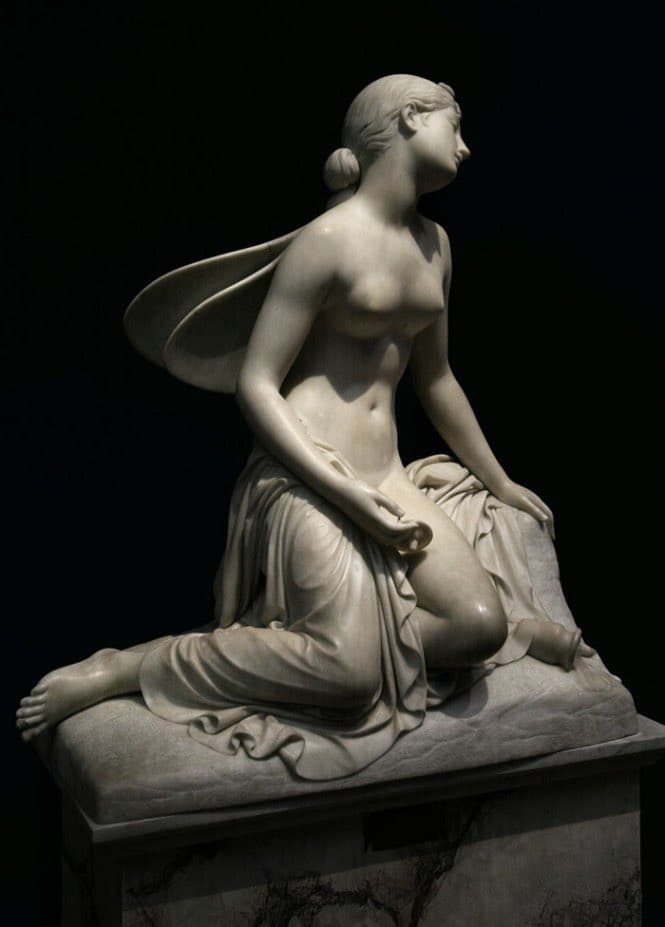
Psyche in a Faint
Pietro Tenerani · composition c. 1822
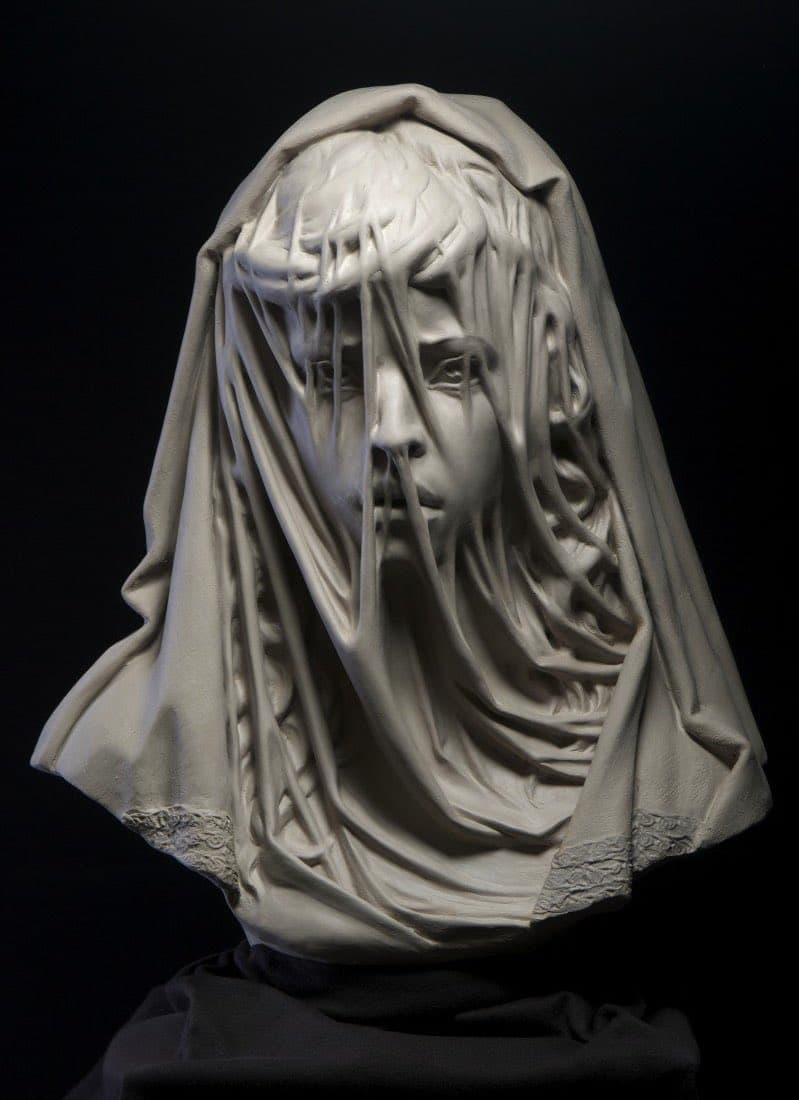
Child Bride
Philippe Faraut · 2014
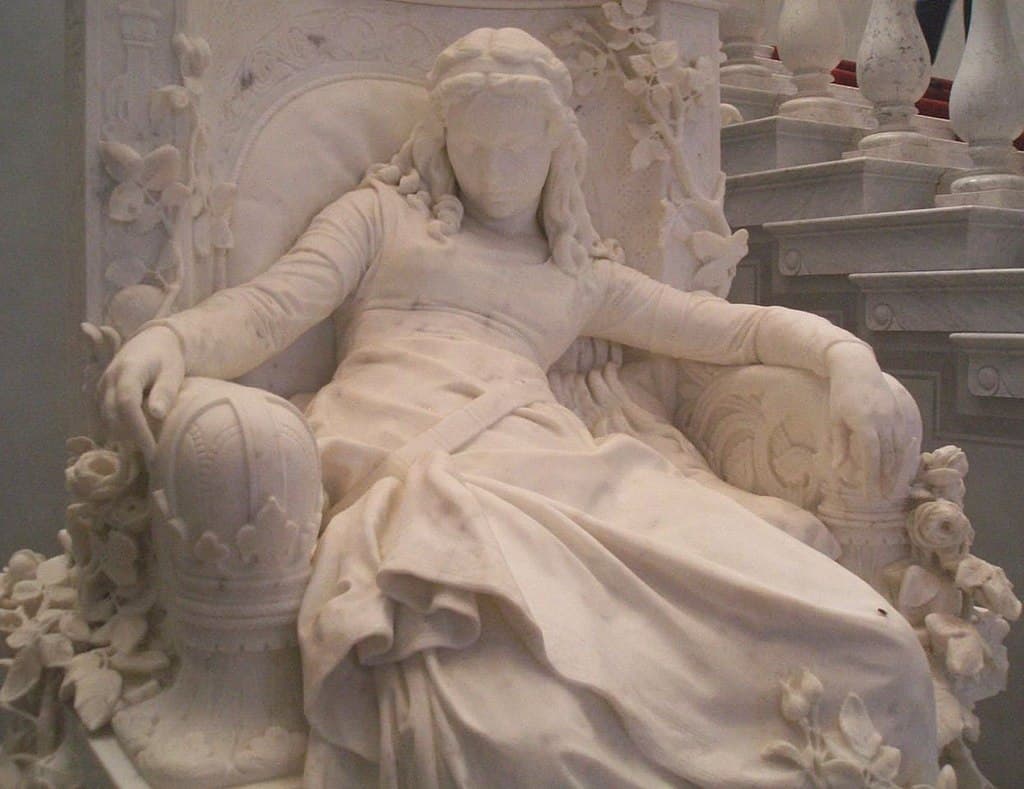
Sleeping Beauty (Dornröschen)
Louis Sussmann-Hellborn · 1878
Berenice's Tresses (La Chioma di Berenice)
Ambrogio Borghi · 1878

Bridge over a Pond of Water Lilies
Claude Monet · 1899

Venus de Milo
Alexandros of Antioch · c. 150–125 BC
The Thinker
Auguste Rodin · Modeled 1880–82; enlarged 1902–03; this cast 1904
The Creation of Adam
Michelangelo · c. 1511–12