Neoclassicism
Charles de Sainte-Maure, Duke of Montausier
Louis-Philippe Mouchy, 1781–89
This marble statue of Charles de Sainte-Maure, duc de Montausier, was carved by Louis-Philippe Mouchy for Louis XVI's "Grands Hommes" series, commissioned in 1781 and shown at the Salon of 1789. It is in the Louvre, Paris.
- Artist
- Louis-Philippe Mouchy
- Date
- 1781–89
- Medium
- Marble
- Dimensions
- 163 × 103 × 97 cm
- Collection
- Musée du Louvre, Paris, France
- Movement
- Neoclassicism
What you are looking at
A gentleman of Louis XIV's court sits forward in an armchair, about to speak. His right hand is out in front of him, the index finger pointing down and outward as if to underline a point. His left hand rests on a broad-brimmed hat heaped with ostrich plumes, laid on his knee. His head turns slightly to his right, and the mouth is set in a dry, half-amused line.
Everything about him is seventeenth-century costume, carved a century later. He wears a full-bottomed wig of tight corkscrew curls falling well past his shoulders. At his throat is a long lace cravat, and on the left breast of his coat the embroidered cross of the Order of the Holy Spirit, France's senior order of chivalry. The coat has deep turned-back cuffs edged with lace, the breeches end in rolled stockings, and the square-toed shoes are tied with big ribbon bows.
The chair is a Louis XVI design with fluted legs, the furniture of Mouchy's own day rather than the duke's. Beneath it sits a fringed cushion and, at the left, what appear to be books, quiet reminders of the sitter's reputation as a man of letters and a tutor. Around the front of the round plinth runs an inscription giving his name, his titles and the date of his death.
The "marble lace handkerchief"
The statue is sometimes nicknamed for its lace, and the lace is where Mouchy shows off. The cravat is not a handkerchief but a jabot of needle lace, and he has drilled through the marble to make its open, scalloped pattern of holes. The same lace edges the cuffs and frills at the wrists. Carving stone so thin that light passes through it was a specialty of eighteenth-century sculptors; Italian contemporaries pushed it furthest in veiled figures such as Sanmartino's Veiled Christ and Corradini's veiled women. Mouchy's version is more restrained, but at close range the cravat is the passage most visitors photograph.
Who was Charles de Sainte-Maure?
Charles de Sainte-Maure, duc de Montausier (1610–1690), was a soldier, courtier and man of letters. He served in the wars of the 1630s and 1640s, became governor of provinces and was made a duke. In 1645 he married Julie d'Angennes, daughter of the Marquise de Rambouillet, whose salon was the center of polite literary life in Paris. Before the marriage he presented her with the Guirlande de Julie, a celebrated manuscript of flower paintings and madrigals written by the poets of the salon.
In 1668 Louis XIV made him governor of the Grand Dauphin, the king's son and heir, responsible for the prince's education. Montausier had a reputation for blunt honesty and severity, and tradition has long seen him as a model for Alceste, the uncompromising hero of Molière's The Misanthrope. Mouchy's pointing hand fits that reputation: a teacher making a point and expecting it to be heeded.
Why the statue was made
The statue was commissioned in 1781 by the Comte d'Angiviller, director of the King's Buildings under Louis XVI, for a series known as the Grands Hommes de la France, the great men of France. Between 1776 and 1789 d'Angiviller ordered marble statues of famous French soldiers, writers, churchmen and statesmen from the leading sculptors of the Académie royale. The figures were meant for a planned museum in the Louvre, where they would teach the public by example. Augustin Pajou's Pascal and Jean-Antoine Houdon's Tourville belong to the same series.
The choice of Montausier is telling. He was not a battlefield hero but a model of upright service and the education of a prince, exactly the virtue the monarchy of the 1780s wished to celebrate. Jacques-Louis David's The Death of Socrates of 1787, another lesson in principled conduct, comes from the same moment.
How it was made
The statue is marble, about 163 cm high, 103 cm wide and 97 cm deep, so the seated figure is slightly larger than life. Mouchy finished it for the Salon of 1789, where it was exhibited that summer, weeks after the storming of the Bastille. The date of commission, 1781, is the one often quoted for the work; 1789 is the date of its completion and exhibition.
The sculptor
Louis-Philippe Mouchy (1734–1801) was a Parisian sculptor, a pupil of Jean-Baptiste Pigalle, whose niece he married. He became a member of the Académie royale and worked steadily on royal commissions. For the Grands Hommes series he also carved the Maréchal de Luxembourg. His work sits between the Rococo and the emerging Neoclassical style: sober in pose, but still delighted by texture, as the lace shows.
Where is the statue of Charles de Sainte-Maure?
The statue is in the Musée du Louvre in Paris, Department of Sculptures (inventory ENT 1987.3). It had a long journey to get there. After the Revolution it was deposited at the Institut de France, from 1806 to 1961, and then at the Palace of Versailles from 1961 to 1987. In 1987 it was one of eight statues from the series that came to the Louvre, which finally received the Grands Hommes it had been meant to house two centuries earlier. Look for it among the Louvre's eighteenth-century French sculpture, and see our famous sculptures for more.
Questions & answers
Who was Charles de Sainte-Maure?
Charles de Sainte-Maure, duc de Montausier (1610–1690), was a French soldier, courtier and man of letters. He married Julie d'Angennes of the famous Rambouillet salon, and in 1668 Louis XIV made him governor of the Grand Dauphin, the heir to the throne. Known for blunt honesty, he is traditionally seen as a model for Molière's Misanthrope.
Where is the statue of Charles de Sainte-Maure?
It is in the Musée du Louvre in Paris, Department of Sculptures, inventory ENT 1987.3. Before arriving at the Louvre in 1987 it was deposited at the Institut de France (1806–1961) and at the Palace of Versailles (1961–1987), which is why some sources still place it at Versailles.
Who made the statue of the Duke of Montausier?
The Parisian sculptor Louis-Philippe Mouchy (1734–1801), a pupil and nephew by marriage of Jean-Baptiste Pigalle. The Comte d'Angiviller commissioned it in 1781 for the royal series of "Grands Hommes de la France," and Mouchy exhibited the finished marble at the Salon of 1789.
Why is it called the marble lace handkerchief?
The nickname comes from the lace at the duke's throat, which is actually a cravat or jabot, not a handkerchief. Mouchy drilled through the marble to create its open, scalloped pattern, so the stone reads as fine needle lace. The same lacework edges the cuffs. It is the detail most visitors look for.
What were the Grands Hommes statues?
A series of marble statues of famous Frenchmen commissioned by the Comte d'Angiviller, director of the King's Buildings, between 1776 and 1789. Soldiers, writers, churchmen and statesmen were carved by leading sculptors such as Pajou, Houdon and Mouchy, for a planned public museum in the Louvre meant to inspire through example.
Kindred works
You may also study
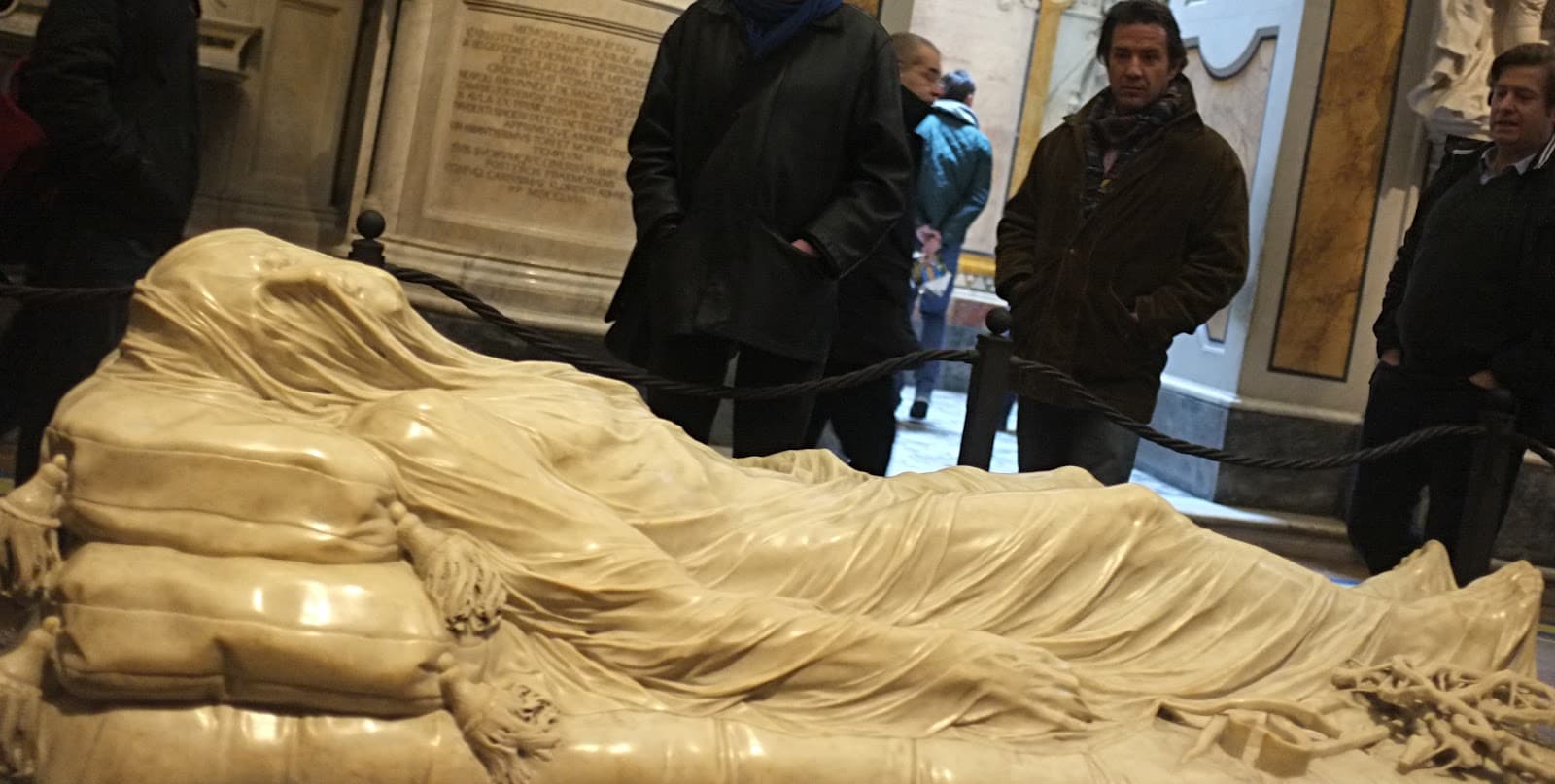
Veiled Christ
Giuseppe Sanmartino · 1753
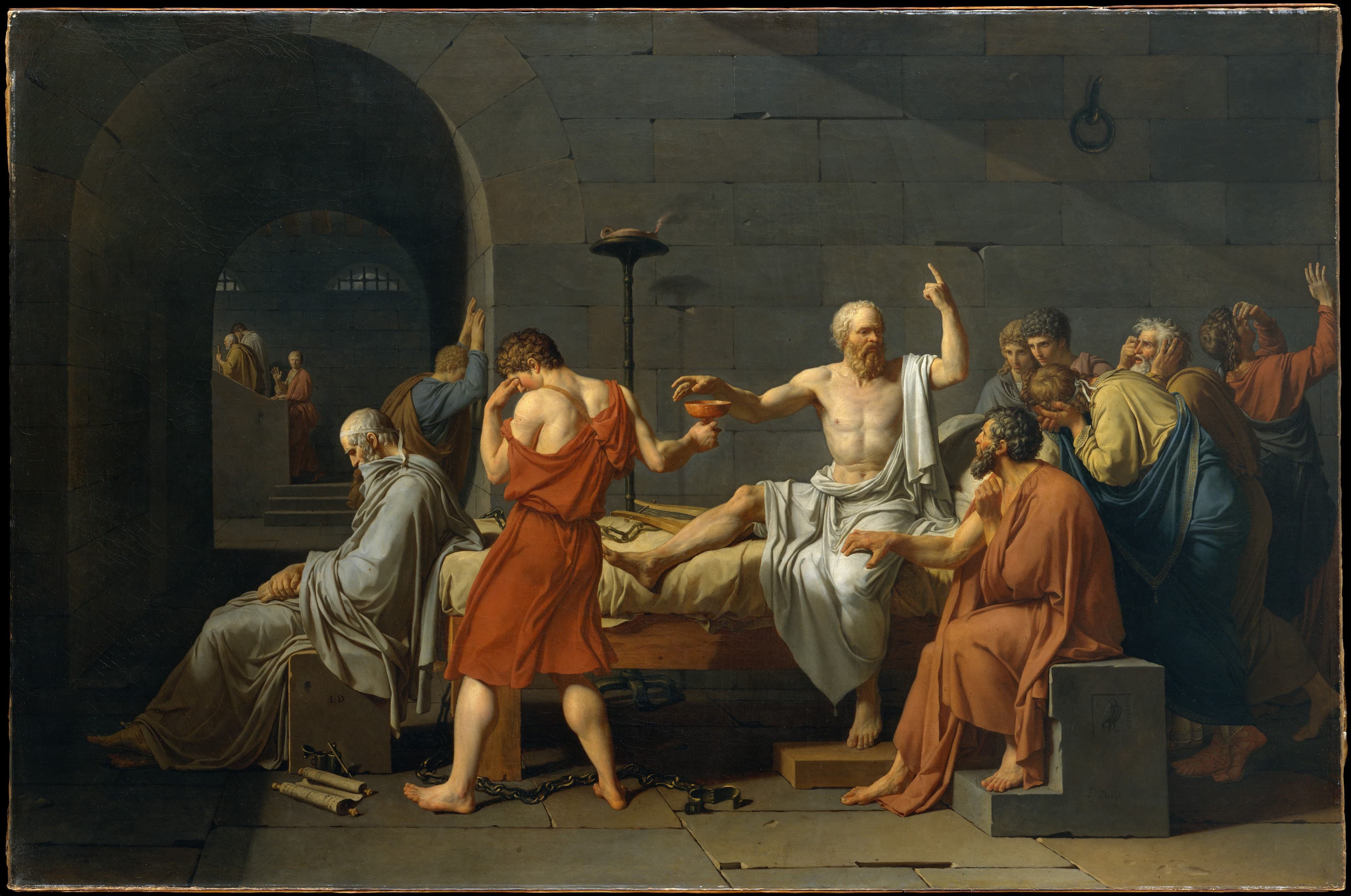
The Death of Socrates
Jacques-Louis David · 1787
The Three Graces
Antonio Canova · 1814–17
Statue of David
Michelangelo · 1501–04

Woman with a Parasol – Madame Monet and Her Son
Claude Monet · 1875
Las Meninas
Diego Velázquez · 1656
The School of Athens
Raphael · 1509–1511
Liberty Leading the People
Eugène Delacroix · 1830