French · Neoclassicism · Rococo
Louis-Philippe Mouchy
b. 31 March 1734 — d. 10 December 1801
Louis-Philippe Mouchy (1734–1801) was a French sculptor, pupil and nephew-by-marriage of Jean-Baptiste Pigalle, best known for his marble statue of the Duke of Montausier for Louis XVI's 'Great Men of France' series, now in the Louvre.
1 work in the collection
Works by Louis-Philippe Mouchy
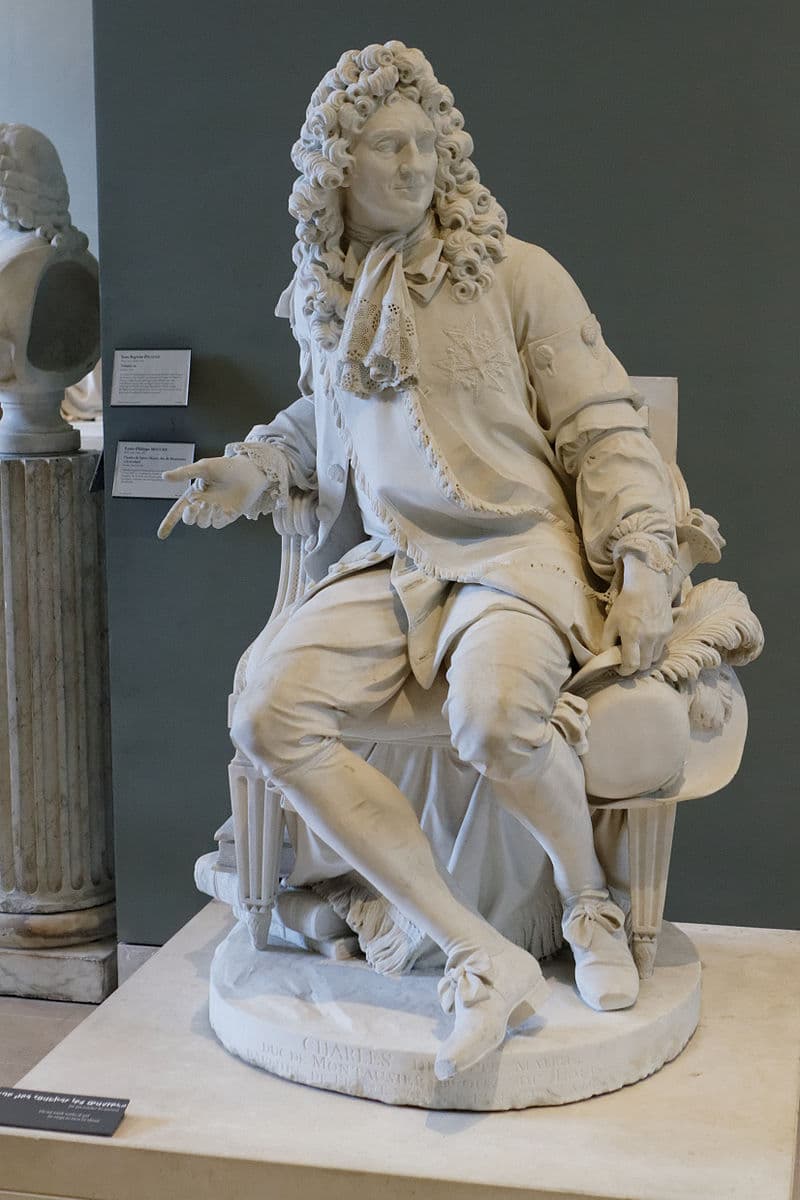
Louis-Philippe Mouchy was a French sculptor of the late 18th century, trained by Jean-Baptiste Pigalle and admitted to the Royal Academy of Painting and Sculpture in 1768. His best-known work is the marble statue of Charles de Sainte-Maure, Duke of Montausier, carved for the crown's series of "Great Men of France" and now in the Musée du Louvre in Paris.
Life and training
Mouchy was born in 1734 and trained in the studio of Pigalle, one of the leading sculptors of Louis XV's reign and the author of the famous nude Voltaire. The bond was personal as well as professional: Mouchy married Pigalle's niece, and he followed his master's style closely throughout his career.
He came up through the Académie royale de peinture et de sculpture in the usual way. He was received as a provisional member (agréé) on 27 September 1766 and as a full academician on 25 June 1768. His reception piece was Un Berger qui se repose (Shepherd at Rest), a marble of a seated youth. The critic Denis Diderot was not impressed, calling it a rather literal copy of the first figure one sees on the left when entering the Tuileries gardens from the Pont Royal. It is a fair glimpse of Mouchy's reputation: technically assured, faithful to models, not a natural inventor.
Mouchy's family linked him to another art. His daughter married the painter and engraver Philibert-Louis Debucourt, famous for his color prints of Parisian life, and in the marriage contract Mouchy offered the couple a three-room apartment in the Louvre, where artists favored by the crown were lodged. Debucourt lived there for twelve and a half years.
Style: costume over the classical nude
Mouchy worked across the transition from Rococo grace to the stricter Neoclassicism of the 1780s. His contemporaries thought he was more comfortable with realist subjects in 17th-century dress than with gods and heroes in the antique manner. His seated marble of Harpocrates, the Greco-Egyptian god of silence shown with a finger to his lips, was criticized as spindly, with a head that lacked nobility.
The costume pieces suited him better. In them he could do what he did best: render lace collars, the weight of a heavy cloak, boots, sword hilts and the particular face of a historical sitter, all with the finish expected of an Academy sculptor.
The Duke of Montausier and the "Grands Hommes"
After Louis XVI came to the throne in 1774, the director of the King's Buildings, the comte d'Angiviller, launched a program of marble statues of illustrious Frenchmen: generals, magistrates, writers and churchmen, intended for a future museum in the Louvre. As an assistant professor at the Academy, Mouchy had precedence when commissions were distributed, and only Augustin Pajou received more.
His statue of Charles de Sainte-Maure, duc de Montausier, was commissioned in 1781 and shown at the Salon of 1789, the year the Revolution began. Montausier was a soldier and courtier of Louis XIV's reign, governor of the Dauphin and famous for blunt honesty. Mouchy shows him in full 17th-century dress, a man of character rather than an idealized hero. The marble is now in the Louvre with the rest of the series.
Other works
Mouchy carved a marble Cupid Carving His Bow from the Club of Hercules after the celebrated original by Edme Bouchardon. His copy was installed in the round Temple of Love that Richard Mique built for Marie Antoinette in the garden of the Petit Trianon at Versailles. He also collaborated with Simon-Louis Boizot on statues for the church of Saint-Sulpice in Paris.
For the Marquis de Marigny, brother of Madame de Pompadour, he made busts of Voltaire and of the Marshal Maurice de Saxe to decorate Marigny's garden. The controller-general of finances, Joseph Marie Terray, commissioned from him a statue of Apollo representing the Arts, meant to pair with Pajou's Mercury representing Commerce. Terray died in 1778 before either was finished, and when his collection was auctioned in January 1779 buyers had to view the two statues in the sculptors' studios. Mouchy's Apollo, also called Apollo, or the Fine Arts, is now in the Louvre.
Reputation and where to see his work
Mouchy has never been a famous name. He worked in Pigalle's shadow and next to more inventive contemporaries such as Pajou, Houdon and Clodion. But his career is a clear window onto how the Academy and the crown produced public sculpture on the eve of the Revolution, and the Montausier statue is one of the best costume figures of the series.
The best place to see him is the Louvre's French sculpture galleries, which hold the Montausier and other works. Collections in the United States also hold pieces by or attributed to him, listed in the French Sculpture Census. For context, see our pages on famous sculptures and the Neoclassical marble of Antonio Canova, whose career was beginning in Rome as Mouchy's was ending.
Questions & answers
Who was Louis-Philippe Mouchy?
Louis-Philippe Mouchy (1734–1801) was a French sculptor, a pupil of Jean-Baptiste Pigalle who married Pigalle's niece. He became a full member of the Royal Academy in 1768 and carved marble statues for Louis XVI's series of 'Great Men of France'.
What is Louis-Philippe Mouchy's most famous sculpture?
His best-known work is the marble statue of Charles de Sainte-Maure, Duke of Montausier, commissioned in 1781 for the 'Grands Hommes' series and exhibited at the Salon of 1789. It is now in the Musée du Louvre in Paris.
Where can I see sculptures by Mouchy?
The Musée du Louvre in Paris holds his statue of the Duke of Montausier and his Apollo, or the Fine Arts. His marble Cupid after Bouchardon was made for the Temple of Love at the Petit Trianon, Versailles.
What was Mouchy's Academy reception piece?
Mouchy was admitted as a full academician on 25 June 1768 with Un Berger qui se repose (Shepherd at Rest). Diderot dismissed it as a rather literal copy of a statue in the Tuileries gardens.