British · Victorian painting · Aestheticism
John Atkinson Grimshaw
b. 6 September 1836, Leeds, England — d. 13 October 1893, Leeds, England
John Atkinson Grimshaw (1836–1893) was a self-taught Victorian painter from Leeds, famous for moonlit lanes, wet streets and gas-lit docks. His nocturnes of Leeds, Liverpool, Hull and London are among the most atmospheric images of the Victorian city.
1 work in the collection
Works by John Atkinson Grimshaw
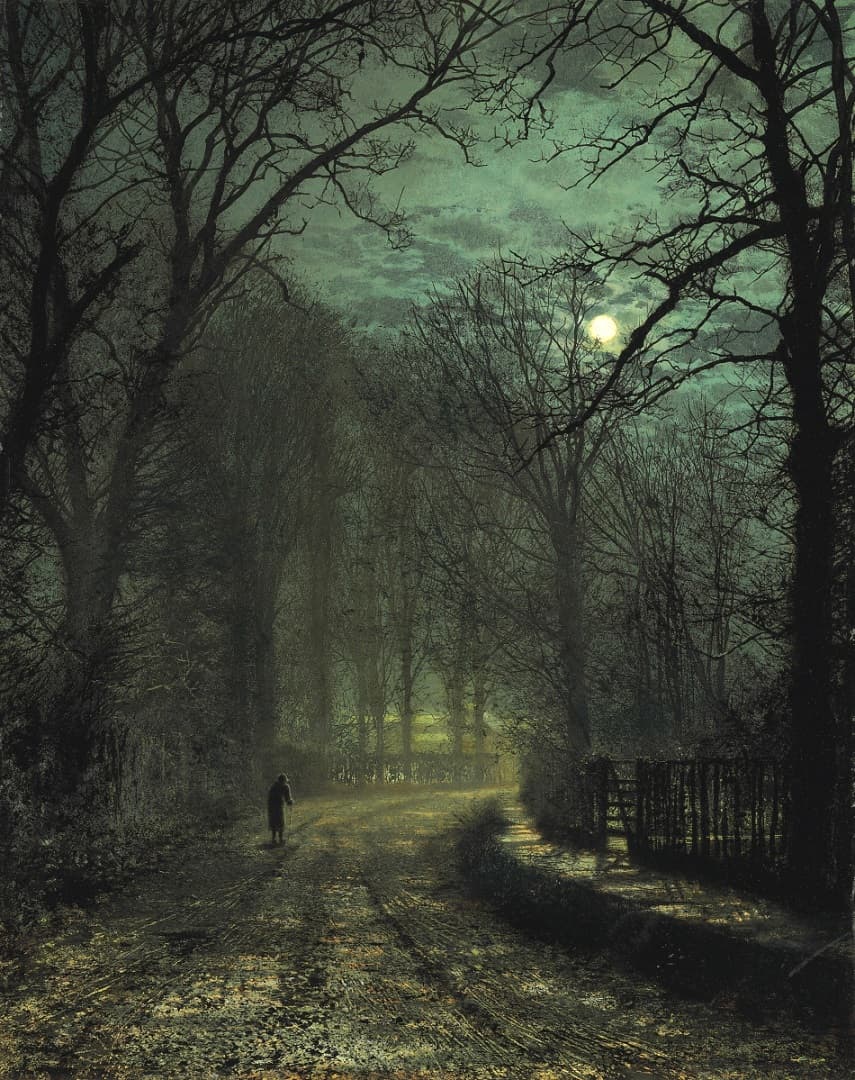
John Atkinson Grimshaw was an English painter of the Victorian era, born in Leeds in 1836, who made the night his subject. His typical picture is a suburban lane or a harbor at dusk or by moonlight: bare trees against a green-gold sky, wet cobbles reflecting lamplight, a single figure hurrying home. The critic Christopher Wood called him a "remarkable and imaginative painter," and his paintings remain among the most recognizable of the period.
Life in brief
Grimshaw was the son of a policeman and began work as a clerk for the Great Northern Railway. He had no formal artistic training. Against his parents' wishes he took up painting, and in 1861 he left the railway to paint full time. His early works were minutely detailed still lifes and landscapes in the Pre-Raphaelite manner. Success in the 1870s let him rent Knostrop Old Hall, a seventeenth-century manor outside Leeds, which appears in many of his pictures. He also kept a London studio in the 1880s, where he knew James McNeill Whistler. He died in Leeds in 1893.
Style and technique
Grimshaw's great theme was light at the edge of darkness: the last glow of sunset, moonlight through mist, the warm windows of shops seen through rain. He built up thin, smooth layers of paint and drew trees and rigging with fine, almost calligraphic precision. Contemporaries suspected that he used photographs or projected images to set out his compositions, and some criticized his surfaces as too smooth to show handling. The same smoothness gives his pictures their stillness. Whistler is reported to have said that he thought himself the inventor of the nocturne until he saw "Grimmy's" moonlit pictures.
Key works
A Yorkshire Lane in November is characteristic: a lone figure walks down a damp lane between leafless trees under a pale moon, the road shining with rain. His harbor pictures of Liverpool, Glasgow, Whitby and Scarborough and his London views of the Thames at night carry the same mood into the industrial city.
Where to see his work
Leeds Art Gallery holds an important group, and Tate in London owns Liverpool Quay by Moonlight (1887). Other works are in Harrogate, Scarborough and many regional collections. For more nocturnes, see Dark Academia.
Questions & answers
What is John Atkinson Grimshaw known for?
Grimshaw is known for moonlit and twilight scenes of Victorian lanes, suburban streets and docks in Leeds, Liverpool, Whitby, Hull and London, painted with smooth surfaces and glowing light reflected on wet roads.
Was Atkinson Grimshaw self-taught?
Yes. Grimshaw had no formal art training. He worked as a railway clerk in Leeds and taught himself to paint, leaving the railway in 1861 to become a full-time artist.
Where can I see Atkinson Grimshaw's paintings?
Leeds Art Gallery has one of the main collections of his work. Tate Britain owns Liverpool Quay by Moonlight, and paintings are also in Harrogate's Mercer Art Gallery, Scarborough Art Gallery and other British regional museums.