Dutch · Dutch Golden Age · Baroque
Rembrandt
b. 15 July 1606, Leiden, Dutch Republic — d. 4 October 1669, Amsterdam, Dutch Republic
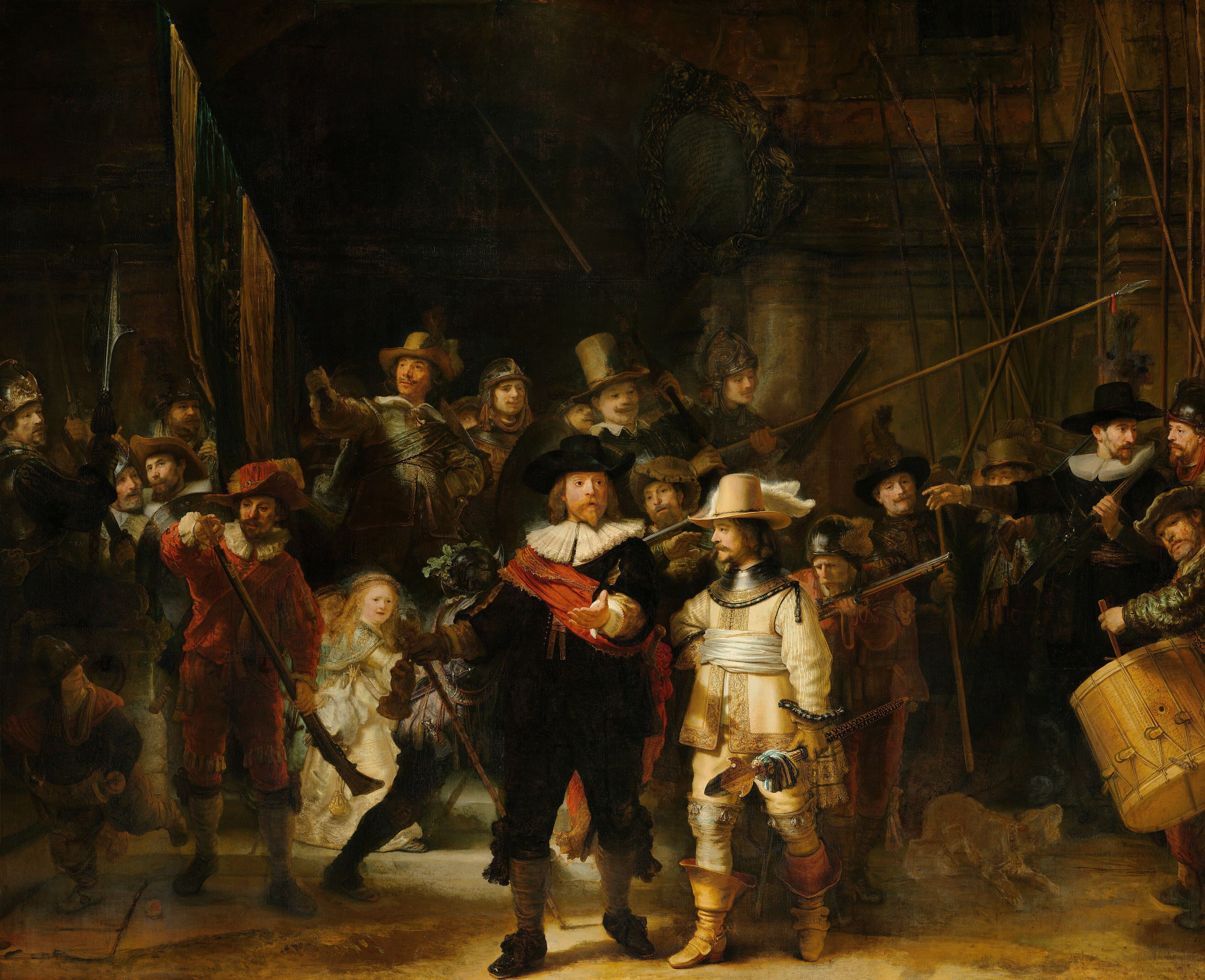
Rembrandt van Rijn (1606–1669) was the greatest painter and printmaker of the Dutch Golden Age, master of light and shadow, of probing self-portraits and of biblical drama, from The Night Watch to his late, searching portraits.
6 works in the collection
Works by Rembrandt
Rembrandt Harmenszoon van Rijn, known simply as Rembrandt, was a Dutch painter, draftsman and etcher born in Leiden in 1606. Working mostly in Amsterdam, he painted portraits, history scenes from the Bible and classical myth, and nearly a hundred self-portraits, and made some of the finest etchings ever produced. His command of light emerging from darkness, and his ability to suggest an inner life in a face, have made him one of the most admired artists in Western history.
Life in brief
Rembrandt was the son of a miller. He briefly attended Leiden University before training as a painter, first in Leiden and then for six months in Amsterdam with Pieter Lastman, a history painter who had studied in Italy. Back in Leiden in the later 1620s he worked closely with Jan Lievens, painting small, intensely lit scenes and studies of old people and of his own face. Around 1631–32 he moved to Amsterdam, where The Anatomy Lesson of Dr. Nicolaes Tulp (1632, Mauritshuis) made him the city's leading portraitist. In 1634 he married Saskia van Uylenburgh. Prosperity brought a large house on the Breestraat, now the Rembrandt House Museum, and a costly collection of art and curiosities.
The 1640s brought loss. Three of his children died in infancy, and Saskia died in 1642, the year he finished The Night Watch. Only their son Titus survived. Rembrandt later lived with Hendrickje Stoffels, with whom he had a daughter, Cornelia. Debts led to insolvency in 1656 and the sale of his house and collection. He continued to receive important commissions, but outlived both Hendrickje and Titus, and died in Amsterdam in 1669.
Style and technique
Rembrandt's early work is smooth and finely detailed, with strong contrasts of light and dark learned from Lastman and, at a distance, from Caravaggio's followers in Utrecht. Over the decades his handling grew broader and more physical. In the late paintings he built up paint thickly with brush, palette knife and even the brush handle, so that flesh and fabric seem modeled in relief, while the shadows stay thin and transparent. Light in his pictures is selective, falling on what matters and leaving the rest in warm darkness. He was also an innovator in etching, reworking plates through many states and wiping ink to create tone.
The works in the catalogue
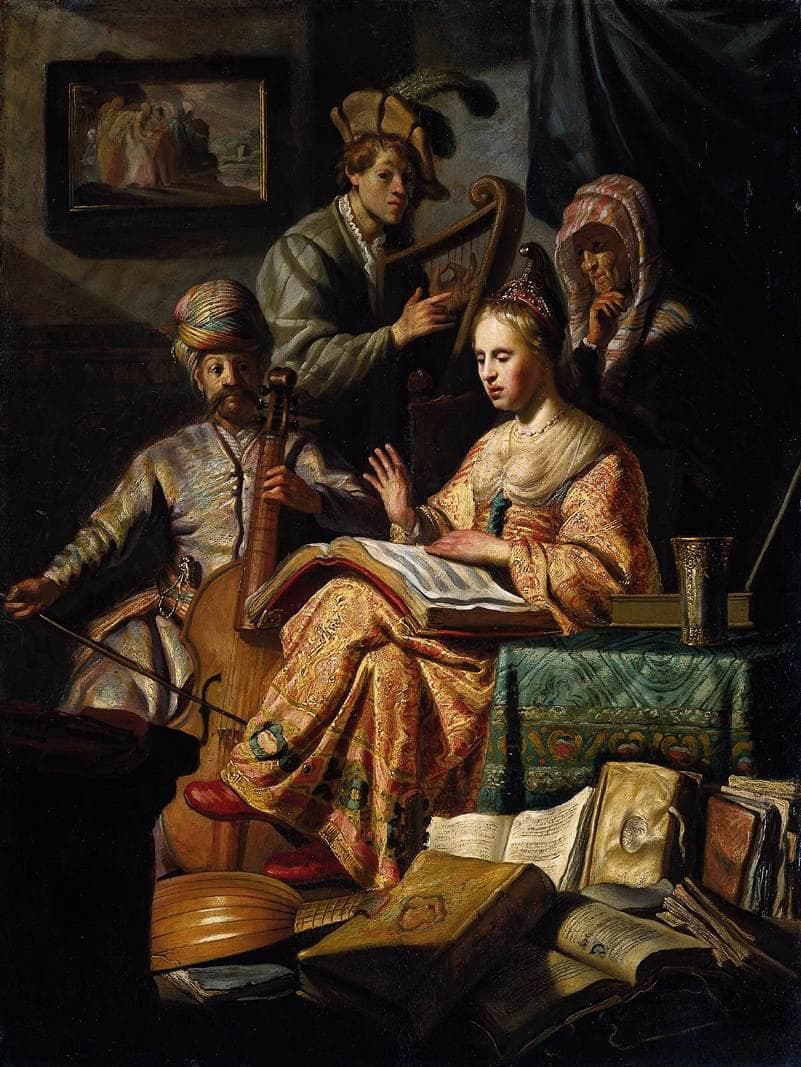
Musical Company (1626, Rijksmuseum) is one of his earliest dated paintings, made at twenty: four figures in exotic costume play and sing among books and instruments, painted in bright, enamel-like colors very different from his later browns. It is often read as an allegory of music or of the senses.
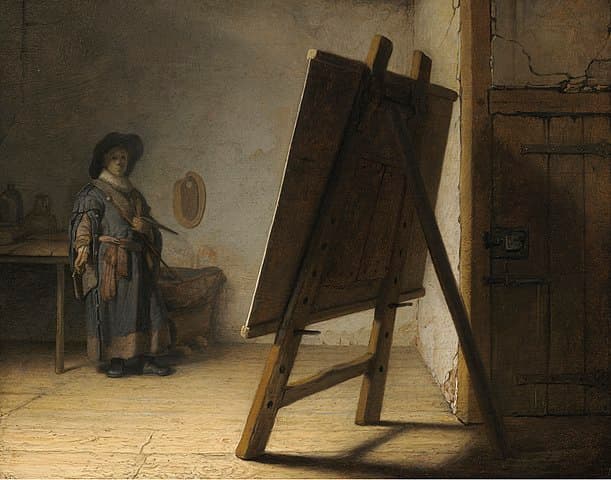
The Artist in His Studio (about 1628, Museum of Fine Arts, Boston) is a small panel in which a young painter, probably Rembrandt himself, stands well back from a huge easel seen from behind. The canvas we cannot see dominates the room. It is often read as a picture about the moment of thinking before painting.
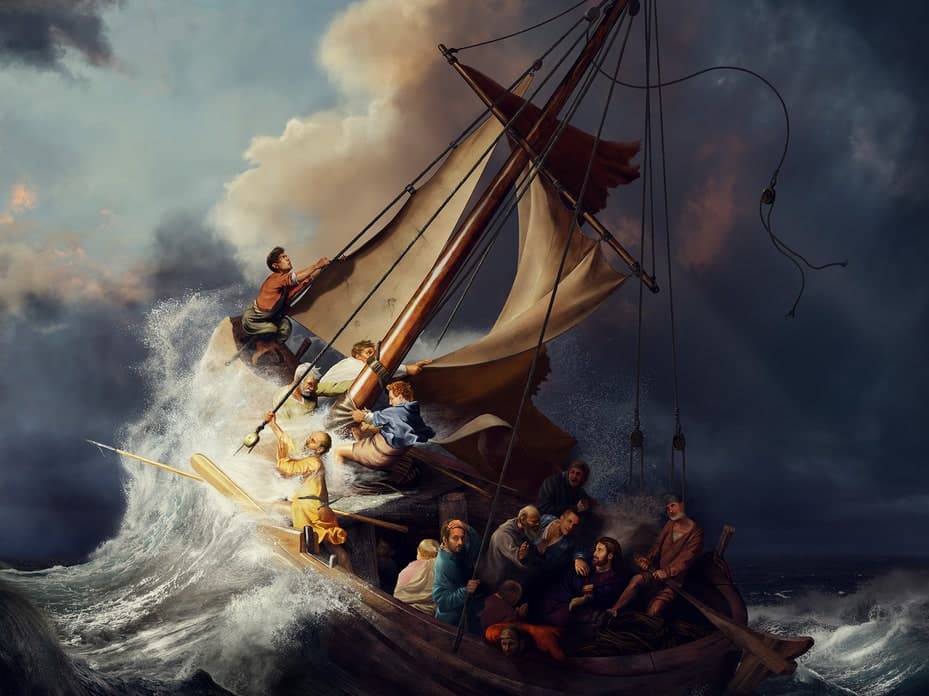
The Storm on the Sea of Galilee (1633), his only seascape, shows Christ's disciples struggling to control a fishing boat in a gale, from the Gospel of Mark. One figure looking out at the viewer is thought to be the artist. The painting was stolen from the Isabella Stewart Gardner Museum in Boston in March 1990 and has never been recovered; its empty frame still hangs in the museum.
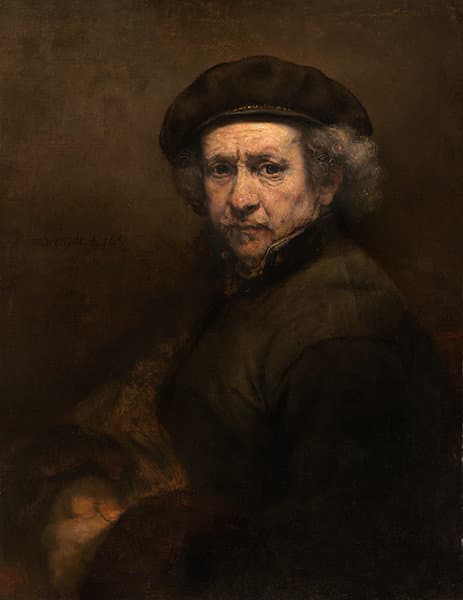
Self-Portrait with Beret and Turned-Up Collar (1659, National Gallery of Art, Washington) was painted three years after his insolvency. Seated, hands clasped, in a dark cloak and wide beret, he looks out with tired directness; the face is built from thick, worked paint, with every sag and blemish recorded.
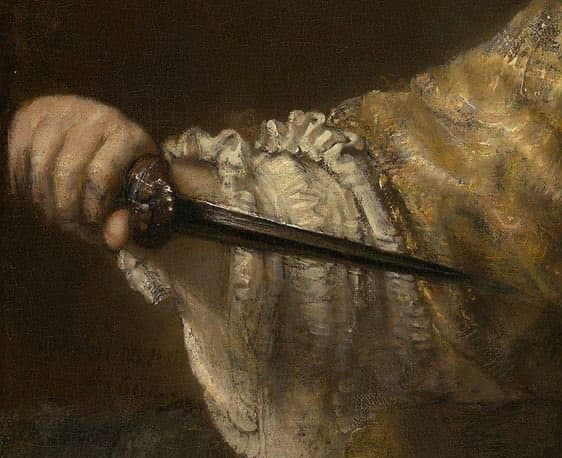
Lucretia (1664, National Gallery of Art, Washington) shows the Roman noblewoman who killed herself after being raped by Sextus Tarquinius, an act that, in Livy's history, led to the founding of the Roman Republic. Rembrandt paints the moment before the blow: she raises the dagger, her face full of sorrow rather than heroism. A second Lucretia of 1666 is in the Minneapolis Institute of Art.
Influence
Rembrandt trained many pupils, including Gerrit Dou, Ferdinand Bol, Govert Flinck and Carel Fabritius, and his workshop style was so widely imitated that the Rembrandt Research Project spent decades separating his own paintings from those of followers. Painters from Goya to Van Gogh looked to him; Vincent van Gogh wrote of his admiration in his letters, and his late self-portraits set the standard for unsparing self-examination in art.
Where to see his work
The Rijksmuseum in Amsterdam holds The Night Watch and The Jewish Bride, and the Rembrandt House Museum shows his etchings in his former home. Major groups are also in the Mauritshuis in The Hague, the National Gallery in London, the Metropolitan Museum and the Frick Collection in New York, the National Gallery of Art in Washington and the Gemäldegalerie in Berlin. See more in Baroque Art and Famous Paintings.
Questions & answers
What is Rembrandt most famous for?
Rembrandt is most famous for The Night Watch (1642, Rijksmuseum), for his many probing self-portraits, and for his dramatic use of light and shadow in biblical scenes and portraits. He is also considered one of the greatest etchers in history.
Was Rembrandt's Storm on the Sea of Galilee ever found?
No. The Storm on the Sea of Galilee (1633), Rembrandt's only seascape, was stolen from the Isabella Stewart Gardner Museum in Boston in March 1990 with twelve other works. It has never been recovered, and its empty frame still hangs in the museum.
Where is Rembrandt's Lucretia?
Rembrandt painted Lucretia twice. The 1664 version, showing her raising a dagger, is in the National Gallery of Art in Washington, D.C.; the 1666 version, after the wound, is in the Minneapolis Institute of Art.
Why did Rembrandt go bankrupt?
Rembrandt lived beyond his means, buying an expensive house in 1639 and collecting art and curiosities. Combined with a downturn in the Dutch economy, his debts led to insolvency in 1656, and his house and collection were sold.