Italian · High Renaissance
Raphael
b. 28 March or 6 April 1483, Urbino — d. 6 April 1520, Rome
Raphael (1483–1520) was the Italian High Renaissance painter and architect of The School of Athens in the Vatican, whose graceful Madonnas and harmonious compositions became the model of classical perfection for four centuries.
1 work in the collection
Works by Raphael
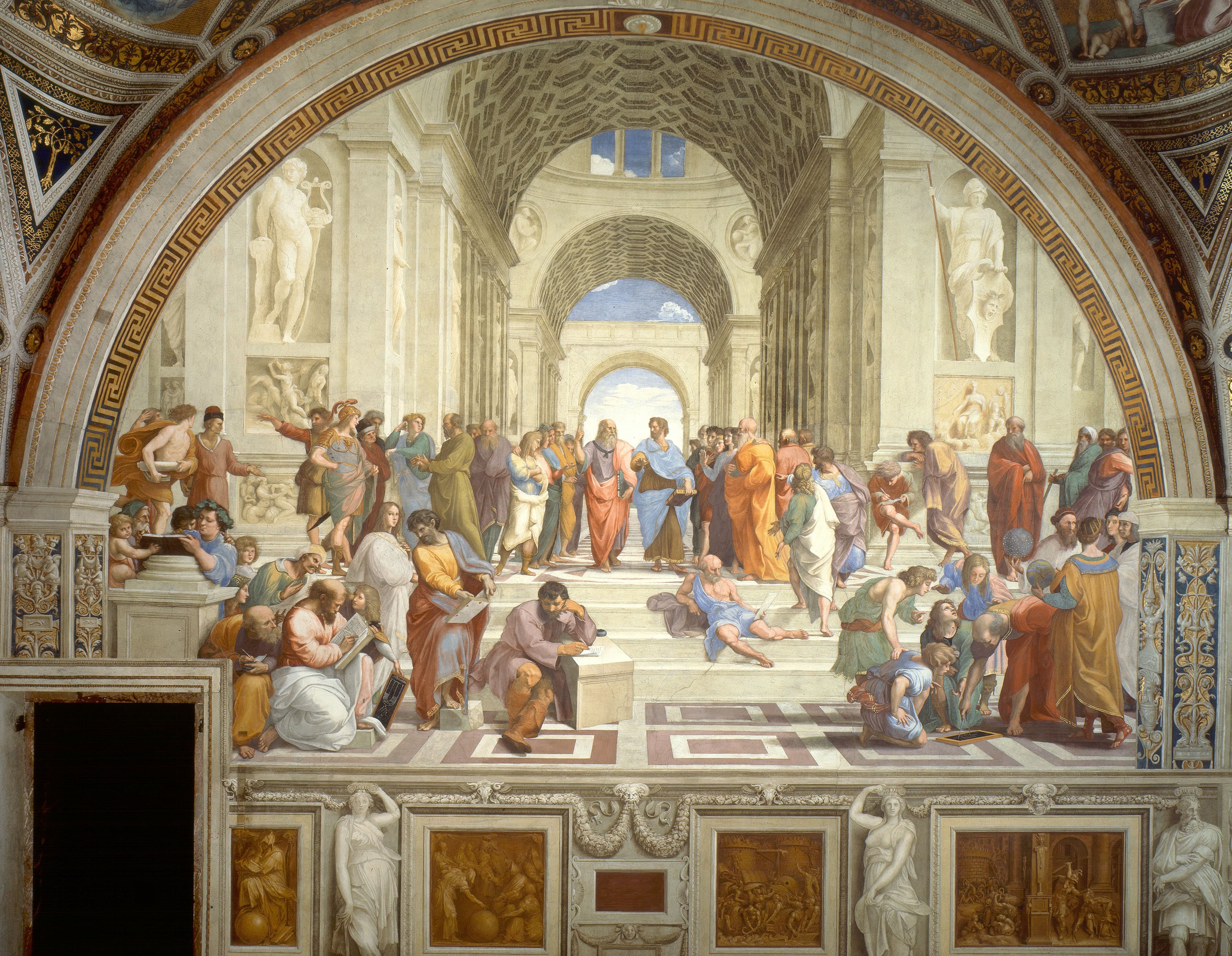
Raffaello Sanzio da Urbino, known in English as Raphael, was a painter and architect of the High Renaissance and, with Leonardo da Vinci and Michelangelo, one of its three great masters. His most famous work, the fresco The School of Athens (1509–11), covers a wall of the Stanza della Segnatura in the Apostolic Palace, now part of the Vatican Museums. He died in Rome at 37, having packed into twenty years a body of work that defined ideal beauty for generations.
Life in brief
Raphael was born in Urbino in 1483, at a cultivated court. His father, Giovanni Santi, was a painter and poet in the service of the dukes of Montefeltro, and taught him the basics before dying in 1494, when Raphael was eleven. By his late teens the young painter was working in the orbit of Pietro Perugino in Umbria, absorbing his calm spaces and sweet-faced figures. The Marriage of the Virgin (1504, Pinacoteca di Brera, Milan), with its domed temple set on a wide piazza, already surpasses its model.
From about 1504 to 1508 he worked in Florence, where he studied the new art of Leonardo and Michelangelo. Leonardo's pyramidal groups and soft modeling transformed his Madonnas, such as the Madonna of the Meadow (1505–06, Kunsthistorisches Museum, Vienna) and La Belle Jardinière (1507, Louvre), and the pose of the Mona Lisa reappears in his portrait of Maddalena Doni.
In 1508 Pope Julius II called him to Rome to decorate a suite of rooms in the Vatican, while Michelangelo was painting the Sistine Chapel ceiling a few steps away. Raphael stayed in Rome for the rest of his life. Under Julius and then Leo X he ran the largest workshop in the city, painting frescoes, altarpieces and portraits, designing tapestries for the Sistine Chapel, and in 1514 succeeding Bramante as architect of the new Saint Peter's Basilica. He was also charged with recording the ruins of ancient Rome. He died on 6 April 1520, after a short fever, and was buried, at his own wish, in the Pantheon.
Style and technique
Raphael's gift was synthesis. He took Perugino's serenity, Leonardo's soft shadows and Michelangelo's powerful bodies and fused them into compositions of perfect clarity. Figures turn and gesture so that the eye moves easily through a crowded scene; nothing seems forced. He was a tireless draftsman, working up each figure through studies in chalk and metalpoint, many from posed workshop assistants.
His late work grows darker and more dramatic. The Transfiguration (1516–20, Pinacoteca Vaticana), his final altarpiece, sets the radiant Christ above a turbulent scene of the apostles failing to heal a possessed boy.
The School of Athens
The fresco imagines the great thinkers of antiquity gathered beneath coffered vaults inspired by Bramante's designs for Saint Peter's. At the center walk Plato, pointing upward to the realm of ideas, and Aristotle, holding his hand flat over the earthly world. Plato is traditionally said to have Leonardo's features. The brooding figure leaning on a block in the foreground, often identified as Heraclitus, was added late and may portray Michelangelo; Euclid, bending over a slate at lower right, is said to resemble Bramante. At the far right edge Raphael painted himself, looking out at us.
The fresco is one of four in the room, which probably housed Julius II's private library. Opposite it, the Disputation of the Holy Sacrament sets theologians around the Eucharist beneath a vision of heaven; on the side walls, Parnassus shows Apollo among the poets, Dante and Homer among them, and the fourth wall is given to Justice and law. Together they present philosophy, theology, poetry and law as the four branches of knowledge, reconciled in a single humanist scheme. The rooms that followed, the Stanza di Eliodoro and the Stanza dell'Incendio, were increasingly painted by his assistants, chief among them Giulio Romano, working from Raphael's designs.
Other key works
- The Sistine Madonna (c. 1512–13, Gemäldegalerie Alte Meister, Dresden), whose two leaning cherubs at the bottom are among the most reproduced details in art.
- The Triumph of Galatea (c. 1514, Villa Farnesina, Rome).
- Portrait of Baldassare Castiglione (c. 1514–15, Louvre), a model of understated elegance.
- La Fornarina (c. 1518–20, Palazzo Barberini, Rome), a half-nude woman wearing an armband inscribed with his name.
- The tapestry cartoons for the Sistine Chapel (1515–16), in the Royal Collection, displayed at the Victoria and Albert Museum.
Influence
For three centuries academies across Europe treated Raphael as the summit of painting. The Pre-Raphaelite Brotherhood of 1848 took its name in reaction against that academic cult, preferring the art before him. His influence runs through Poussin, Ingres and Bouguereau.
Where to see his work
The Vatican Museums hold the Raphael Rooms and the Pinacoteca. Florence has works in the Uffizi and Palazzo Pitti; other major paintings are in the Louvre, the National Gallery in London, Dresden, Vienna, Milan and Washington. Explore the period in Renaissance Paintings and Famous Paintings.
Questions & answers
What is Raphael most famous for?
Raphael is most famous for The School of Athens (1509–11), his fresco of ancient philosophers in the Vatican's Stanza della Segnatura, and for serene Madonnas such as the Sistine Madonna. He is ranked with Leonardo and Michelangelo as one of the three giants of the High Renaissance.
Where is The School of Athens?
The School of Athens is a fresco on the wall of the Stanza della Segnatura, one of the Raphael Rooms in the Apostolic Palace, Vatican City. It is visited as part of the Vatican Museums route, usually just before the Sistine Chapel.
How did Raphael die?
Raphael died in Rome on Good Friday, 6 April 1520, aged 37, after an illness of about two weeks with high fever. Vasari blamed excess; modern historians suggest an infection or pneumonia. He was buried in the Pantheon, where his tomb can still be seen.
Who is in The School of Athens?
The central figures are Plato and Aristotle. Others commonly identified include Socrates, Pythagoras, Euclid, Diogenes, Heraclitus, Ptolemy and Zoroaster. Plato is often said to resemble Leonardo, Heraclitus Michelangelo, and Raphael included his own portrait at the right edge.
Where can I see Raphael's paintings?
The Vatican Museums have the Raphael Rooms and The Transfiguration. The Uffizi and Palazzo Pitti in Florence, the Louvre, the National Gallery in London, the Gemäldegalerie in Dresden and the Kunsthistorisches Museum in Vienna all hold major works.