Italian · Baroque
Gian Lorenzo Bernini
b. 7 December 1598, Naples — d. 28 November 1680, Rome
Gian Lorenzo Bernini (1598–1680) was the sculptor and architect who created the Baroque look of Rome, from the Rape of Proserpina to St. Peter's Square, and whose works guide the plot of Angels & Demons.
5 works in the collection
Works by Gian Lorenzo Bernini
Gian Lorenzo Bernini (1598–1680) was an Italian sculptor, architect and stage designer, the dominant artist of Baroque Rome. His marble figures seem to move and breathe, and his churches, fountains and the colonnade of St. Peter's Square still define the look of the city. Many readers find him through Dan Brown's Angels & Demons, whose plot is built on his sculptures.
Life in brief
Bernini was born in Naples, the son of the Florentine sculptor Pietro Bernini, and moved to Rome as a child when his father found work there. He was carving professionally before he was twenty. Cardinal Scipione Borghese, nephew of Pope Paul V, commissioned the life-size marble groups that made his name in the early 1620s. When Maffeo Barberini, an admirer, became Pope Urban VIII in 1623, Bernini became the papacy's chief artist, a position he held, with one brief interruption, under a succession of popes for more than fifty years.
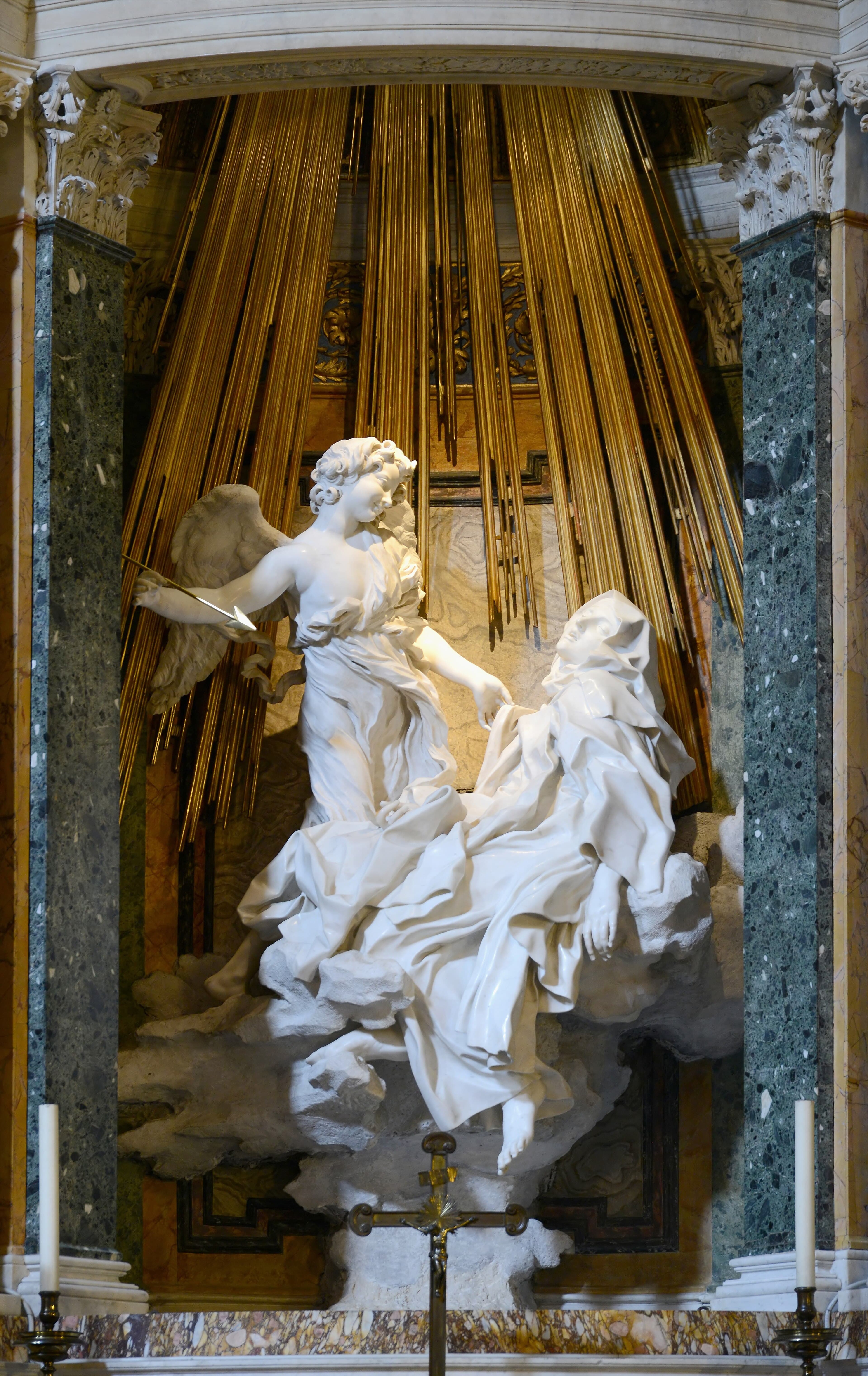
He worked on a huge scale with a large workshop: the bronze baldacchino over the high altar of St. Peter's (1623–34), the Cornaro Chapel with the Ecstasy of Saint Teresa (1647–52), the Fountain of the Four Rivers in Piazza Navona (1648–51), the church of Sant'Andrea al Quirinale and the great elliptical colonnade of St. Peter's Square (1656–67). In 1665 Louis XIV invited him to Paris to design the Louvre; his plans were rejected, but he carved a famous marble bust of the king. He died in Rome in 1680, aged 81, and is buried in Santa Maria Maggiore.
The Borghese sculptures
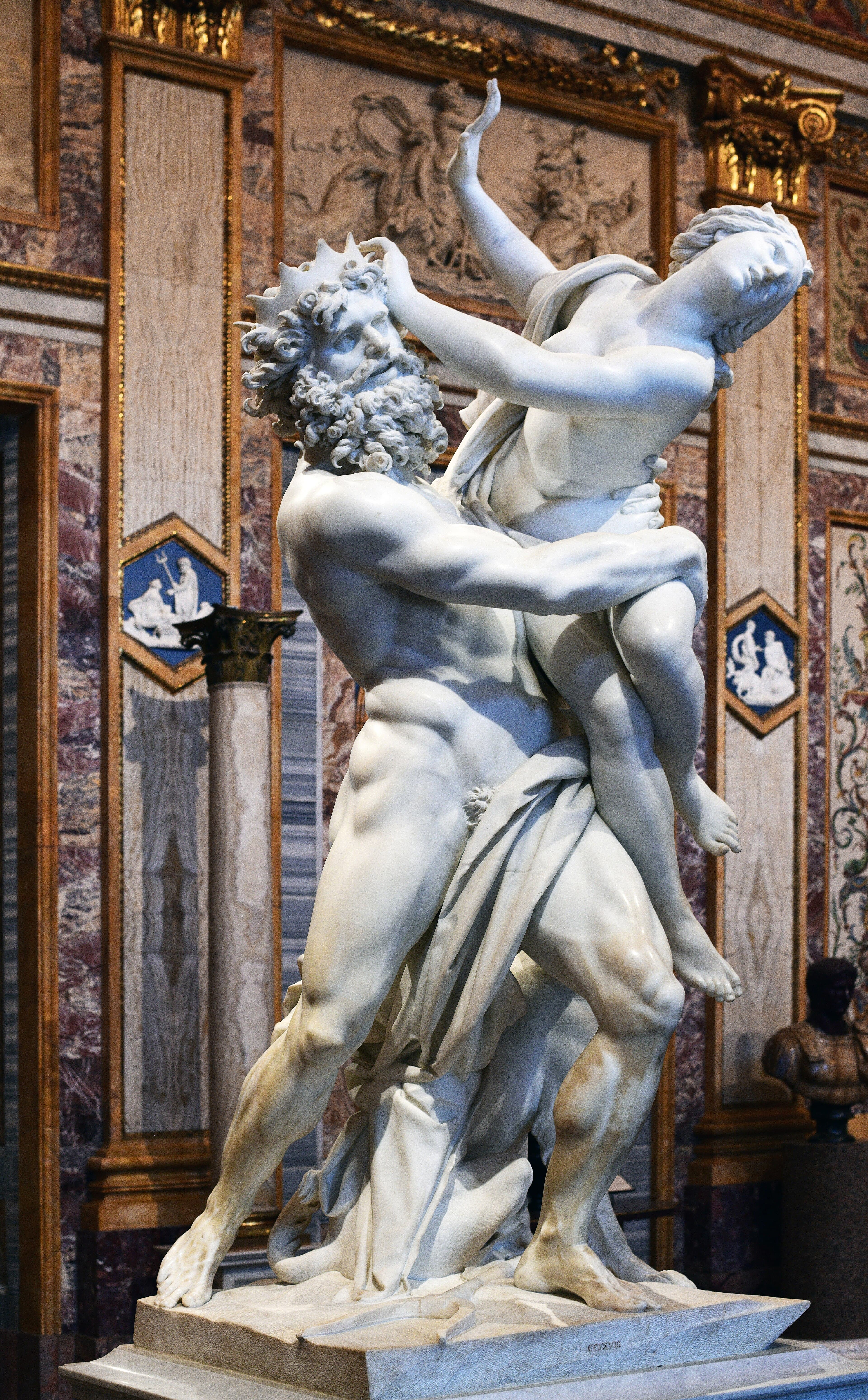
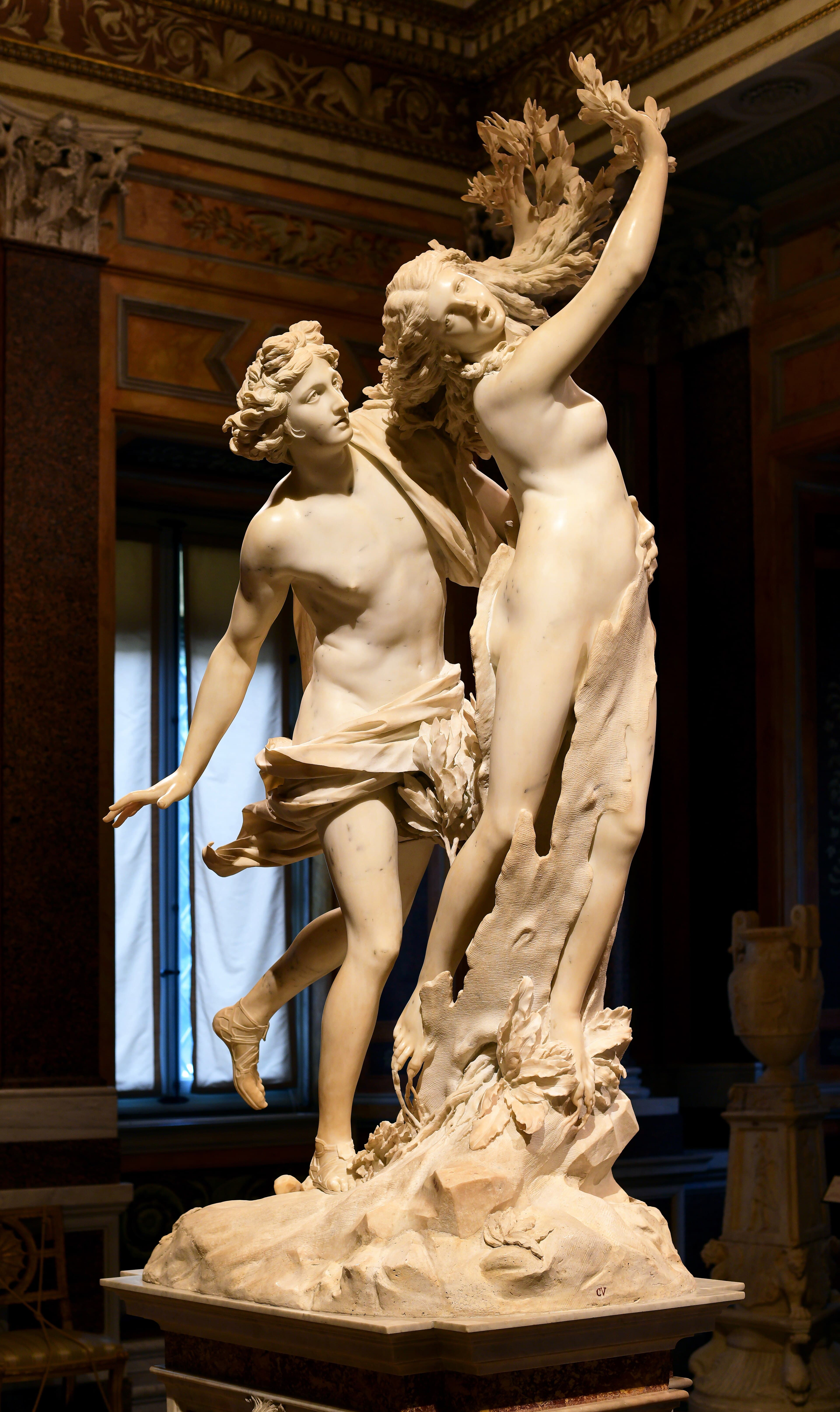
Bernini's early groups for Scipione Borghese changed what marble could do. The Rape of Proserpina (1621–22, also catalogued as Ratto di Proserpina) shows Pluto seizing the young goddess to carry her to the underworld. Look at Pluto's left hand: his fingers press into her thigh and the marble dents like flesh. A tear runs down her cheek, and the three-headed dog Cerberus barks at their feet. Soon after came Apollo and Daphne (1622–25), in which bark climbs the nymph's legs and leaves sprout from her fingers as the god catches her. Both are in the Galleria Borghese in Rome.
Style and technique
Bernini's sculpture is theatrical in a literal sense. He chose the most dramatic instant of a story, placed figures so that you meet them from a planned viewpoint, and combined marble, bronze, colored stone, gilding and hidden windows to control light. He drilled, chiseled and polished different parts of a single block in different ways, so that skin, hair, cloth and stone each have their own texture.
The Vision of Constantine
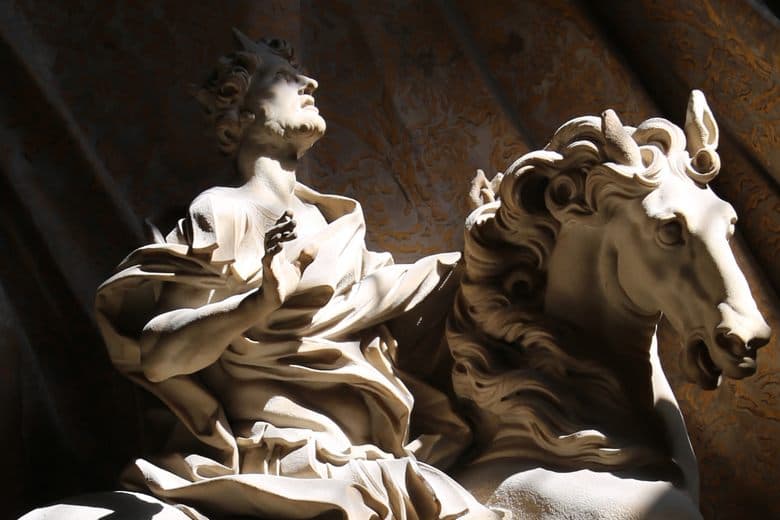
The Vision of Constantine (1654–70) stands at the foot of the Scala Regia, the ceremonial staircase into the Vatican Palace. The emperor's horse rears in shock as Constantine looks up at the cross in the sky; behind them a great curtain of stucco drapery falls like a stage backdrop. Bernini designed the staircase as well, using tricks of perspective to make a cramped space look grand.
Bernini and Angels & Demons
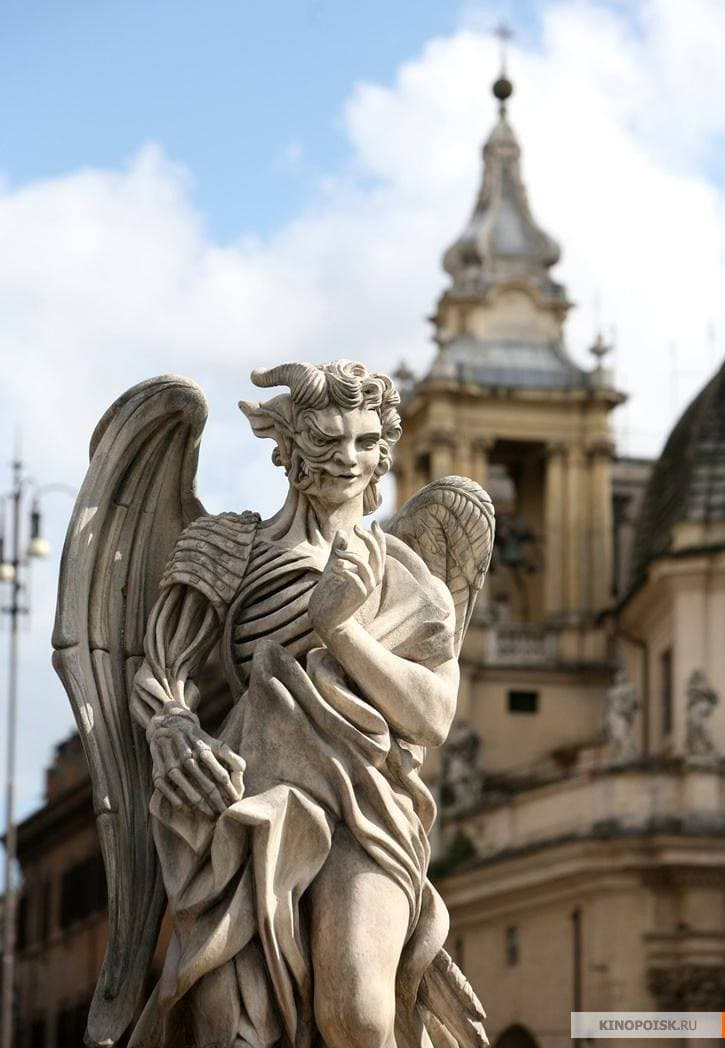
In Dan Brown's novel Angels & Demons (2000) and Ron Howard's 2009 film, the hero follows a trail of clues, the "Path of Illumination," through Bernini works in Rome: Habakkuk and the Angel in Santa Maria del Popolo, the West Ponente relief in St. Peter's Square, the Ecstasy of Saint Teresa and the Fountain of the Four Rivers. The secret society story is fiction, but the sculptures are real and can all be visited. Our catalogue includes a sculpted prop made for the film, a demonic angel in Bernini's manner photographed in Piazza del Popolo in 2008; it is not a real monument. For the wider theme, see Angels & Demons in Art.
Influence
Bernini defined the Baroque for sculptors across Catholic Europe for a century. His reputation suffered under Neoclassical critics who found him excessive, but he is now seen, alongside Michelangelo, as one of the two greatest sculptors Rome has known. Explore more in Baroque Art and Famous Sculptures.
Where to see his work
Rome is the place: the Galleria Borghese for the early groups, St. Peter's Basilica and Square, Santa Maria della Vittoria for Saint Teresa, Piazza Navona for the Four Rivers, and Sant'Andrea al Quirinale. His bust of Louis XIV is at Versailles.
Questions & answers
Which Bernini sculptures appear in Angels & Demons?
Dan Brown's Path of Illumination uses Bernini's Habakkuk and the Angel in Santa Maria del Popolo, the West Ponente relief in St. Peter's Square, the Ecstasy of Saint Teresa in Santa Maria della Vittoria and the Fountain of the Four Rivers in Piazza Navona. All are real and in Rome.
Is the angel statue in the Angels & Demons movie by Bernini?
No. The demonic angel statue photographed in Piazza del Popolo in 2008 was a prop made for Ron Howard's 2009 film. It imitates Bernini's style, but it is not one of his works and is not a permanent monument.
Where is Bernini's Rape of Proserpina?
The Rape of Proserpina, carved in 1621–22 when Bernini was 23, is in the Galleria Borghese in Rome, the villa of the cardinal who commissioned it. Advance booking is required to visit.
How old was Bernini when he carved the Rape of Proserpina?
Bernini was 23 when he carved The Rape of Proserpina in 1621–22. He began Apollo and Daphne immediately afterward and finished it in 1625, by which age he was already the leading sculptor in Rome.
What did Bernini design in St. Peter's?
Bernini designed the bronze baldacchino over the high altar, the Cathedra Petri in the apse, several papal tombs, the Scala Regia with The Vision of Constantine and the colonnade enclosing St. Peter's Square.