Colonial Revival
The First Thanksgiving at Plymouth
Jennie Augusta Brownscombe, 1914
The First Thanksgiving at Plymouth is a 1914 oil painting by Jennie Augusta Brownscombe imagining the 1621 harvest feast of the Plymouth colonists and the Wampanoag. It is in the Pilgrim Hall Museum, Plymouth, Massachusetts.
- Date
- 1914
- Medium
- Oil on canvas
- Collection
- Pilgrim Hall Museum, Plymouth, Massachusetts, United States
- Movement
- Colonial Revival
What you're looking at
Few images have shaped how Americans picture the first Thanksgiving as much as this one. Jennie Augusta Brownscombe set the scene outdoors on an autumn afternoon, on open ground above a bay with low hills on the far shore. At the left, colonists sit at a long table spread with white linen. Behind them a white-bearded elder stands with his hands pressed together and his eyes raised, leading the prayer, while the company around the table bows its heads. A red-haired girl in a russet dress folds her hands in the foreground, half-turned away from us like a child who has just been told to be still.
The right half of the picture belongs to the Wampanoag guests. A few stand behind the diners; most sit on the grass in a loose group, watching. Between the two groups, women in white caps carry dishes, and a heap of orange pumpkins glows against the trees. In the lower right corner Brownscombe placed the detail she cared about most: a young mother bends over a baby asleep in a cradle made from a hollowed log, while a small girl in pink stands at her side. It is the kind of domestic note she built into almost all of her history pictures, and it quietly tells the viewer that this is a story about families and the future.
The palette is warm and seasonal: rust, ochre, deep red and olive, set off by white collars and caps and by the orange and gold of the turning leaves. The light is soft and even, the light of a clear fall day rather than a dramatic sunset. Nothing in the picture is violent or uneasy. It is a scene of order, plenty and gratitude, which is exactly what its first audiences wanted from it.
Look at the edges and the history starts to wobble. At the upper right, behind the seated guests, stands a log cabin with a stone chimney, a building type the Plymouth colonists did not use; their first houses were timber-framed and clad in boards and thatch. Several of the Native men wear feathered headdresses of the kind associated with the Plains nations far to the west, not with the Wampanoag of southeastern New England. These are the details a casual viewer passes over, and the ones historians point to first.
How it was made
Brownscombe painted the picture in oil on canvas in 1914, at the height of her reputation as a painter of colonial American subjects. She had trained at the Cooper Union School of Design for Women and the National Academy of Design in New York, was a founding member of the Art Students League, and had studied in Paris. By the 1890s she was earning a living not only from canvases but from reproduction rights: more than a hundred of her pictures were sold for prints, calendars and greeting cards. That commercial reach is one reason this composition spread so widely.
Her method for history subjects was research first. For the later version of this scene, the National Museum of Women in the Arts notes that she studied period portraits and documents to make the costumes and setting convincing, and contemporaries praised the results as true to life. The anachronisms that remain tell us less about carelessness than about what counted as "authentic" to an American audience in the 1910s.
The story behind the scene
The event itself is documented in a single eyewitness passage. In a letter of December 1621, later printed in Mourt's Relation (1622), the colonist Edward Winslow described how, after the harvest was gathered, the governor sent men fowling so the settlers might "rejoice together." The Wampanoag leader Massasoit arrived with about ninety men, who stayed for three days and contributed five deer. Winslow does not call it a "thanksgiving"; for the colonists that word meant a day of prayer, not a feast.
The idea of that 1621 meal as "the First Thanksgiving" took hold in the nineteenth century, after Abraham Lincoln proclaimed a national day of thanksgiving in 1863 and writers began looking for its origin. Brownscombe painted in the years just before the 1920 tercentenary of the Mayflower landing, when interest in the Pilgrims was intense. She had a personal stake as well: her mother's family descended from a Mayflower passenger, and Brownscombe was an active member of the Mayflower Descendants and the Daughters of the American Revolution.
What the painting means
Read in its own time, The First Thanksgiving at Plymouth belongs to the Colonial Revival, the movement that turned early American life into a source of national identity through furniture, architecture, pageants and pictures. The painting's message is harmony: settlers and Native people sharing a table under God's blessing, the colony secure, the harvest in. The praying elder, the mother with her children and the abundant table all carry that idea.
Read today, the same picture is a document of memory rather than of 1621. The friendly feast was real, but within a generation relations between the colonists and the Wampanoag had collapsed into King Philip's War (1675–76). Since 1970, Indigenous groups have marked the fourth Thursday of November at Plymouth as a National Day of Mourning. Seen against that history, the Plains headdresses are more than a costume error. They show a painter, and a public, imagining "the Indian" as a single generic figure rather than as the specific Wampanoag people whose land the colony stood on.
Neither reading cancels the other. The painting is skilled, sincere and carefully composed, and it is also a clear example of how a nation tells itself an origin story.
A second version: Thanksgiving at Plymouth (1925)
Brownscombe returned to the subject in Thanksgiving at Plymouth (1925), now in the National Museum of Women in the Arts in Washington, D.C. (oil on canvas, 30 × 39 1/8 in.). The arrangement is similar: an old man leads the prayer at a long table, a woman tends small children at the left, and a group of Native men sits nearby. Sources differ on how far she corrected the earlier picture; the museum's own entry notes that the 1925 canvas still includes log cabins and Plains-style headdresses. The two pictures are often confused, so check the date when you see one reproduced.
Legacy
Through prints, schoolbooks and holiday cards, Brownscombe's composition helped fix the image of the long outdoor table, the pious colonists and the feathered guests in the American imagination. It sits alongside later holiday pictures such as Norman Rockwell's Freedom From Want and Home for Thanksgiving, which moved the feast indoors to the family dining room, and Henry Ossawa Tanner's quieter The Thankful Poor, where thanks is given over a plain meal. Taken together they trace how the meaning of the holiday shifted from origin myth to family ritual.
Where to see it
The 1914 painting belongs to the Pilgrim Hall Museum in Plymouth, Massachusetts, founded in 1824 and the oldest public museum in the United States in continuous operation, where history paintings of the Pilgrims and the Wampanoag hang salon-style in the main gallery. The image has also been circulated by the Museum De Lakenhal in Leiden, the Dutch city where many of the Pilgrims lived before sailing, so some sources list it there; check with Pilgrim Hall before visiting. The 1925 version is in Washington, D.C. See more of the artist's work on the Jennie Augusta Brownscombe page.
Questions & answers
Who painted The First Thanksgiving?
The best-known painting of the first Thanksgiving, The First Thanksgiving at Plymouth (1914), is by the American artist Jennie Augusta Brownscombe (1850–1936), a specialist in colonial history scenes. Other well-known versions include Jean Leon Gerome Ferris's The First Thanksgiving, 1621, painted around 1912–15.
Where is The First Thanksgiving painting by Brownscombe?
The 1914 painting is in the collection of the Pilgrim Hall Museum in Plymouth, Massachusetts. Brownscombe's later version, Thanksgiving at Plymouth (1925), is in the National Museum of Women in the Arts in Washington, D.C. Because the two are often confused, check the date on any reproduction.
Is The First Thanksgiving painting historically accurate?
Not entirely. The 1621 feast of the Plymouth colonists and about ninety Wampanoag men led by Massasoit did happen, but Brownscombe added log cabins the colonists never built and dressed Native figures in Plains-style feathered headdresses rather than Wampanoag clothing. The painting reflects 1910s Colonial Revival ideas more than 1621.
What does The First Thanksgiving painting show?
It shows an outdoor harvest meal in autumn: colonists at a long table bow as a white-bearded elder leads a prayer, women carry food, and Wampanoag guests sit on the grass nearby. In the foreground a mother tends a baby in a log cradle, and a log cabin stands in the background.
Why did Jennie Brownscombe paint the first Thanksgiving?
Brownscombe built her career on scenes of colonial American history, and her mother's family descended from a Mayflower passenger. She painted the subject in 1914, as interest in the Pilgrims grew ahead of the 1920 tercentenary, and her pictures reached a mass audience through prints and calendars.
Kindred works
You may also study
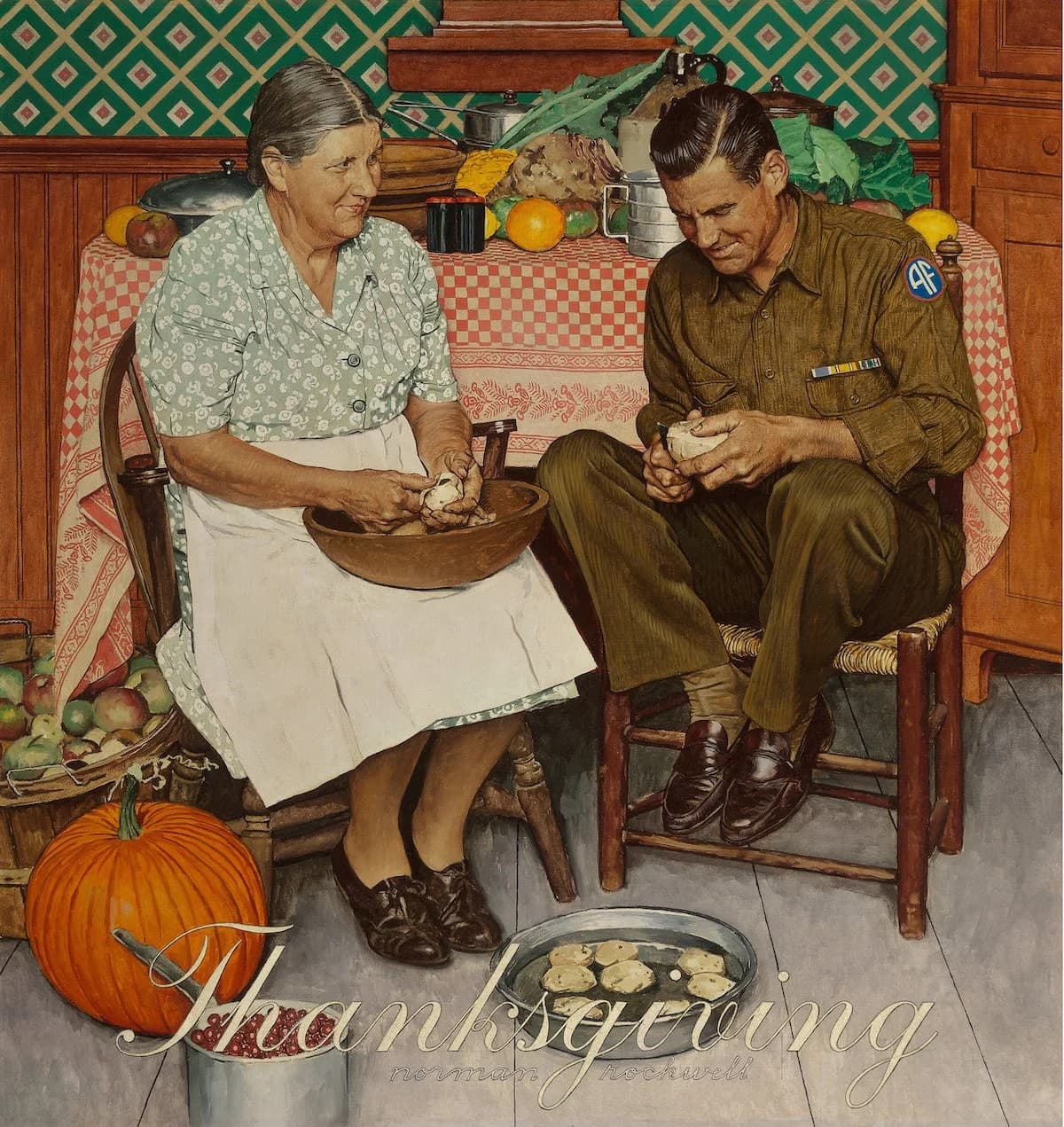
Home for Thanksgiving
Norman Rockwell · 1945
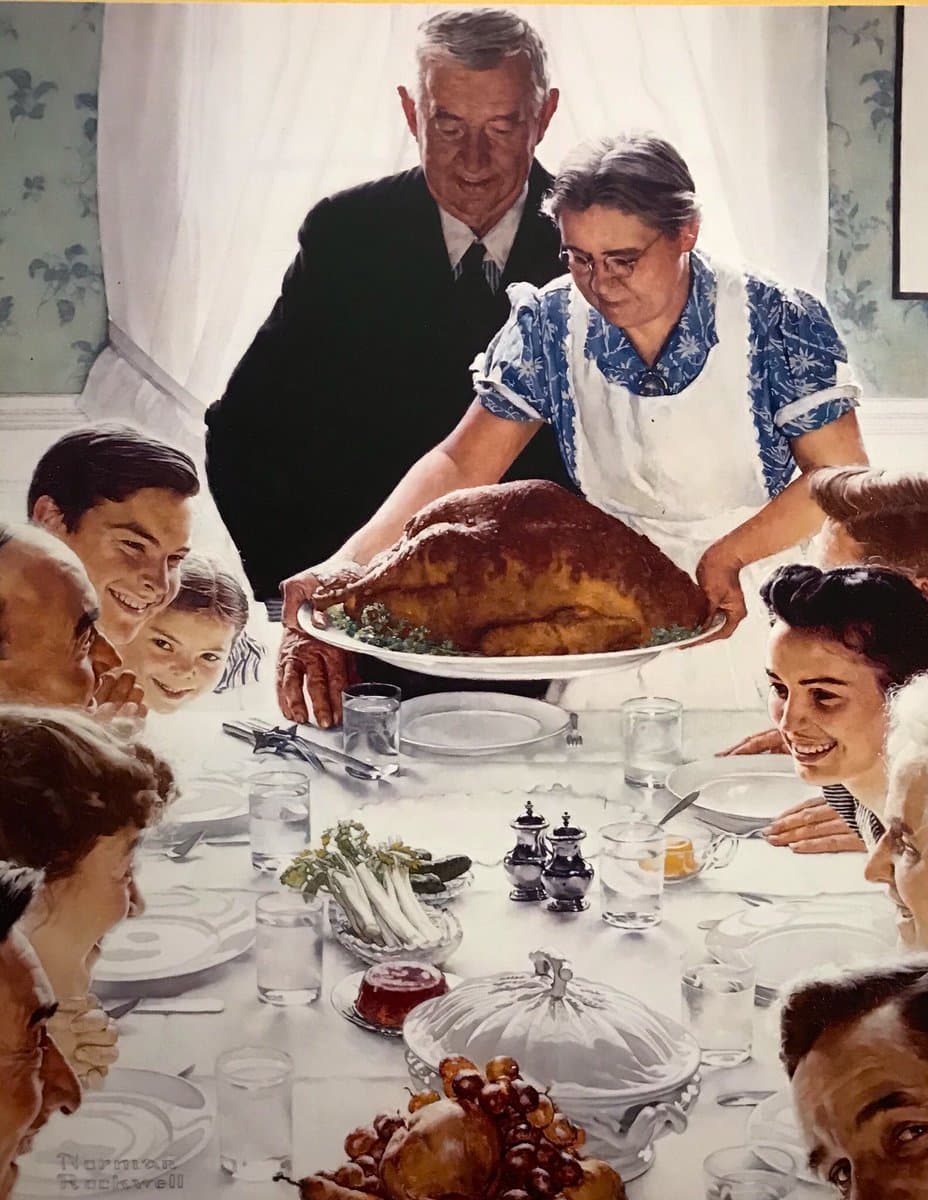
Freedom from Want
Norman Rockwell · 1943
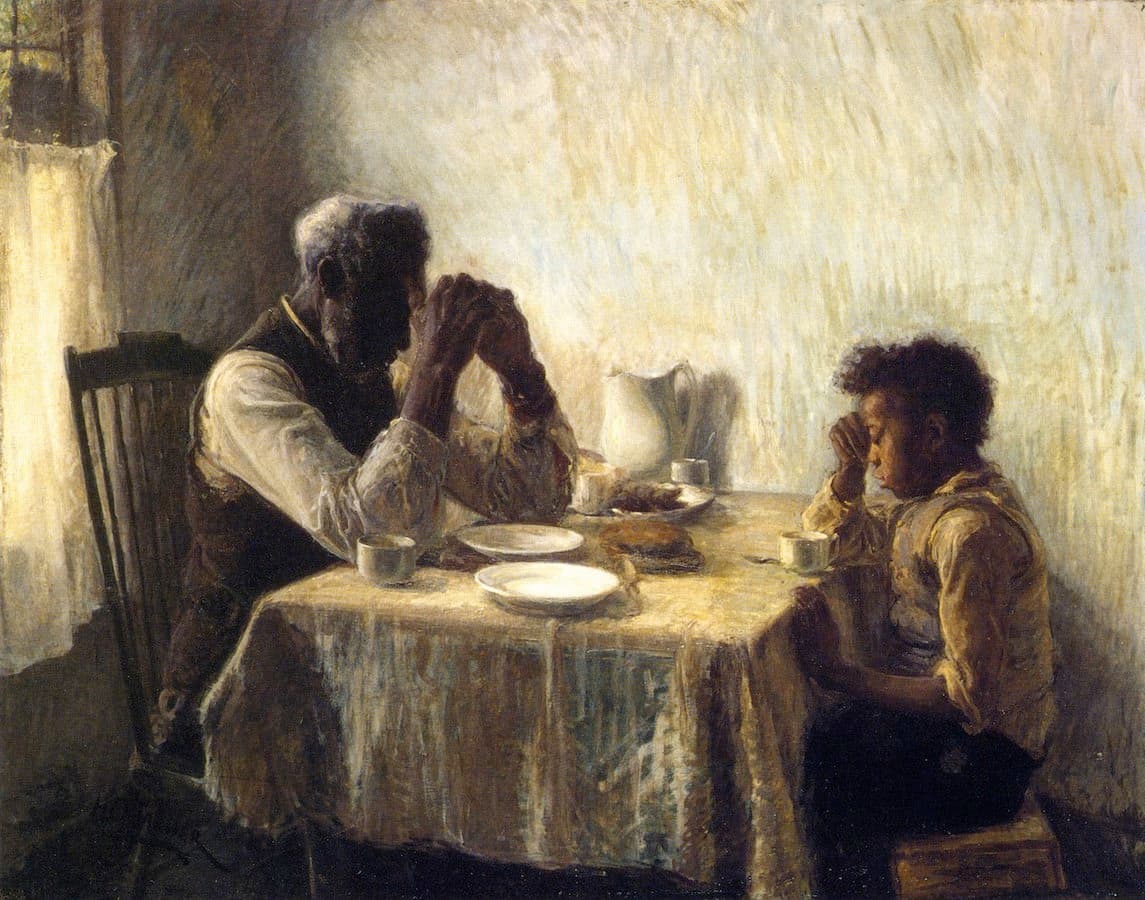
The Thankful Poor
Henry Ossawa Tanner · 1894
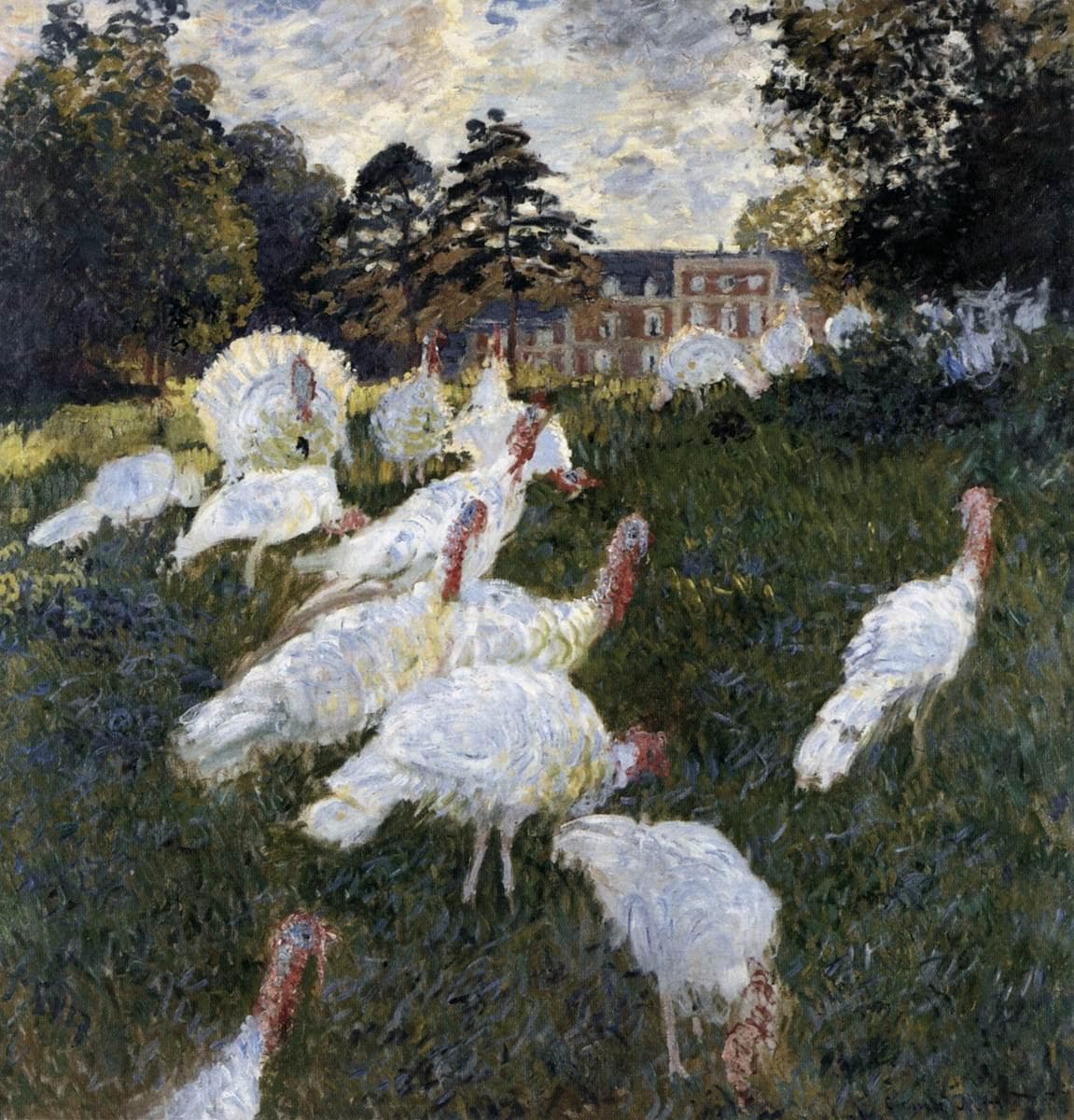
The Turkeys
Claude Monet · 1877

Bridge over a Pond of Water Lilies
Claude Monet · 1899

The Scream
Edvard Munch · 1893
The Creation of Adam
Michelangelo · c. 1511–12

Ophelia
John Everett Millais · 1851–52