French · Academic art
Alexandre Cabanel
b. 28 September 1823, Montpellier — d. 23 January 1889, Paris
Alexandre Cabanel (1823–1889) was a leading French academic painter, favorite of Napoleon III, known for The Birth of Venus (1863) and Fallen Angel (1847), and an influential teacher at the École des Beaux-Arts.
1 work in the collection
Works by Alexandre Cabanel
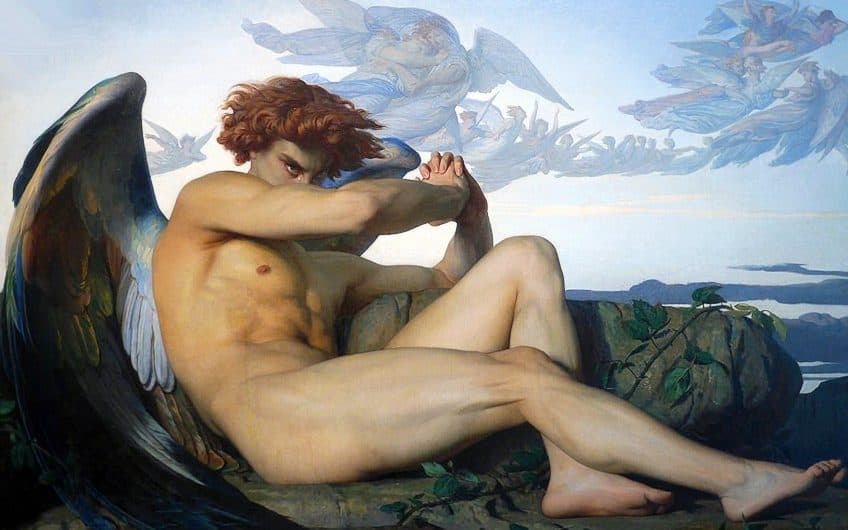
Alexandre Cabanel was one of the most successful painters of France's Second Empire, an artist of polished mythological, religious and historical scenes and of society portraits. In the gallery he is represented by Fallen Angel (L'Ange déchu, 1847), his tearful, defiant Lucifer, in the Musée Fabre, Montpellier.
Life
Cabanel was born in Montpellier on 28 September 1823, the son of a carpenter, and trained at the local school of fine arts. In 1840 he entered the École des Beaux-Arts in Paris as a pupil of François-Édouard Picot, and in 1845, at 22, he won the Prix de Rome, which took him to the Villa Medici until 1850. Fallen Angel was painted there as one of his works sent back from Rome.
His breakthrough was The Birth of Venus at the Salon of 1863, bought at once by Napoleon III and now in the Musée d'Orsay. That year he was elected to the Académie des Beaux-Arts, and in 1864 became a professor at the École, where he taught until his death. He sat on the Salon jury seventeen times and won its Medal of Honor in 1865, 1867 and 1878. He died in Paris on 23 January 1889 and was buried in Montpellier.
Style
Cabanel embodied the academic ideal: a literary subject, refined drawing, porcelain-smooth finish and idealized form. Critics such as Émile Zola mocked that perfection, and Cabanel is often cast as the villain of the story of modern art because his jury helped reject Manet in 1863, the year of the Salon des Refusés. Yet his pupils numbered in the hundreds, among them Pierre Auguste Cot.
Key works
Fallen Angel (1847), The Birth of Venus (1863), The Death of Francesca da Rimini and Paolo Malatesta (1870) and Cleopatra Testing Poisons on Condemned Prisoners (1887, Antwerp) are among his best-known paintings. Fallen Angel is unusual for its psychology: Lucifer hides his mouth behind his arm, and a single tear sits in his eye.
Where to see his work
The Musée Fabre in Montpellier and the Musée d'Orsay hold his major works. See also fallen angels in art and Academic art.
Questions & answers
Where is Cabanel's Fallen Angel?
Fallen Angel (L'Ange déchu), painted in 1847 when Cabanel was a student in Rome, is in the Musée Fabre in his hometown of Montpellier, France.
What is Alexandre Cabanel famous for?
Cabanel is famous for The Birth of Venus (1863), bought by Napoleon III, and Fallen Angel (1847). He was also a dominant Salon juror and a teacher of hundreds of pupils at the École des Beaux-Arts.
Why does Cabanel's Fallen Angel have a tear?
The tear in Lucifer's eye shows rage mixed with grief and regret after his expulsion from Heaven. Cabanel paints a fallen angel who is defiant yet suffering, a psychologically human Satan in the Romantic tradition of Milton.