French · Neoclassicism
Jacques-Louis David
b. 30 August 1748, Paris — d. 29 December 1825, Brussels
Jacques-Louis David (1748–1825) was the leading French Neoclassical painter, creator of The Death of Socrates and The Death of Marat, and artist in turn of the Revolution and of Napoleon.
2 works in the collection
Works by Jacques-Louis David
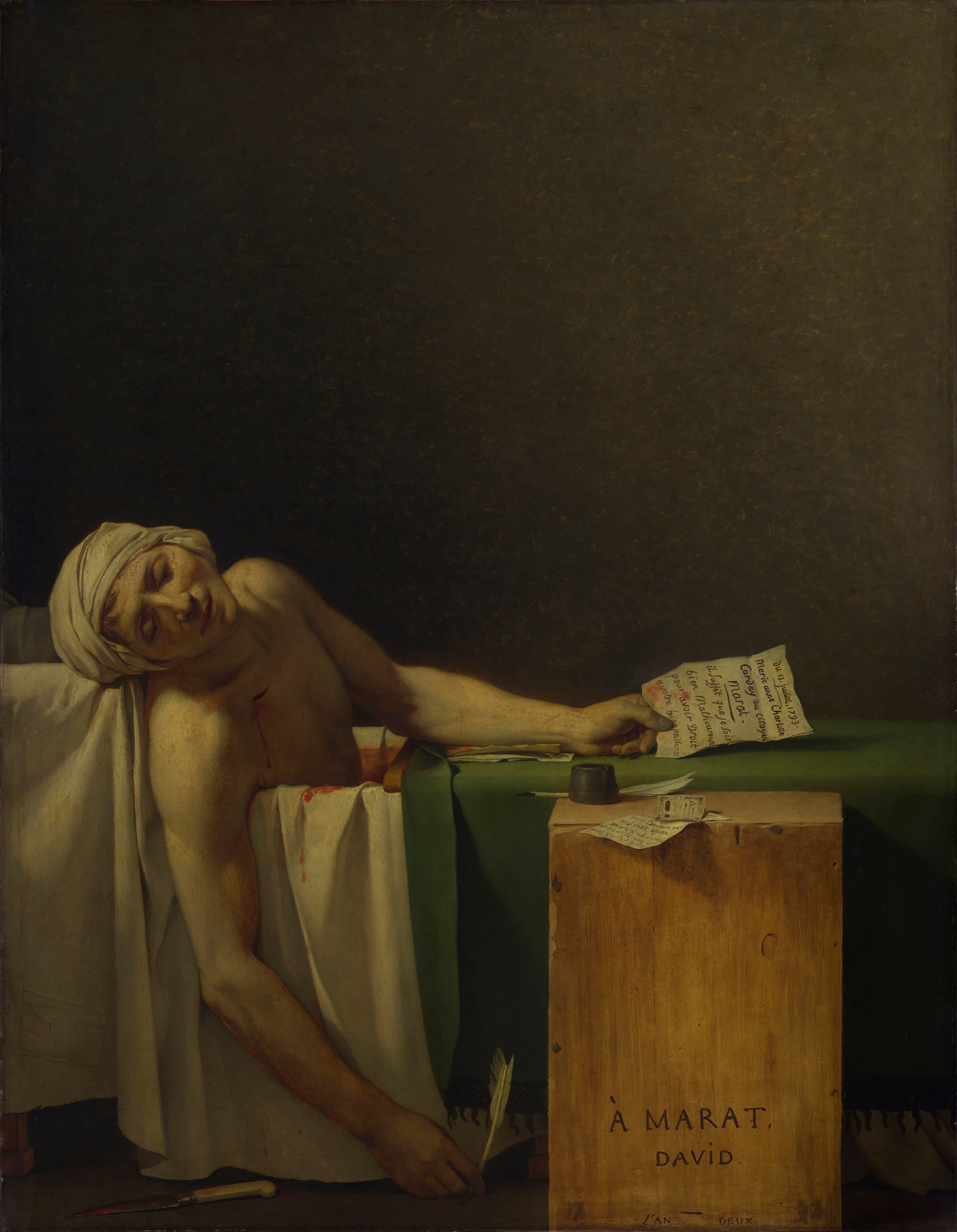
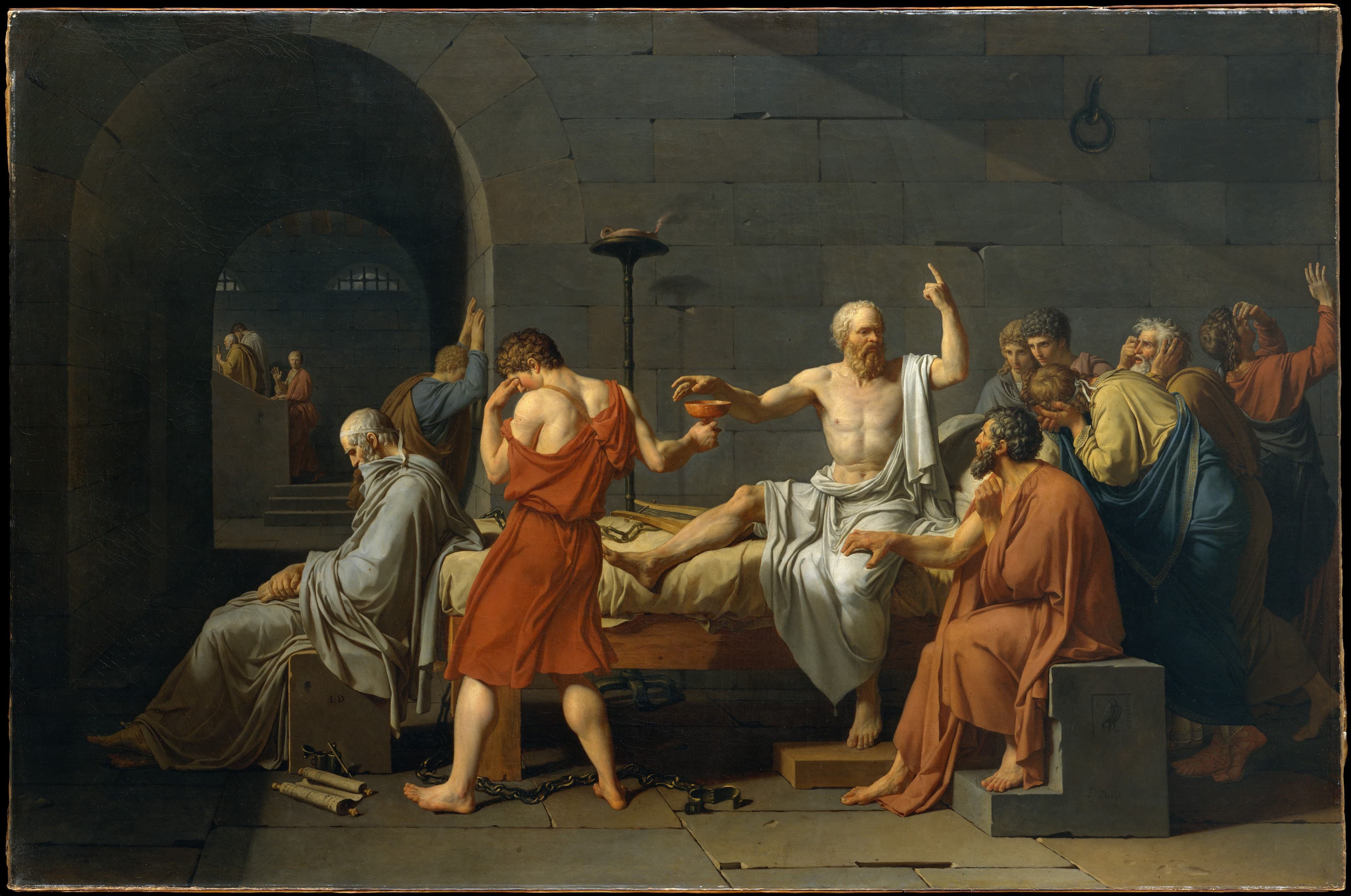
Jacques-Louis David was the dominant French painter of the late eighteenth century, the master of Neoclassicism, and an artist deeply involved in the politics of his time. His best-known works include The Death of Marat (1793), in the Royal Museums of Fine Arts of Belgium in Brussels, and The Death of Socrates (1787), in the Metropolitan Museum of Art, New York.
Life in brief
David was born in Paris in 1748 into a prosperous merchant family. His father was killed in a duel when the boy was nine, and he was raised by uncles who sent him to train with the history painter Joseph-Marie Vien. He competed for the Prix de Rome four times before winning it in 1774, and spent 1775–80 at the French Academy in Rome. There, in the presence of ancient sculpture and the paintings of Poussin and Raphael, he abandoned the soft Rococo manner of his youth.
Back in Paris he became the most admired painter of the 1780s. The Oath of the Horatii (1784–85, Louvre), painted in Rome and shown at the Salon of 1785, presented three Roman brothers swearing to die for their city with the clarity of a classical relief; it became the manifesto of a new, severe style.
When the Revolution came, David threw himself into it. He was elected to the National Convention in 1792, voted for the execution of Louis XVI, sat on the Committee of General Security and designed the great revolutionary festivals, including the Festival of the Supreme Being in 1794. After the fall of Robespierre in July 1794 he was imprisoned twice; in prison he planned The Intervention of the Sabine Women (1799, Louvre), a plea for reconciliation.
Under Napoleon he became First Painter to the Emperor in 1804 and produced the official images of the regime, including Napoleon Crossing the Alps (1801) and the enormous Coronation of Napoleon (1805–07, Louvre). After the Bourbon restoration, as a regicide, he was banished in 1816 and settled in Brussels, where he died in 1825. He was refused burial in France; he lies in Brussels, and his heart is in Père Lachaise cemetery in Paris.
Style and technique
David's painting is built from drawing. He composed in shallow, stage-like spaces with figures arranged parallel to the picture surface, studied each from the nude before clothing them, and lit them with a hard, raking light that models bodies like marble. Brushwork is controlled and nearly invisible, colors limited and strong. Gesture carries the meaning: an arm thrust upward, a hand dropping a pen. His portraits, such as Antoine-Laurent Lavoisier and His Wife (1788, Met) and Madame Récamier (1800, Louvre), apply the same restraint to modern sitters.
The Death of Socrates
Painted in 1787 for the young magistrate Charles-Michel Trudaine de la Sablière, the picture shows the Athenian philosopher in prison, condemned to death for impiety and corrupting the young. Socrates sits upright on his bed, one hand reaching for the cup of hemlock without looking at it, the other pointing upward as he continues to teach about the immortality of the soul. Around him his followers collapse in grief; the aged Plato sits slumped at the foot of the bed, though historically he was absent. The scene is a lesson in Stoic virtue: reason and principle above life itself.
The Death of Marat
On 13 July 1793 the radical journalist Jean-Paul Marat, David's friend, was stabbed in his bath by Charlotte Corday, a supporter of the rival Girondin faction. David, who had visited Marat the day before, painted him within months and presented the work to the Convention. Marat slumps over the side of the tub, a quill still in one hand and Corday's letter in the other, the knife on the floor. The wooden crate beside him bears the dedication À Marat, David and the revolutionary date l'an deux. The upper half of the canvas is empty, a vibrating dark void. Stripped of everything inessential, the figure echoes a Christ taken down from the cross, turning a political murder into the image of a secular martyr.
The painting has inspired many later responses, among them Edvard Munch's Death of Marat, which turns the scene into a private drama of sex and violence.
Influence
David ran the most important studio in Europe. His pupils included Antoine-Jean Gros, Anne-Louis Girodet, François Gérard and Jean-Auguste-Dominique Ingres, and his model of history painting shaped academies for half a century. The next generation of Romantics, including Théodore Géricault in The Raft of the Medusa, built on his monumental figure style even as they rejected his calm.
Where to see his work
The Louvre has the largest group, including The Oath of the Horatii, The Sabine Women, Madame Récamier and The Coronation of Napoleon. The Death of Marat is in Brussels, The Death of Socrates and the Lavoisier portrait are in New York, and versions of Napoleon Crossing the Alps are at Malmaison, Versailles, Charlottenburg and the Belvedere, Vienna. Explore Death in Art, Dark Academia and Famous Paintings.
Questions & answers
What is Jacques-Louis David famous for?
David is famous as the leader of French Neoclassical painting and for works such as The Oath of the Horatii (1784–85), The Death of Socrates (1787), The Death of Marat (1793) and The Coronation of Napoleon (1805–07). He was also a revolutionary politician and later Napoleon's First Painter.
Where is The Death of Marat by David?
The original Death of Marat (1793) is in the Royal Museums of Fine Arts of Belgium in Brussels, the city where David spent his last years in exile. It remained with his family after his death before entering the museum. Workshop copies are in the Louvre, Versailles, Reims and Dijon.
Where is The Death of Socrates painting?
The Death of Socrates (1787) is in the Metropolitan Museum of Art in New York. The Met acquired it in 1931 through the Catharine Lorillard Wolfe Collection. It is oil on canvas, about 130 by 196 cm, and hangs in the European paintings galleries.
What does The Death of Socrates mean?
The painting shows Socrates choosing death by hemlock rather than renouncing his beliefs, while he goes on teaching. Based on Plato's Phaedo, it celebrates Stoic virtue and intellectual integrity; in the years before the Revolution, viewers also read it as a call to sacrifice for principle.
Why was David exiled?
As a member of the National Convention David voted in 1793 for the execution of Louis XVI. When the Bourbon monarchy returned after Napoleon's fall, regicides were banished, and in 1816 David went into exile in Brussels. He refused offers of a pardon and died there in 1825.